
Interviews / Observatoire géopolitique de l’espace post-soviétique
11 June 2026
Electoral Victory for Pro-Western Forces in Armenia: What Comes Next?
-

Scientific Adviser at IRIS, Head of the Middle East/North Africa Programme
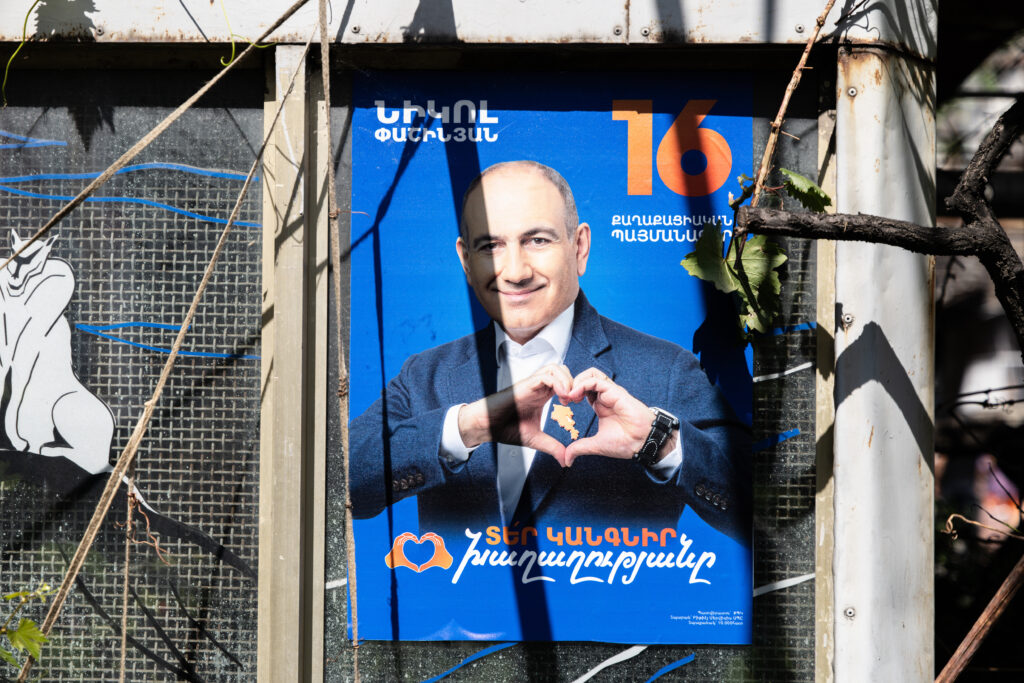
On 7 June 2026, Armenians went to the polls to elect their Prime Minister. At the end of the vote, Nikol Pashinyan was re-elected with 49.8% of the vote, well ahead of the pro-Russian candidate Samvel Karapetian, who secured 23.3%. The election took place against a backdrop of profound upheaval for Armenia. The defeat against Azerbaijan during the 2020 war, followed by Baku’s recapture of Nagorno-Karabakh in 2023, left a deep mark on the country and led to large-scale population displacement. Despite their longstanding alliance, Moscow did not intervene to prevent the loss of the enclave, fuelling widespread distrust of Russia within Armenian society. In what context were the parliamentary elections in Armenia held? To what extent does this vote reflect the country’s desire to distance itself from Moscow? Is closer alignment with the European Union and the United States conceivable? Finally, what prospects does the election result open up for the normalisation of relations between Armenia and Azerbaijan? An assessment by Didier Billion, Deputy Director of IRIS.
What was the context in which the parliamentary elections were held in Armenia?
Armenia is emerging from several years of acute tensions that have traumatised a large part of the population. This stems first and foremost from the heavy military defeat against Azerbaijan in 2020, followed by its recapture of Nagorno-Karabakh in 2023, which led to the departure of between 100,000 and 120,000 Karabakh Armenians, the majority of whom sought refuge in Armenia.
More recently, the Israeli-American war against neighbouring Iran has heightened concerns, even though Armenia itself has not been directly affected by the fighting. Economic relations with the Islamic Republic remain limited, accounting for less than 4% of trade, but in this case it is the shared border that represents a genuine opening and therefore a vital strategic issue for a landlocked country whose borders with Turkey and Azerbaijan have been closed for many years.
Finally, although a text outlining the prospect of signing a peace agreement with Azerbaijan was approved in Washington in August 2025 under Donald Trump’s auspices, it has not yet been ratified by either the Armenian or Azerbaijani parliaments.
To what extent does Nikol Pashinyan’s re-election reflect Armenian society’s desire to break away from Russian influence? What consequences could this have for bilateral relations between Yerevan and Moscow? How might the outcome of this election strengthen the prospects for closer ties between Armenia, the European Union and the United States?
The result achieved by the outgoing Prime Minister, Nikol Pashinyan, approaching 50% of the votes cast, reflects undeniable support for the policy he has pursued, particularly at the regional level. A strong sense of distrust towards Russia is clearly apparent, especially since the wars of 2020 and 2023, during which many Armenians felt betrayed by Moscow’s failure to intervene despite the protector role it had claimed since independence. This situation led Armenia to freeze its participation in the Collective Security Treaty Organisation (CSTO), the Russian-dominated political and military organisation comprising several former Soviet republics. This also explains why Nikol Pashinyan is cautiously steering his country towards Western powers.
Against this backdrop, Moscow has not hesitated in recent weeks to issue relatively thinly veiled threats of its own. During Armenia’s election campaign, Vladimir Putin stated that gas sold at preferential rates could be brought into line with European pricing, approximately four times higher, should the process of closer alignment with the European Union (EU) continue, at a time when a law initiating the EU accession process had already been adopted by the Armenian parliament in March 2025. There is therefore a clear pro-European inclination in Yerevan, but it is also Armenia’s relationship with the United States that concerns Russia.
The agreements concluded with Azerbaijan, already mentioned, are indeed significant. Not only did they portray Donald Trump as a broker of reconciliation between two peoples long at war, something he openly celebrated, but they also significantly advanced the project modestly entitled “Trump Route for International Peace and Prosperity”. If implemented, this corridor, including roads, railways, oil pipelines and gas pipelines, would connect Azerbaijan to its exclave of Nakhchivan, greatly facilitating transit between Central Asia and Europe, particularly Turkey, while bypassing both Russia and Iran. American influence was further strengthened during the visit of Vice-President J. D. Vance, the first visit at this level to Armenia, in February 2026. Several agreements were signed, notably covering drones, civil nuclear energy and semiconductor technologies. The visit continued with a stop in Baku, during which a strategic cooperation agreement with Azerbaijan was signed.
It is therefore understandable that Moscow has reason to be concerned as it observes its gradual loss of influence. The election result clearly encourages Nikol Pashinyan to continue along the same path and deepen Armenia’s rapprochement with both the European Union and the United States.
Nikol Pashinyan has stated that he wants to “institutionalise a peace agreement between Armenia and Azerbaijan”. Following this election and in the absence of a parliamentary majority to adopt constitutional amendments, what room for manoeuvre does he have regarding the Nagorno-Karabakh issue? Should we expect stabilisation of tensions in the Caucasus, or, on the contrary, an intensification of regional rivalries?
The question now is no longer strictly speaking about Nagorno-Karabakh itself, since almost all of its inhabitants were forced to flee in 2023 and the territory has now been reintegrated into Azerbaijan. This reality has been acknowledged by Nikol Pashinyan himself, which has led to recurring accusations of betrayal against him, but Azerbaijani President Ilham Aliyev, negotiating from a position of strength, is demanding amendments to the Armenian constitution to remove all references to Nagorno-Karabakh.
In any event, it is now the direct relationship and normalisation process between the two South Caucasus states that lies at the heart of the issue. The wounds have not healed and the challenges remain considerable, given that three decades of conflict have generated mutual hostility. Armenia, for example, accuses Azerbaijan of illegally occupying 200 km² of its territory, and the border delimitation process remains incomplete. Through his Atlanticist policy and rapprochement with the European Union, Nikol Pashinyan seeks to strengthen external support and will continue along this path, confirming the decline of Russian influence in the region.