
Analyses / Middle East / North Africa
3 April 2026
The State of Israel: A drift without limits
-

Scientific Adviser at IRIS, Head of the Middle East/North Africa Programme
Since its creation, the Hebrew State has pursued an unrelenting colonial policy which has taken on an increasingly troubling dimension over the years. Its policy of aggression towards the surrounding states has aggravated the regional situation and Israel now appears as the principal destabilising power in the Middle East, a region whose tensions and conflicts are known to have international repercussions.
In recent days, many voices have spoken out against the law passed on 30 March 2026 by the Israeli parliament establishing and legalising the death penalty for Palestinians, in practice only Palestinians, and have rightly described it as an apartheid law. Such indignation is legitimate, but it must not obscure what has characterised the policy of the Hebrew State for decades. It is not possible here to present an exhaustive account, but only to highlight several elements in order to decipher the underlying logic at work.
Occupation policy. This is probably the defining characteristic of the Hebrew State. One only has to consult the maps to observe its continuous territorial expansion since 1948. This has been accompanied by a methodical settlement policy and several figures deserve to be recalled in order to understand its scale: 10,000 settlers in 1972, 280,000 in 1993, 750,000 in 2025. Among many recent examples, a tender for the construction of 3,401 housing units was published on 10 December 2025, the implementation of which will divide the West Bank into two parts, making the prospect of a Palestinian state impossible. In February 2026, Israel modified the land registration rules in Area C of the West Bank, namely the area entirely under the control of the occupation forces and representing 63% of West Bank territory. Because in many cases there is no means of proving land ownership, a legacy of rules established during the Ottoman Empire, these lands could potentially revert to the Israeli state, which could concern 58% of Area C.
The situation in the West Bank is extremely grave, all the more so as the multiplication of violence by radicalised settlers against the Palestinian population now takes place in the presence of, and with the complicity of, the Israeli army. According to Amnesty International, 830 victims have been recorded since 7 October 2023 and, for February 2026 alone, 511 attacks were documented.
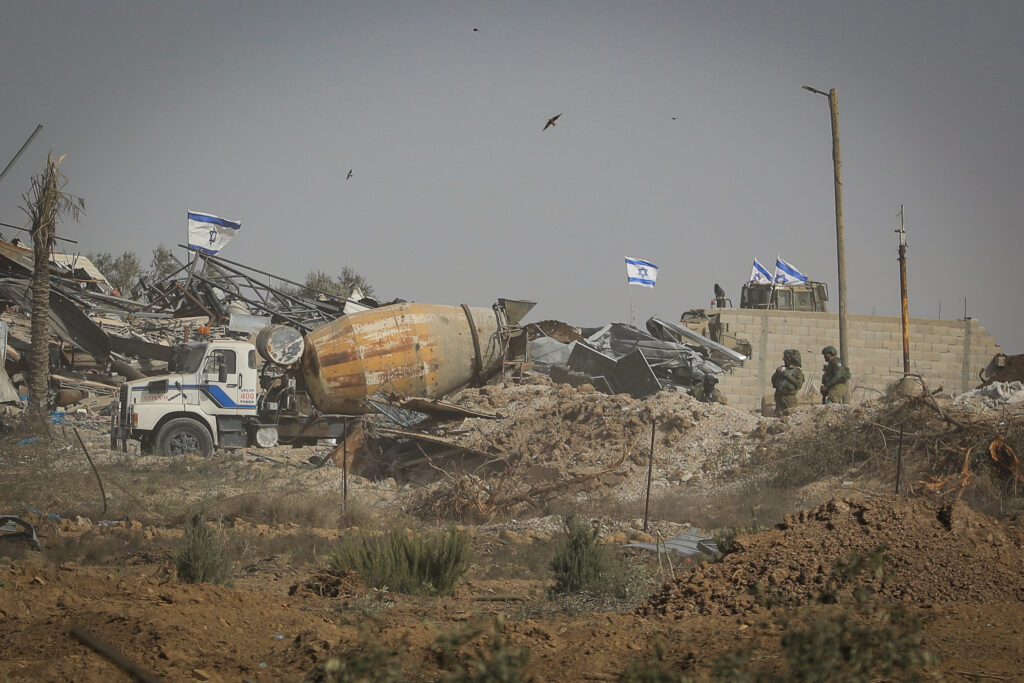
Annexationist policy. The measures implemented in the West Bank are not merely part of a policy of occupation, they are intended to expel Palestinians in order to create favourable conditions for the annexation of the territory, as members of the government openly declare. The same logic is at work in the Gaza Strip since, after months of continuous intensive bombardments, they have continued despite the proclamation of the misleadingly named “ceasefire” of 10 October 2025, which has been constantly violated. Seven hundred deaths have been recorded since then and the distribution of food and medicines/medical equipment remains infinitely below the real needs of a population of which at least half continues, somehow, to shelter under makeshift structures in appalling conditions. Furthermore, more than 50% of the Gaza Strip remains under occupation by the Israeli army. In both territories, the objective pursued is identical: to exhaust the population in order to force it to leave, which would ultimately make annexation possible.
The same logic is at work in southern Lebanon where the now openly stated objective is to occupy the territory up to the Litani River after having destroyed numerous villages and rendered part of the region unsuitable for agriculture. Syria may also be mentioned, where part of the Golan was occupied by the Israeli army in 1967, then annexed in 1981, something the United Nations has never accepted. As an aggravating factor, it should be noted that the occupation zone was expanded following the fall of Bashar al-Assad in December 2024.
When all these facts are linked to the statements of Israeli leaders concerning the prospect of Greater Israel which, according to their biblical references, could extend from the Nile to the Euphrates, if words have meaning, this would therefore encompass the Palestinian territories, part of Egypt, Jordan, Lebanon, Syria and Iraq, one can only be convinced of the existence of an expansionist project with annexationist aims implemented in a planned manner. Certainly, this is not at present the officially declared policy of the authorities in Tel Aviv, but such religious references are nevertheless used by ministers, therefore at the highest level of the state. This does not prejudge whether such projects could ultimately be realised, but they illustrate the hubris that has seized part of the Israeli ruling spheres.
Genocidal policy. While the term remained taboo for many observers for some time, it is difficult to deny it today when 72,000 victims have been recorded in the Gaza Strip, a figure probably vastly underestimated because of the number of bodies that could not be recovered from the rubble and whose exact scale will probably never be known. Yet genocide is not a question of the number of victims, it is the expression of a determination methodically to destroy a population because of its belonging to a national, ethnic, racial or religious group. The intentional submission of the population of Gaza to conditions of existence liable to bring about its total or partial physical destruction corresponds to one of the five criteria making it possible to characterise the material reality of genocide. From this perspective, statements made by some of Israel’s most senior political leaders leave little doubt. Among countless examples, let us retain only two. The first is the reference used, in relation to the people of Gaza, by Benjamin Netanyahu and Isaac Herzog, the Israeli president, to the destruction of the people of Amalek exterminated by the Hebrews on divine orders. The second concerns Israel Katz, Minister of Defence, who urged the people of Gaza to return the hostages and rid themselves of Hamas, otherwise “the alternative is total destruction and devastation”. As the jurist Johann Soufi explains, the characterisation of genocide requires highlighting the “intent” to destroy a human group. The material facts and the statements leave little doubt on this point.
Policy of aggression. The grim events of recent weeks remind those willing to hear it that the concept of “preventive war” runs counter to the principles of international law. In this respect, the war launched against the Islamic Republic of Iran is illegal and must be characterised as such. No evidence of an imminent threat of Iranian aggression against anyone has been proven. US intelligence services have not reported such a possibility. Joe Kent, Director of the United States National Counterterrorism Center, even wrote precisely the opposite in his resignation letter sent to Donald Trump on 17 March. It is not known with certainty whether Israel convinced the United States to attack Iran on 28 February 2026, as Secretary of State Marco Rubio seemed at one point to suggest before retracting, but it may reasonably be assumed that Benjamin Netanyahu’s meeting with Donald Trump on the previous 11 February was not unrelated to the White House occupant’s decision. Furthermore, what we suspect is that Israeli leaders strongly influenced Donald Trump to launch the Twelve-Day War in June 2025. In both cases, we also know that these attacks were decided while negotiations between the United States and Iran were taking place and appeared capable of leading to compromises, the worst possible outcome for the leaders in Tel Aviv.
This policy of aggression is unfolding in the same manner in Lebanon. While one may certainly question the tactical appropriateness of Hezbollah’s decision to launch rockets and missiles against Israel on 2 March, it should not be forgotten that, according to the United Nations through UNIFIL, Israel had itself violated the ceasefire more than 10,000 times between October 2024, the date of its signing, and the end of 2025, causing around 300 deaths, not to mention the material destruction.
Apartheid policy. As mentioned at the beginning of these reminders, the law passed on 30 March resembles an apartheid text prepared and defended by the supremacist Minister of National Security, Itamar Ben Gvir, whom Olfer Bronstein, Emmanuel Macron’s special envoy for Israeli-Palestinian reconciliation, himself describes as a “Judeo-Nazi”.
Nevertheless, the reality of an apartheid regime has existed for a long time since discriminatory measures are applied against the Palestinians of Israel who represent 20% of the population. In this respect, one may recall the law on the “Nation-State of the Jewish People”, adopted by the Israeli parliament in July 2018, which codifies apartheid and institutionalises inequality of rights between Palestinian citizens and Jewish citizens by stating in Article 1: “The right to exercise national self-determination in the State of Israel is unique to the Jewish people.” This law also seeks to downgrade the status of the Arabic language, codify “the development of Jewish settlements as a national value” and, among other provisions, officially formalise the annexation of Jerusalem, including its eastern part, in contradiction with the numerous UN resolutions on this issue. For a long time, the qualification of apartheid has been used by attentive observers of developments within Israeli society. NGOs such as B’Tselem, Amnesty International and Human Rights Watch use this term without circumlocution to describe the situation prevailing in the Hebrew State.
Finally, one may underline the recent report by Francesca Albanese, UN Special Rapporteur on the situation of human rights in the Palestinian territories occupied since 1967, concerning Israeli prisons, presented in March 2026 to the UN Human Rights Council. The findings are severe and damning, referring to degrading treatment in detention and torture described as systematic and institutionalised against Palestinian prisoners.
Clearly, however condemnable in itself the law on the death penalty adopted on 30 March 2026 may be, it is necessary to stress that it forms part of a disturbing drift in Israeli policy, which is plunging ever deeper into a limitless headlong rush. The question that constantly arises therefore lies in the observation that a sense of impunity is becoming durably entrenched among Israeli leaders. Verbal condemnations against them certainly exist, albeit timidly, but no sanctions capable of finally altering the disastrous course under way. The so-called international community ought to react in order to prevent the law of the strongest from prevailing. The treatment of these complex issues solely through military means is a dead end, diplomacy must be revitalised and the political path therefore prioritised in the hope of contributing to the stabilisation of the region.