
Analyses / Defence, Strategy, Armament
8 April 2026
Hormuz, Bab el-Mandeb: The war within the war
-

Associate Research Fellow, IRIS
Its defensive capabilities rapidly annihilated during the first days of the Israeli-American air assault, Iran adopted a counter-offensive strategy against its aggressors: attacks against Israel and American military bases in the Near East intended to weaken enemy capabilities. Given the capabilities displayed, this remained an operation of still limited effectiveness, but one intended to endure over time with a significant media and psychological impact.
It then rapidly extended its strikes to targets of interest belonging to the countries hosting American bases or offering them facilities. Thus, various national infrastructures were targeted in Kuwait, Qatar, the United Arab Emirates (UAE), Iraq and Jordan, while strikes (warning shots?) were directed against Turkey, Cyprus and Diego Garcia, a British territory in the Indian Ocean. Iran therefore chose, one might logically say, a strategy aimed at dismantling the regional support system of the United States and proving to its partners the Americans’ inability to protect them. The immediate results are inconclusive, Saudi Arabia and the UAE have raised their tone against Iran. Nonetheless, uncertainty remains regarding the ability of the United States to ensure this protection over time. Several recent attacks with strong media impact in Saudi Arabia (destruction of fuel storage facilities at the port of Yanbu, destruction of an airborne detection and command system (AWACS) at Prince Sultan Air Base, etc.) are intended to shake confidence.
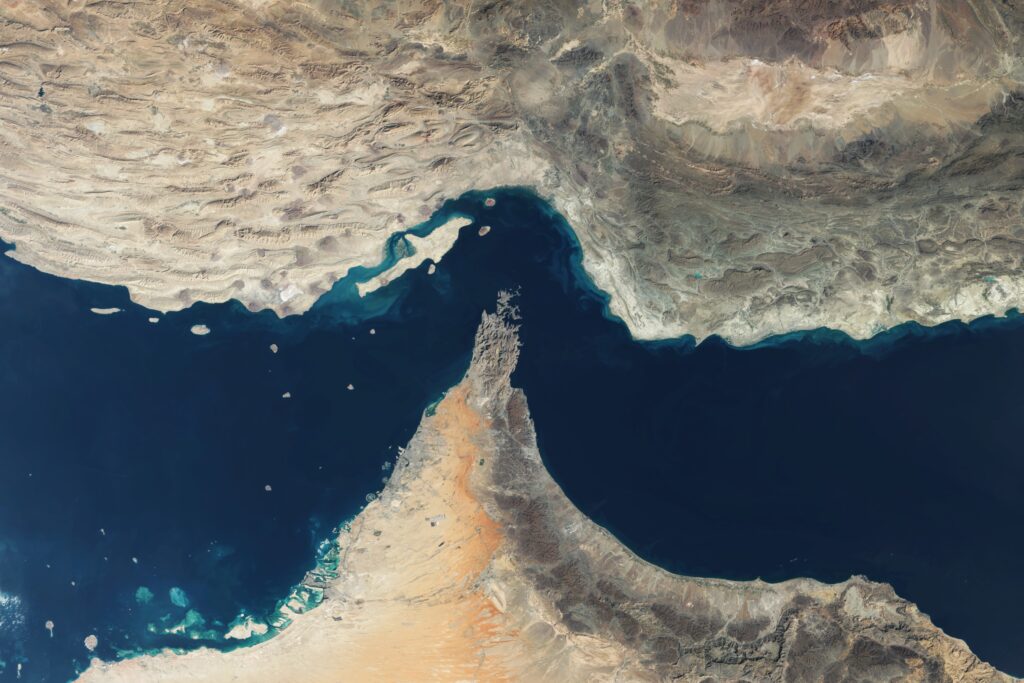
But Iran’s master card lies in its ability to export the effects of the war it is enduring to the entire world through the chokeholds it can impose on the flows of the global economy by virtue of its position and its absolute control tactics over the Straits of Hormuz and Bab el-Mandeb (through the Houthis established in Yemen). The narrowness of the navigable zone within these straits (especially Hormuz), the solid Iranian or Houthi presence on the northern shores and the combat systems employed (short- and medium-range missiles launched from bunkers, fast craft or midget submarines; explosive naval or aerial drones, etc.) drastically restrict the defensive capabilities of the targeted vessels, civilian of course, but equally military. Faced with such a form of threat, potentially capable of striking before being destroyed, or even detected, the escort tactic mentioned here and there is entirely ineffective.
The climate of anxiety generated first led insurers to suspend their guarantees, thereby halting traffic. The counter-measure of reinsurance by the United States produced no effect because, in response, Iran immediately made it known that it opposed the navigation of any vessel not accredited by its authorities, which limits transit to a small number of countries (naturally Iran itself and Greek, Indian, Pakistani, Syrian and Chinese vessels). It also imposes a transit tax.
A war within the war
Control of the straits is the major asset of the Iranian defence system, which uses it as leverage in an attempt to turn the international community against the Israeli-American coalition. The immobilisation of thousands of vessels cuts global supplies of oil and gas (20% of world consumption), fertilisers (30%), helium (30%) and aluminium (20%). The immediate consequence is the inevitable drastic increase in costs, followed in the long term by an economic, financial and food crisis. Trump proclaims that these supply problems do not concern the United States, but, by profoundly aggravating the consequences of the war, they have a direct effect on the credibility of the POTUS and of the United States.
First internally: markets fluctuate according to Trump’s statements, but clearly demonstrate their aversion to the continuation of the war (Treasury bond yields, stock markets, inflation), fuel prices are soaring and with them declines popular support, already weak, for the war and Republican optimism for the Midterm elections. Finally, there is the wearing down of the military apparatus (overuse of the Navy, declining stockpiles and additional costs). Externally, however much the United States refuses to assume responsibility for the blocking of the Strait of Hormuz, many countries think otherwise, not least the Europeans who refuse to engage in security operations made necessary by a war “that is not theirs”, and certain Gulf countries beginning to doubt the reliability of the defensive shield provided by their alliance with the United States.
It is certain that this war was poorly prepared politically, with major strategic deficiencies in planning (blind spots regarding the straits and Iran’s determination to export the conflict; absolute confidence in the tactic of the “elimination of leaders”) and the conviction of the coalition’s military and technological superiority, real indeed, but ineffective against a country structured, equipped and trained to conduct asymmetric warfare across several concentric circles: its national territory, its subordinate external forces (Hamas, Lebanese Hezbollah, Iraqi Hezbollah, Houthis) and finally its dormant international terrorist networks.
Towards a frozen conflict?
It is certain that the United States would find advantage in securing an exit strategy, for its own interests and because, fundamentally, even if it has not achieved the war aims attributed to it by some, it has inflicted considerable damage upon Iran. As for the straits, Washington leaves the “users” to find a solution with Iran. For his part, Trump must believe he can still rely on economic sanctions, intelligence capabilities and reaction capacities to control Iran over the medium term, thereby leaving a frozen conflict, not along a ceasefire line, but based on an overall assessment of the situation (nuclear programme, ballistic programme and Iranian air defence coverage) reduced to an acceptable level of threat. This is indeed what the POTUS implied in his speech of 1 April 2026 beyond the threat to intensify strikes for two weeks. A threat followed by a new 48-hour ultimatum announcing apocalypse upon Iran, itself followed by the announcement of a two-week truce minutes before its expiry (7 April 2026).
Certainly, at the same time, reinforcements are arriving in the Near East: intelligence and electronic warfare capabilities, bombing capabilities (B-52s), air-land combat forces (Military Expeditionary Unit; airborne brigade), forcing Iran to adopt protective measures across its entire territory.
Trump is using the “strategy of confusion” without restraint, his future statements will fall within the same register, and yet no one can ignore them, whether enemies, allies or indifferent observers. Positive talks with Iran, provided the latter accept the conditions? A decisive strike before disengagement? Disengagement while proclaiming objectives achieved? The latest statements do not provide the answers expected by geopolitical analysts, but they are above all intended to reassure the markets which have become the principal lever of crises. They demand that this crisis come to an end. The frozen conflict, presented under positive appearances, as Trump knows how to do, is a highly probable outcome, provided Israel follows suit. But could it do otherwise if it wishes to maintain American support.
Above all, however, the relative impotence of the United States in the face of Iranian resilience opens a dynamic towards a profound reshaping of the international order:
- There is certainly a weakening of Iranian military and nuclear capabilities, but a strengthening of its international role through control of the Straits of Hormuz and Bab el-Mandeb and the preservation of its international terrorist and influence networks. Iran, master of the straits, will hold Western economies, and therefore Western policies, under its power;
- Satisfaction prevails among the enemies of the United States, enrolled since 2009 (BRICS) behind Russia in contesting the “rules-based international order”. One should expect initiatives of all kinds intended to exploit this political weakness which military power is no longer able to offset;
- The rise of a profound climate of anxiety in all countries, principally in the Gulf, but also in Eastern Europe, which relied on American military protection yet now see the United States retreating;
- The rise of an existential questioning within the European component of NATO, following Trump’s threats to abandon this “paper tiger” unwilling to respond positively to his calls for assistance. Europe will be divided between those who initiated the movement of distancing themselves from the United States during this war and those who still rely upon American protection. The fracture within NATO could become twofold: United States/Europe and Western Europe/Eastern Europe.
- The end of NATO, were it to materialise, would be accompanied by the establishment of bilateral relations between the United States and its “European clients” in search of security. Not a positive horizon for the dynamics of European integration.
“War is of vital importance to the State. It is the domain of life and death: the preservation or loss of the empire depends upon it; it is imperative to regulate it well.” Sun Tzu, The Art of War.
“It’s quite simple and direct. I aim very high, and then I just keep pushing and pushing and pushing to get what I’m after.” Donald Trump, The Art of the Deal.