
Analyses / Defence, Strategy, Armament
27 March 2026
Air-land operations in Iran: What are we talking about?
-

Associate Research Fellow, IRIS
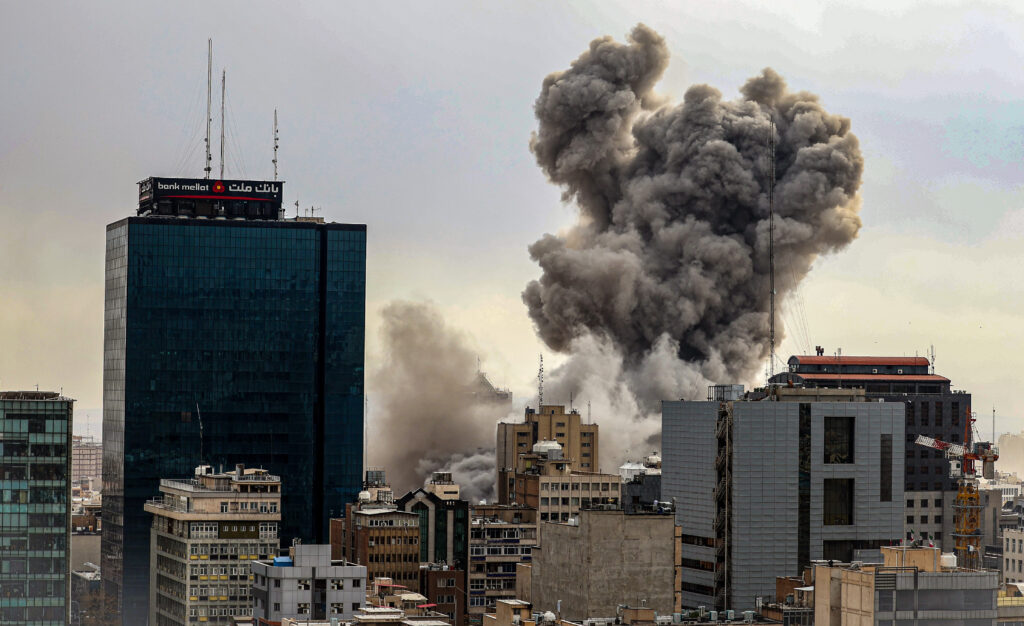
The United States and Israel have been conducting air operations against Iran since 28 February 2026. But since mid-March, reinforcements consisting of units with air-land capabilities have been deployed to the theatre of operations. These consist of two Marine Expeditionary Units (MEU). Embarked on their own vessels, these units possess powerful air and ground capabilities as well as diversified support and sustainment assets[1]. They are deployed amphibiously or by helicopter and can operate autonomously with 2,500 personnel. Around 3,000 paratroopers from the 82nd Airborne Division have also been announced. Highly trained, though with less powerful combat capabilities, they will find on US bases in the Middle East the additional support and sustainment required for their engagements, which often begin by parachute insertion or air assault.
Lines of operation and tactical capabilities
Defining the missions of these units first requires assessing their potential contribution to the strategic lines of operation (LOS): 1/ Destruction of military nuclear capabilities; 2/ Destruction of ballistic capabilities; 3/ Destruction of air, land and naval combat capabilities, principally those of the Pasdaran; 4/ Neutralisation of the Basij militias; 5/ Decapitation of the religious, civilian and military leadership structures; 6/ Seizure of a strategic “centre of gravity”; 7/ Uprising of the population. A new and apparently unforeseen line has been added: 8/ Securing the Strait of Hormuz. All these LOS contribute towards a political objective, which admittedly appeared different at the outset for Israel and the United States, but which could, in view of the inconclusive results, be summarised in the coming weeks by a consensus: “to weaken the regime sufficiently so that it cannot resume its aggressive programme for several years”. A political objective grounded in pragmatism, moving away from the pursuit of regime collapse in light of its current resilience, and which would make it possible to justify a withdrawal that appears to be taking shape through negotiations.
It also, and above all, requires assessing the tactical capability of the means deployed to achieve these aims.
In this regard, it is clear that these reinforcements will only be able to carry out missions within a limited space-time framework, on the periphery of Iran to facilitate their disengagement or, more riskily, deep within its territory.
What probability of ground operations?
For LOS 1: the tactics employed over recent years have revolved around the bombing of sites, cyberattacks or the neutralisation of scientists. It is difficult to see what a ground operation could add, including for locating and extracting the 440 kg of enriched uranium. One must first know where it is and, above all, the Iranians have naturally established around these stockpiles a defence system capable of destroying any force, however prestigious, upon its arrival on site, necessarily by air. An outcome comparable to the fiasco of Operation Eagle Claw[2] looms on the horizon…
For LOS 2: the reasoning concerning the probability of tactical success and the operational value of such a mission is the same as for LOS 1.
For LOS 3 (to be linked to LOS 8): for the moment, tactical priority here is being given to air strikes and submarine operations. However, it cannot be ruled out that certain strongholds of naval drone units or anti-ship missile positions along the shores of the Strait of Hormuz may prove difficult to neutralise in this way. A raid launched from the sea or the air against them may make tactical and strategic sense, because Iran’s strength today lies in its ability to deny navigation and therefore strangle global trade and, by doing so, discredit the United States. But such operations must be integrated into a sustained action over time and space in order to cover more than 150 kilometres of coastline, including a large city – Bandar Abbas – within which anti-ship missile sites may be concealed. The battle for Hormuz, if it is to be fought, will constitute a war within the war in which air-land forces could have a role, though their numbers appear largely insufficient.
For LOS 4: the Basij militia operates in civilian clothing among the population. It is being targeted, particularly in Tehran, through air strikes based on intelligence provided by a population hostile to the authorities (several senior officers, including its commander, have been killed). This tactic leads to collateral damage, but a ground operation in the heart of the cities makes no tactical sense. This is a matter for clandestine units.
For LOS 5: the tactic employed since the beginning of the war has been air strikes, but also covert operations (the attack on General Qassem Soleimani in 2020). An MEU or paratroopers would add nothing further to these proven methods.
For LOS 6: the obvious strategic asset is Kharg Island, the economic heart of Iran, from which oil and gas exports financing the regime are shipped. The military installations protecting it were bombed in mid-March, but will certainly be regenerated before any possible assault. This would be a high-cost operation, both in terms of forcible seizure and long-term holding. An opportunity for Iran to inflict human losses on the Americans. It would therefore be an operation of great tactical difficulty and potentially politically damaging, both in terms of domestic US politics and with regard to customers of Iranian energy, foremost among them China.
For LOS 7: there is no organised and armed opposition to support, unlike the situation with the Northern Alliance in Afghanistan, for example. Nevertheless, several Kurdish units, trained by US special forces, are already infiltrating from Iraq into the north-west of the country. Support by the American infantry units mentioned above is tactically possible, up until the counterattack of the Pasdaran division holding the area. The balance of forces is not in favour of the Kurds. Strategically, such an operation would have a very limited effect and, finally, it could have disastrous political consequences by entrenching the seeds of communal civil war with no prospect of resolution.
Kinetic planning or psychological action?
It is difficult to imagine any positive contribution by these deployments of units with air-land capabilities to the war operations currently under way. Yet the two force multipliers of military effectiveness are precisely surprise and its corollary, deception[3]. Beyond the options examined above, which Iran is aware of, the primary purpose of this show of force may be to compel the Iranian General Staff to multiply its protective efforts beyond air defence and consequently disperse its capabilities across multiple postures in order to avoid any surprise. A surprise which could involve the attack of an objective not analysed here. Nevertheless, the gain in terms of the outcome of the conflict appears very limited and the risk of human losses high, with significant political repercussions.
[1] “Support” refers to combat assets that reinforce a given force (artillery, engineers, drones, etc.), while “sustainment” refers to the logistical units enabling its deployment (resupply, ammunition, maintenance, etc.).
[2] Operation conducted in Iran on 24 April 1980 in an attempt to free the hostages held at the United States embassy in Tehran, the failure of which cost the lives of eight soldiers and the loss of two aircraft.
[3] Deception constitutes the specifically military component of disinformation.