
Analyses / Middle East / North Africa
23 March 2026
The Gulf States drawn into the war in Iran
-

Associate Research Fellow, IRIS
EBy signing defence agreements with the United States, most Gulf States believed themselves to be sheltered from the Iranian threat. In exchange for these agreements, the States of the region had agreed to the installation of US bases or infrastructure on their territory. Some countries, such as the United Arab Emirates, also joined the Abraham Accords in 2020 and pushed their cooperation with Israel very far.
The Arab Gulf States (Saudi Arabia, the United Arab Emirates, Qatar, Bahrain, Kuwait and Oman) sought to maintain good relations with their Iranian neighbour even though they viewed with apprehension the encirclement taking shape in a Shia crescent stretching from Iraq to Yemen through Lebanon and Syria. The fall of the Assad regime in December 2024 and the severe blow dealt to Lebanese Hezbollah in autumn 2024 had been welcomed with a certain relief by Saudi Arabia and the other countries of the region. Since then, Riyadh has become, alongside Turkey, the principal supporter of Syrian President Ahmed Al-Charaa.
A normalisation of relations tinged with mistrust and ulterior motives
For several years, relations between the Gulf States and their Persian neighbour had been moving towards normalisation. The March 2023 agreements signed in Beijing aimed to restore a semblance of good neighbourly relations between Saudi Arabia and Iran. Since that date, the relationship between the two countries had clearly calmed and senior Iranian officials, notably Ali Larijani, had travelled to Saudi Arabia on two occasions (in July and September 2025).
The Sultanate of Oman, which occupies a particular position since it shares control of the Strait of Hormuz with its Iranian neighbour, has long played an essential facilitating role in relations between Tehran and Washington. Exchanges of visits at the highest level have been frequent in recent years (President Raisi’s visit to Muscat in May 2022, Sultan Haitham’s visit to Tehran in May 2023, President Pezchkian’s visit to Muscat in May 2025). Oman was heavily involved in the negotiations on the Iranian nuclear issue, both on its territory and in Geneva. Ali Larijani notably travelled to the Sultanate to exchange proposals with the US side.
All the countries of the region, aware of the consequences of a massive attack against Iran, had sought to dissuade President Trump from intervening against the country. Especially as such an intervention did not appear justified at the stage reached in the ongoing negotiations and significant progress had been made in the discussions, as Sayyid Badr underlines in an article published by The Economist.
A severe blow to the attractiveness of the countries of the region
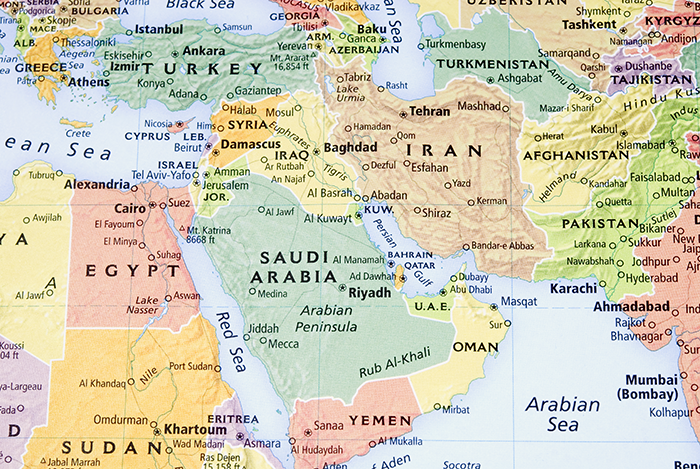
The massive attack of 28 February 2026 against Iran took all the countries of the region by surprise. The Iranian response and its ability to strike oil and gas terminals, refineries, seawater desalination plants and other infrastructure such as the airports of Dubai, Abu Dhabi and Doha, which in recent years had become major regional hubs for air traffic between Europe and Asia, dealt a severe blow to the economies of these countries.
The tarnished image resulting from this is perhaps even more damaging for the oil monarchies of the region which, buoyed by their almost inexhaustible rents, had succeeded in constructing a model of modernity and sanitised living that had attracted many people to Dubai and elsewhere in the Gulf.
The Gulf States, between shock and passivity
By striking its neighbours hard, Iran is highlighting their vulnerability. By blocking the Strait of Hormuz and preventing the transit of oil, gas, fertilisers and many other products such as aluminium, Tehran is depriving its neighbours of their principal sources of revenue. There are several possible explanations for this, one could be that by acting in this way the Iranian authorities wish to compel the countries of the region to put pressure on the United States so that the attacks against Iran cease. The other explanation would be the desire to demonstrate the fragility of the foundations upon which the adopted development models rest.
The passivity of the countries of the region is surprising. Over recent years, these States have acquired a plethora of military equipment from the United States, as well as from European countries including France and other Asian countries. For the moment, they have been careful not to use it or retaliate against the attacks. Is this a way of preserving the future or an admission of weakness regarding their inability to ensure a credible defence?
Why did Iran take the risk of durably deteriorating its relationship with its immediate neighbours after years of attempting to restore a semblance of good neighbourly relations? Why target Saudi Arabia and Qatar when these countries appeared willing to accommodate this neighbourhood? Saudi Arabia, through the voice of its Minister of Foreign Affairs, declared that: “trust between Iran and its neighbours had been broken and these attacks will have long-term consequences”.
The post-conflict period could profoundly alter the situation
Aware of their vulnerability and their dependence on the Strait of Hormuz, the countries of the Gulf Cooperation Council (GCC) could consider alternatives. The blockade of the Strait impacts the countries of the region to varying degrees. While Bahrain, Qatar and Kuwait have no alternative other than to transport their oil through Hormuz, Saudi Arabia, the United Arab Emirates and Oman are less dependent on it. Saudi Arabia could export its oil through the 720 km pipeline that crosses the country and opens onto the Red Sea. This pipeline has a capacity of 5 million barrels per day. The Tapline, which enabled the export of Saudi and other Gulf oil to the Mediterranean, has not operated for decades, but it could one day be revived.
The capacities of the Fujairah oil terminal on the Gulf of Oman are estimated at 1.5 million barrels per day. They could be reinforced. In the longer term, the trans-Gulf railway project, which has stagnated for years, could be implemented. Existing roads such as the approximately 700 km route crossing the Rub Al Khali and linking Saudi Arabia to Oman could see traffic intensify.
Another consequence of this conflict has been the warming of relations between Saudi Arabia and Abu Dhabi. The day after the attacks, the two heads of State held talks even though relations between the two countries had been going through a period of stagnation.
If the objectives of the Israeli-American attack against Iran (regime change and destruction of nuclear capabilities) are not achieved, certain countries of the region such as the United Arab Emirates could be tempted to revise their policy towards Israel.
The States of the region have become aware of their vulnerability and will have to act accordingly in order to build a credible defence capable of deterring their powerful neighbour, but do they possess the human resources necessary to do so?
This “war”, whether short or long, will undoubtedly have lasting consequences in the years to come.