
Analyses / Global Health Observatory
13 March 2026
The war in Iran: a conflict with lasting environmental and health consequences
-

Research Fellow, IRIS
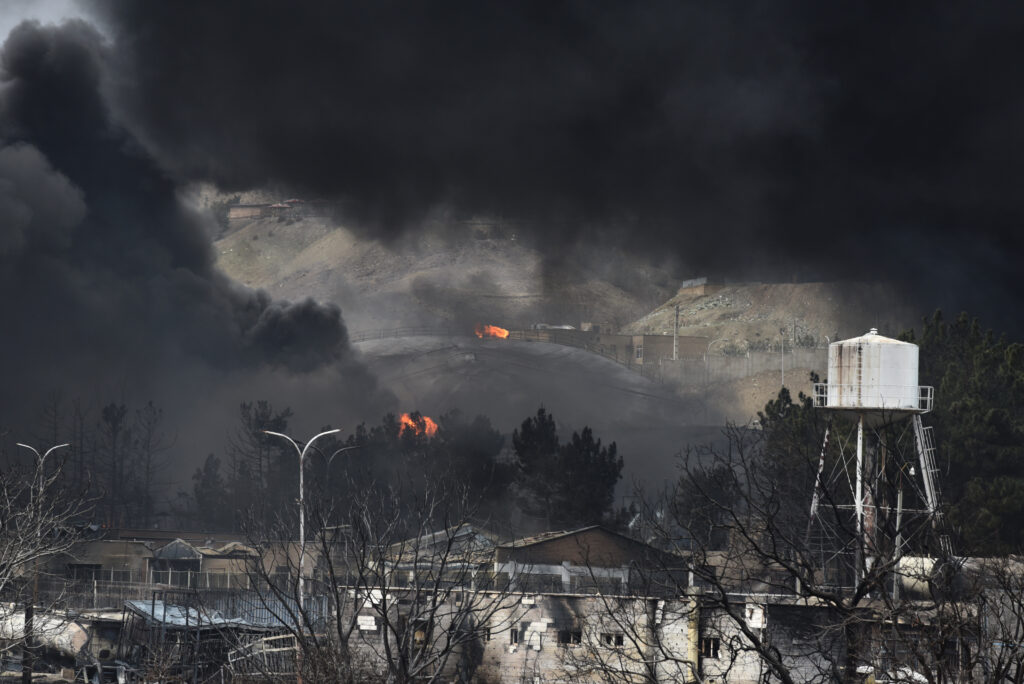
Wars no longer destroy only territories or infrastructure. They now disrupt the ecological systems upon which the stability of societies depends. The war in Iran illustrates this evolution. Strikes targeting oil facilities, industrial fires and damage to energy infrastructure have caused significant air and water pollution, exposing populations to immediate and long-term health risks.
In a world already subject to strong environmental pressures, these conflict-related ecological destructions can durably weaken ecosystems, natural resources and the living conditions of civilian populations.
Industrial fires with major atmospheric effects
Strikes that hit several oil depots located near Tehran have generated large plumes of black smoke above an urban area of nearly ten million inhabitants.
The atmospheric impacts of such events can now be observed and documented by satellite. Instruments on board the Sentinel-5P satellite of the European Copernicus programme make it possible to measure several atmospheric pollutants, such as nitrogen dioxide, sulphur dioxide or carbon monoxide, and to map the plumes generated by industrial fires or damaged energy infrastructure. Contemporary conflicts are thus becoming increasingly observable in their environmental dimensions from space, helping to document the ecological damage associated with military operations.
These plumes contain, in particular, benzene, formaldehyde, polycyclic aromatic hydrocarbons and other fine particulate matter. The latter can penetrate deep into the respiratory tract and aggravate pre-existing conditions, particularly respiratory and cardiovascular diseases[1]. When exposure is prolonged, these impacts become long-lasting and may be accompanied by an increased risk of cancers, as well as certain neurological disorders.
In a context where air quality already constitutes one of the main environmental problems in Iran[2], these industrial fires further increase the exposure of millions of inhabitants to high levels of air pollution.
Soil pollution and toxic debris: the invisible legacy of conflicts
Beyond fires or other spectacular destruction, the explosion of munitions and military debris can also lead to long-term soil contamination. Analyses conducted in several conflict zones have highlighted the presence of heavy metals[3] such as lead, cadmium, nickel or chromium in bombed areas. These contaminants can persist in soils and gradually enter food chains.
Urban destruction constitutes a major source of contamination, through debris that may contain asbestos, industrial chemicals and/or remnants of unexploded ordnance. The management of these materials often represents one of the main environmental challenges in the post-conflict period.
Recent conflicts illustrate the scale of these phenomena. In Ukraine, the bombing of industrial infrastructure and urban areas has led to the dispersion of numerous pollutants into the environment. In the Gaza Strip, the massive destruction of buildings and infrastructure has generated millions of tonnes of rubble, which will significantly complicate decontamination and reconstruction operations.
These forms of contamination, often less visible than immediate destruction, can prolong the environmental and health impacts of a conflict for decades, long after the fighting has ended.
A water crisis exacerbated by the conflict
The environmental risks linked to the war in Iran also concern water resources.
Explosions and fires have caused hydrocarbons to flow into urban drainage systems and certain waterways, potentially contaminating soils and groundwater. Such pollution is likely to durably affect water quality.
This deterioration is occurring in a country already facing a particularly severe water crisis. Iran has for several years experienced a combination of more frequent droughts, agricultural overexploitation and contested water management policies. The overexploitation of groundwater[4] constitutes another major vulnerability.
In this context of extreme water stress, water-related infrastructure becomes particularly sensitive. Allegations of attacks against a desalination plant on Qeshm Island also emerged during the conflict, revealing the growing vulnerability of water infrastructure in contemporary wars.
In a context of extreme water stress, these attacks on water infrastructure illustrate how conflicts can transform pre-existing environmental vulnerabilities into factors of health and social destabilisation.
Environmental infrastructure as strategic targets
The Iranian conflict reveals a gradual transformation in the nature of contemporary warfare. Environmental infrastructure is becoming a strategic target.
Energy installations, water systems, sanitation networks and maritime routes now constitute critical nodes whose destruction can trigger systemic disruptions within societies.
Incidents involving several oil tankers in the Gulf and the Sea of Oman illustrate this vulnerability. Each attack raises the risk of oil spills in a region that concentrates major energy routes and sensitive marine ecosystems.
In societies that are highly dependent on complex infrastructure for access to water, energy or food, these installations become major strategic levers. Their destruction is not only intended to weaken the adversary’s military capabilities, but also to exert pressure on the living conditions of populations and on the stability of states.
The targeting of environmental infrastructure is thus increasingly part of contemporary logics of coercion and indirect deterrence. By threatening access to essential resources such as water or energy, belligerents may seek to durably undermine the economic, health and social balances of their adversary.
However, damage to ecosystems in conflict zones does not produce only local effects. In a world already confronted with planetary boundaries, these destructions can weaken ecological systems upon which global stability depends, turning certain conflicts into environmental disruptions that may extend far beyond the areas of combat.
Recent conflicts: a global trend
Wars no longer take place in isolated spaces, far from infrastructure and populations. Fighting now occurs at the heart of densely urbanised and industrialised territories, which amplifies their environmental and health impacts. The ecological dimension of conflict is not new. During the Gulf War in 1991, Iraqi forces set fire to more than six hundred oil wells in Kuwait[5], generating immense plumes of smoke for several months, darkening the skies over the region and causing one of the largest environmental disasters associated with a conflict.
More recently, Russia’s invasion of Ukraine in 2022 led to multiple forms of industrial pollution. The bombing of energy infrastructure and industrial facilities contaminated air, soils and water resources. The destruction of the Kakhovka dam in 2023 caused massive flooding in the lower Dnieper basin, submerging vast natural and agricultural areas. The draining of the reservoir disrupted aquatic ecosystems and dispersed industrial pollutants as well as contaminated sediments, with environmental impacts likely to persist for many years.
These examples show that contemporary conflicts do not only destroy infrastructure or territories: they can also generate long-lasting environmental disruptions.
Wars, pollution and planetary boundaries: a new security issue
The war in Iran takes place within a geopolitical context marked by increasing environmental pressures. Several planetary boundaries identified by the Stockholm Resilience Centre have now been exceeded or are severely disrupted, particularly those relating to climate, pollution, biodiversity and biogeochemical cycles.
In this context, armed conflicts can act as accelerators of environmental degradation: industrial fires, soil contamination, maritime pollution or damage to water resources add to already existing ecological pressures.
Armed conflicts also constitute a direct source of greenhouse gas emissions. In 2022, armed forces and their supply chains accounted for 5.5 % of global emissions[6]. A level comparable to, or even higher than, that of certain highly publicised civilian sectors such as aviation. In a context of accelerated rearmament and the multiplication of conflicts, this carbon footprint is likely even higher today.
Yet these dimensions remain largely absent from public debates on environmental responsibility. The stability of societies increasingly depends on the proper functioning of the ecological systems that sustain human life. When these systems are degraded, the consequences are multiple: health crises, water shortages, food insecurity, population displacement… all of which threaten post-conflict resilience.
In a world already constrained by planetary boundaries, environmental destruction linked to conflicts thus constitutes an additional factor of global instability. It highlights that human security does not depend solely on the balance of power or military capabilities, but also on the preservation of the ecological systems upon which societies depend.
In this context, war increasingly appears as a driver of ecological crisis in its own right.
At a time when the environmental and health responsibilities of the aviation, agricultural or road sectors are widely debated, the environmental cost of conflicts and the persistent inability of our societies to resolve their differences other than through violence remain largely underestimated.
[1] WHO, Air pollution and health risk assessment, 2021.
[2] Taghizadeh, F., Mokhtarani, B. & Rahmanian, N. “Air pollution in Iran: The current status and potential solutions”. Environ Monit Assess 195, 737 (2023). https://doi.org/10.1007/s10661-023-11296-5
[3] Altahaan, Z.; Dobslaw, D. “The Impact of War on Heavy Metal Concentrations and the Seasonal Variation of Pollutants in Soils of the Conflict Zone and Adjacent Areas in Mosul City”. Environments 2024, 11, 247. https://doi.org/10.3390/environments11110247
[4] Jasechko, S., Seybold, H., Perrone, D. et al. “Rapid groundwater decline and some cases of recovery in aquifers globally”. Nature 625, 715–721 (2024). https://doi.org/10.1038/s41586-023-06879-8
[5] UNEP, Desk Study on the Environment in Iraq, 2003.
[6] Conflict and Environment Observatory, Estimating the Military’s Global Greenhouse Gas Emissions, 2022.