
Analyses
5 March 2026
Hormuz: A Narrow Strait, Far-Reaching Shockwaves
-

Associate Research Fellow, IRIS
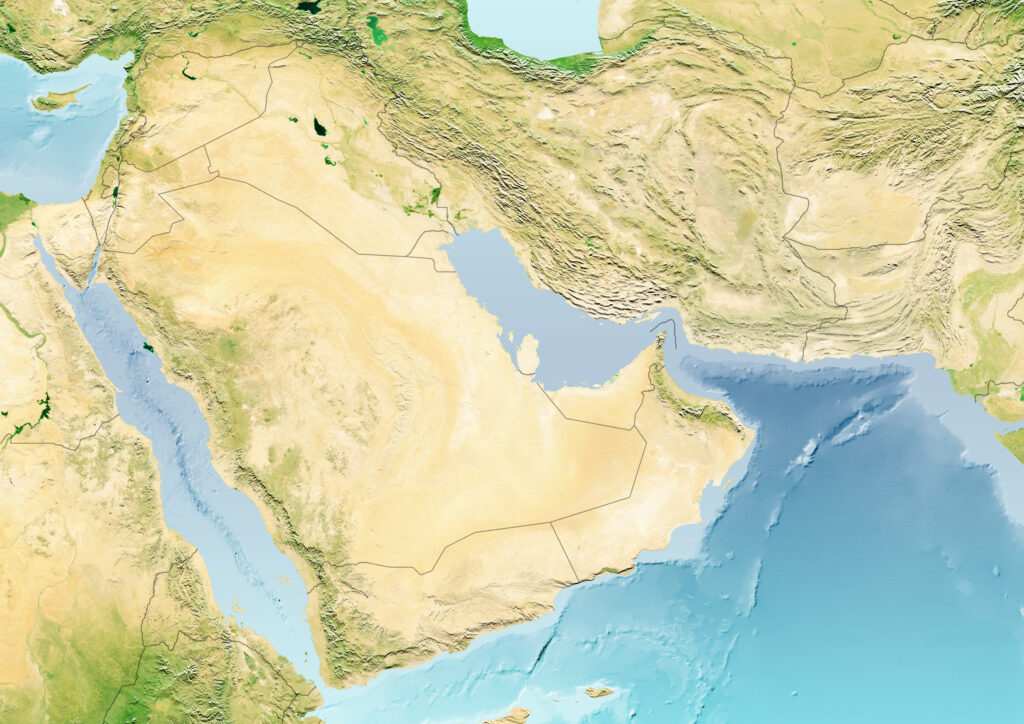
A stretch of some thirty kilometres separates Iran from Oman. A narrow maritime passage, when one focuses on Hormuz. A strait linking the vast Indian Ocean to the confined Persian Gulf. The war engulfing Iran and the Middle East, beyond the bombs, the tragedies and the political messaging, offers a crash course in contemporary geoeconomics. Let us begin with the Persian Gulf. Covering an area of 250,000 km², ten times smaller than the Mediterranean, it accounts for barely 1% of the world’s oceanic space. Yet it holds 50% of proven oil reserves and 40% in the case of gas[1]. A colossal concentration of energy and economic wealth, contained within a basin of limited dimensions, with a maximum depth of around one hundred metres and a width of approximately 300 kilometres at its widest point. Along this Persian Gulf lie eight coastal states, home to a combined population of 200 million people, of whom 60 to 70 million live along the shoreline, on these highly coveted coasts where the presence of water offers reassurance when a vast desert lies behind. Even the dominant energy fields, whether already exploited or yet to be developed, are offshore, beneath the sea. For these coastal states, the maritime domain is therefore above all an economic space. Seawater is desalinated to provide drinking water or to irrigate the limited agricultural production that can withstand such arid conditions. The depths are drilled to extract hydrocarbons so prized by the global economy, thereby enriching the coastal nations. The maritime domain is also coveted because it provides access to the open seas, enabling both exports and imports, provided that the tap of the Strait of Hormuz remains open. The Strait of Hormuz is a vital artery for the countries of the Persian Gulf and a major energy lifeline for much of the world. When flows proceed without disruption, which is generally the case since it is rarely in anyone’s interest to deprive themselves of economic oxygen, the strait operates at full capacity: one third of global oil trade, (with 12 to 13 million barrels per day!), 20% of liquefied natural gas (LNG), 30% of liquefied petroleum gas, 15% of refined petroleum products, and 30% of nitrogen fertilisers[2], based on annual averages over the period 2023–2025. These commodities are transported by tankers, LNG carriers or bulk carriers. Each merchant vessel represents a value that quickly amounts to several million dollars. The majority are bound for Asia. China alone absorbs nearly 40% of the oil leaving the Persian Gulf, and as much as 80% of Iranian crude in recent years[3]. Significant volumes also transit via Hormuz to India, accounting for 15%, and to South Korea and Japan (with around 10% each)[4]. In the case of gas and nitrogen fertilisers, destinations are less concentrated in Asia, extending towards Africa or through the Red Sea to reach European markets. The European Union, for example, imports 8% of its LNG from Qatari resources[5]. The strategic importance of this maritime passage is therefore immense for the economies of the Gulf states. Kuwait and Qatar depend entirely on the Strait of Hormuz for their hydrocarbon exports, while around 95% of exports from Iraq and Iran transit through it[6]. Saudi Arabia, whose main oil fields are located on its eastern seaboard, relies on this route for approximately 90% of its exports[7]. The United Arab Emirates are slightly less exposed thanks to their direct access to the Indian Ocean and the commercial port of Khor Fakkan, from which roughly 25% of Emirati flows depart[8]. Geography dictates logistics, just as economics does, since these raw materials do not travel by air or overland rail or road routes, except for the final kilometres needed for distribution. Otherwise, it is the ocean that connects supply and demand.
Current events are turning Hormuz into a bottleneck for the local, regional and potentially global economy. Iran claims it can close the strait. In any case, risks have multiplied to such an extent that trade could come to an abrupt halt. The steady flow of crossing vessels is giving way to ships left circling idly, trapped in the Persian Gulf, loaded and far from port (estimated at around 500), or remaining stationary in the Gulf of Oman, as the danger is now too great to justify crossing the strait. The United States has announced the possibility of actions on site to reopen the Strait of Hormuz. Other countries are considering similar moves, as the economic repercussions could cascade the longer the situation persists. Insurance premiums have already surged. Shipping companies are strongly advised to avoid the strait, where vessels have been struck by military fire or kamikaze underwater drones. Following Maersk and MSC, the Chinese shipping giant Cosco has suspended services to and from Gulf countries. The geostrategic situation could deteriorate further if floating mines were deployed, rendering the strait even less navigable. Moreover, an oil spill resulting from a sunk tanker would constitute an ecological disaster in this quasi-enclosed sea. Since 28 February 2026, these extreme geopolitical tensions have already led to a significant rise in oil and gas prices. Should the Strait of Hormuz remain blocked for a month or more, a global energy and economic shock is to be feared, particularly in a context of already highly volatile, tense and increasingly opaque markets. From Covid-19 to Ukraine, alongside other shocks since 2020, inflation has returned to everyday vocabulary. Fuel prices in Europe are expected to rise by several cents per litre within days. With higher gas prices, electricity bills in highly dependent countries such as Germany are also likely to increase. Hormuz is also a vital passage for feeding the populations of the Persian Gulf, which are highly dependent on external supplies arriving from afar to meet the food needs of a region lacking substantial agricultural production. Between 15 and 20 million tonnes of grain (including cereals and soybeans), enter the Persian Gulf each year[9], supplied primarily by Brazil, Russia, Australia, Turkey and Ukraine. For several EU Member States, this represents an essential market characterised by growing consumption. Italy, France and the Netherlands, among others, export agri-food products to these structurally import-dependent markets. Grain flows into the Persian Gulf in January and February 2026 were twice the usual averages. Each country appears to have anticipated the crisis and increased its stocks, although these are unlikely to cover more than six months.
The Strait of Hormuz is a stark reminder of the fragility of extended supply chains for resources that are globally consumed yet highly concentrated at their source. What is currently unfolding with Iran, the Persian Gulf and this strait is therefore also a geoeconomic conflict extending well beyond the regional sphere. The passage through the Red Sea, already complex over the past two years due to Houthi attacks on commercial vessels transiting via Bab el-Mandeb, is likely to come under renewed strain as the Iranian regime reactivates its proxy forces. Maritime trade is consequently being redirected towards southern Africa and the Cape of Good Hope. Transit times are increasing, and transport costs are rising. As is often the case, these geoeconomic variables must be integrated into broader analytical frameworks for understanding conflicts and rivalries between powers. If the strategy of Iran’s clerical leadership is to pursue an all-out approach, effectively staking everything in a decisive confrontation with Israel and the United States, it cannot be ruled out that it will seek to inflict maximum damage in the economic domain, even if the disruption or destruction of the Strait of Hormuz directly harms Iran itself.
What will neighbouring nations do, particularly the Gulf monarchies, led by Saudi Arabia, which in recent weeks appeared to favour non-intervention, likely out of concern for unleashing a Pandora’s box of multiple instabilities? It should not be forgotten that the rapprochement between Tehran and Riyadh is recent, that it was brokered under the auspices of China, which may become more active in this conflict for geoeconomic reasons, and that cooperation among Persian Gulf states remains limited. Dialogue exists and comparisons are made, but durable solidarities are rare, due to the primacy of sovereign interests and security considerations… The Middle East remains one of the world’s largest arms markets, and if escalation continues, the conflict could intensify further and shift in nature. Holidays in Dubai, bye-bye.
[1] US – Energy Information Administration
[2] Argus-Media
[3] World Energy Council
[4] Eurostat
[5] US – Energy Information Administration
[6] US – Energy Information Administration
[7] US – Energy Information Administration
[8] US – Energy Information Administration
[9] International Grain Council