
Interviews / Energy and Raw Materials
2 March 2026
The conflict in Iran revives fears over the global economic consequences of a potential blockade of the Strait of Hormuz
-

Senior Research Fellow, IRIS
The conflict observed in Iran since the beginning of the weekend, and more broadly across the Middle East, is unfolding in a region that constitutes a major transit route for global oil flows. In this context, what can be anticipated on oil markets in the months ahead? An assessment with Emmanuel Hache, Director of Research at IRIS.
What is Iran’s position in global oil and gas markets?
In 2025, Iran produced approximately 3.3 million barrels per day (mb/d) of crude oil and around 1.3 mb/d of distillates. The country therefore accounts for roughly 4.5% of global oil supply and, as of January 2026, according to the International Energy Agency (IEA), ranks as the fourth-largest producer within the Organization of the Petroleum Exporting Countries (OPEC), behind Saudi Arabia (10.28 mb/d), Iraq (4.34 mb/d) and the United Arab Emirates (3.6 mb/d). Despite its weight within the organisation, Iran exports only around 1.5 mb/d of crude oil and distillates. While Iranian exports have increased significantly since 2020—when they had fallen to their lowest levels in recent years (0.4 mb/d)—the structure of these exports has gradually become concentrated almost exclusively on China. Beijing now accounts for more than 90% of Iranian exports, compared with less than 25% in 2017. A similar pattern can be observed in global gas markets. Iran is indeed a major player, holding the world’s second-largest reserves (17.5%), behind Russia (19.9%), and accounting for around 6.5% of global production. However, its exports represent only 6.5% of the volumes produced, with more than 93% of Iranian gas consumed domestically. The bombardments observed since Saturday have, for the time being, not affected oil and gas infrastructure (with the exception of vessels), most of which are located in the south and south-west of the country. In terms of oil exports, Kharg Island alone accounts for 90% of crude exports. Consequently, the risk of destabilising global energy markets through a mere disruption of Iranian exports remains limited. Oil markets are under pressure not solely because of the bombardments in Iran, but due to the broader risk of regional destabilisation and disruptions to oil flows through the Strait of Hormuz.
Does the Strait of Hormuz remain strategically central in global energy geopolitics?
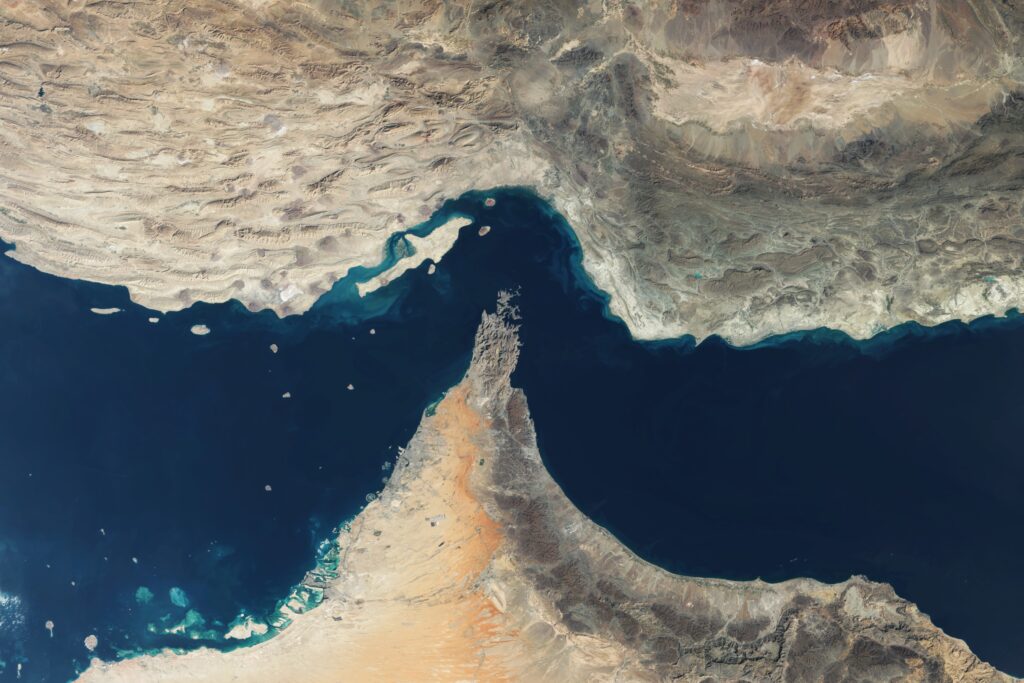
Yes, the Strait of Hormuz remains one of the most critical chokepoints in global energy geopolitics. The conflict in Iran has revived concerns over the consequences of a potential blockade of the Strait of Hormuz for the global economy. The Strait of Hormuz, which connects the Persian Gulf to the Gulf of Oman, lies between Iran and the Sultanate of Oman. It is approximately 63 km long and around 40 km wide at its narrowest point, with shipping lanes no wider than 3.7 km. Hormuz has a triple strategic significance. In 2025, of the 102 million barrels of oil consumed daily worldwide, nearly 76 mb/d were transported by sea. The majority transited through the Strait of Malacca (23.7 mb/d) and the Strait of Hormuz (20.1 mb/d). Thus, Hormuz alone accounts for nearly 20% of global oil consumption flows. A significant share of exports from major regional producers (Saudi Arabia, the United Arab Emirates, Iran, Iraq, Kuwait and Qatar) passes through it, with more than 75% destined for Asia. It is therefore this specific chokepoint that concerns markets. In addition, liquefied natural gas (LNG) supplies—particularly from Qatar—follow the same route, with around 20% of global LNG flows transiting through the strait. It is also the final passage point for all trade flows within the Persian Gulf, a theatre of confrontation during the Iran–Iraq War (1980–1988) and with the United States in 1987 and 1988 during the so-called Tanker War. Finally, the Strait of Hormuz constitutes a major instrument of pressure and leverage for Iran vis-à-vis its neighbours and the United States. However, even at the height of the Iran–Iraq War in the 1980s or during the Gulf Wars, it was never closed, raising questions about Iran’s willingness and capacity to do so. Nevertheless, the intention of the Islamic Revolutionary Guard Corps to close the strait and escalate towards a worst-case scenario is now clearly asserted, and the Iranian strikes observed in Persian Gulf countries over the weekend further complicate the situation.
Do the bombardments in Iran occur within a specific market context that could limit a sustained increase in prices?
The main uncertainties today revolve around two questions: the duration of the conflict and its impact on oil flows in the Persian Gulf and the Strait of Hormuz. On Sunday, two vessels were struck, which could foreshadow severe economic and environmental consequences. More broadly, geopolitical developments since January 2026—particularly in Venezuela, as well as, to a lesser extent, production declines in Kazakhstan and Russia—have helped maintain oil prices at around 60 dollars per barrel. In February 2026, Brent crude rose to approximately 70 dollars due to tensions between the United States and Iran and the lack of tangible progress in negotiations. In a scenario involving a total blockade of the strait, it is difficult to predict how high prices could rise. In June 2025, during US strikes on Iranian nuclear facilities (the so-called 12-day war), prices increased by nearly 15%, exceeding 80 dollars before returning to equilibrium levels below 70 dollars. On Monday 2 March, at market opening, prices reached around 80 dollars, but uncertainty remains. Prices are likely to fluctuate in line with developments in the region, and the risk persists of a sustained rise above 100 dollars, which would impact global growth already weakened by trade tensions and geopolitical uncertainty since early 2026. Some actors appear to have taken precautionary measures, as crude exports had already accelerated in the Gulf for nearly a week. Moreover, OECD countries hold strategic reserves (approximately 90 days of net imports for IEA member states), which can help limit price increases by reassuring markets. Certain Gulf countries can also redirect part of their flows towards the Red Sea via pipeline networks. Saudi Arabia, for instance, can reroute 60% of its crude exports (8.2 mb/d in 2024), as can the United Arab Emirates, while Qatar can redirect gas flows via the port of Fujairah in the Gulf of Oman[1]. OPEC, which met on 1 March, decided to increase production quotas by 206,000 barrels per day—a relatively modest adjustment given the events of the weekend. Alternatives therefore remain limited, as even maximum rerouting of shipments would still leave an estimated shortfall of between 8 and 10 million barrels on global markets. More broadly, in times of crisis, it is fear that dominates markets. It revives the spectre of a crisis comparable to the oil shocks of 1973–1974 and 1979, which plunged the global economy into recession. It also highlights the continued importance of oil for economies and the need to accelerate decarbonisation policies in the transport sector. Decarbonisation remains the most effective lever for limiting the consequences of geopolitical risks on oil markets.
The bombardments nevertheless occur in a rather specific market context. At the beginning of 2026, oil markets were significantly imbalanced due to weaker than expected demand, further revised downwards by the IEA in its February 2026 Oil Market Report (from +0.93 mb/d to 0.85 mb/d), and strong supply growth. The IEA estimated a surplus of around 3.7 mb/d in 2026, while the US Department of Energy projected 3.1 mb/d, compared with 2.7 mb/d in 2025. Market fundamentals prior to the conflict therefore pointed towards relatively low prices (around 60 dollars) for 2026 and 2027. Oil markets were undergoing significant transformation. On the demand side, decarbonisation policies are slowing demand growth, which is now driven exclusively by non-OECD countries. While China has driven global oil demand growth over the past decade, its demand growth has slowed markedly, and India could soon become the primary engine. On the supply side, OPEC policies and those of other producers remain decisive. In 2026, the Americas (Argentina, Brazil, Canada, the United States and Guyana) alone could add 1.3 mb/d to global supply. A short-term oil shock is therefore not inconceivable in light of developments in the Persian Gulf. However, 2026 will not be 1974, due to lower oil intensity in the global economy and market fundamentals that point towards relatively low prices in the years ahead.
[1] Passages stratégiques maritimes et sécurité énergétique européenne : bouleversements géopolitiques et stratégies de mitigation, rapport de l’Observatoire de la sécurité des flux et des matières énergétiques, n°22, juillet 2025.