
Analyses / Middle East / North Africa
17 March 2026
Lebanon once again thrown into the turmoil of the Israel-Hezbollah War
-

Fouad Khoury Helou
Author, researcher specialising in Lebanon and the Middle East, former director of the French-language Lebanese daily L’Orient-Le Jour
The Middle East is once again engulfed in violence. Since 28 February, Israel and the United States have launched an attack against Iran, beginning with the elimination of a large number of leaders, including Supreme Leader Ali Khamenei. While the elimination of Khamenei, the country’s supreme leader for decades, has dealt a severe blow to the regime, the latter nevertheless appears to continue resisting, particularly under the impetus of the Revolutionary Guards (Pasdaran), the regime’s praetorian guard. Iran is thus throwing its forces into the battle, implementing the methods of asymmetric warfare, whose principle is simple: against a militarily more powerful adversary (the United States and Israel), the objective is not to achieve victory, but to survive, and to increase as much as possible the cost of the confrontation for the adversary in order to force it to abandon the fight, or at least agree to a ceasefire. Iran is therefore maintaining a defiant posture, while continuing to bombard the entire region, targeting both US forces and Israel, as well as all the Gulf States. Tehran is also threatening to close the Strait of Hormuz, through which one fifth of global oil exports transit. The objective is clear: to threaten to provoke an international energy crisis, and to paralyse the regional economy. Iran is also maintaining ambiguity regarding the real fate of its stockpiles of enriched nuclear fuel.
On the other hand, while the Iranian regime is attempting to weather the storm in the face of a more powerful war machine that is methodically destroying command centres, arms factories and missile launch sites, its strategy nevertheless contains a weakness: it is better suited to guerrilla and decentralised resistance movements that blend into the population, such as the Viet Cong or Hezbollah, than to a centralised state. How long will the regime be able to hold out in this way? Have the Pasdaran considered alternative scenarios? The question remains open.
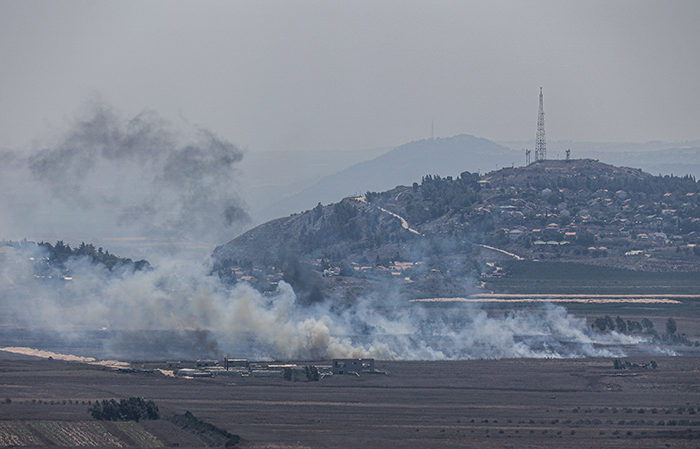
At the same time, Lebanese Hezbollah, one of Iran’s principal regional allies, also entered the battle on 2 March by launching missiles at Israel, which responded harshly across Lebanese territory. Hezbollah also relies on asymmetric warfare: “as long as we have one rifle left to fight with, we will consider ourselves victorious”, Hezbollah leader Hassan Nasrallah, killed by Israel in September 2024, once declared. While the Hebrew State has eliminated a large number of Hezbollah leaders and officials, the organisation appears since then to have been taken back in hand directly by the Iranian Revolutionary Guards, who have delegated officials on the ground in Lebanon to hold the reins of the Lebanese movement, particularly its military wing.
The real capabilities of Hezbollah nevertheless remain uncertain. While many observers asserted, before September 2024, that it possessed tens of thousands of fighters and missiles, it has however suffered heavy losses, with several thousand of its members killed, in addition to around five thousand members put out of action during the “pager attack” carried out by Israel in September 2024. Israeli aviation also continued to pound Hezbollah between November 2024 and March 2026, during the period of relative calm on the Lebanese front, eliminating several hundred members and officials, including the organisation’s military chief Haytham Tabatabai (whose father was Iranian). While Hezbollah appears, according to certain analyses, to have lost up to 70% of its initial capabilities, it nevertheless still remains capable of firing missiles at Israel, while attempting to offer maximum resistance to Israeli forces on Lebanese territory. Furthermore, through their Lebanese base, the Iranian Revolutionary Guards could potentially threaten Europe itself: while Cyprus (a member of the European Union), located around 200 kilometres away, is within range of missiles and drones, longer-range Iranian ballistic missiles (up to 2,500 km) could reach Greece, Italy, and even the edge of the French coastline as well as Corsica. The question therefore is whether the Pasdaran have deployed this type of missile in Lebanon (particularly in the mountainous foothills in the north of the country), and what Europe’s reaction would be to such a possibility.
While the outcome of the conflict with Iran therefore remains uncertain, and depends as much on American and Israeli intentions as on internal developments within Iran itself, several scenarios may therefore emerge for Lebanon. Firstly, the Lebanese government has attempted to implement a “diplomatic” solution by taking two important decisions (although undoubtedly belatedly), namely, on the one hand, officially banning Hezbollah’s military activities, and, on the other hand, requesting the opening of official negotiations with Israel. Whatever their immediate scope, these two initiatives nevertheless show that official Lebanon has made its choice, placing it, politically and diplomatically, outside the pro-Iranian camp. It is nevertheless to be feared that the Lebanese army, designed since the end of the 1975-1990 war primarily as an internal peacekeeping force, does not today possess the capabilities to disarm Hezbollah itself, whose fighters are highly battle-hardened after years of conflict, particularly in Syria – the army also hesitating to confront Hezbollah so as not to risk an inter-Lebanese conflict.
While the posture adopted by the Lebanese state may therefore serve long-term diplomatic objectives, namely attempting to “salvage what can still be saved”, and to secure for the country a place at the table of future regional negotiations, it is therefore to be feared that Israel will instead favour, in the short term, a military solution, in order to defeat the pro-Iranian militia itself. But how far would the army of the Hebrew State go? After having forced almost all the inhabitants of South Lebanon and Beirut’s southern suburbs, namely nearly one million people, mostly Shiites, to flee under bombardment and crowd into other regions, will it decide to invade Lebanon in order to hunt down Hezbollah and force it to evacuate the country, as it did with Yasser Arafat’s forces in 1982? Bearing in mind that Hezbollah’s fighters are, above all, Lebanese and not Palestinian.
Another scenario could therefore emerge, which, if it materialises, would have severe consequences for Lebanon. It would involve Israel occupying a vast area of South Lebanon, which would be largely destroyed, in a manner similar to Gaza, while permanently pushing the predominantly Shiite populations of this region towards Beirut and the north. Israel would thus create a buffer zone in the south, while continuing to pound Hezbollah in the rest of the country. Having significantly reduced Hezbollah’s capabilities, the Hebrew State would also continue (as it is already doing) to threaten the Lebanese government with reprisals, particularly against civilian infrastructure, should the Lebanese army fail to decide to disarm Hezbollah. While at the same time striking the Shiite community hard in an attempt to turn it against the pro-Iranian militia (particularly the Speaker of Parliament Nabih Berri). Lebanon, which has still not recovered from its economic collapse since late 2019, and which is buckling under destruction, would find itself trapped, in a position similar to that of Palestinian President Mahmoud Abbas, compelled to pursue in the West Bank the factions opposed to Israel, including Hamas, without truly having the means to do so. This “Gaza in the south, West Bank elsewhere” scenario, coupled with security fragmentation, would place Lebanon before a dilemma with far-reaching consequences, all the more so as the country’s demographic and confessional map, relatively stable since 1990, would once again become blurred, with one million refugees crowding into regions with different confessional and political orientations, often anti-Hezbollah, and doing so in the most complete destitution. In this context, one therefore wonders whether Lebanon, already highly weakened, will be able on its own to confront all the social, economic, political and security difficulties that lie ahead, and whether it will urgently require the international community, and Europe in particular, to provide it with multifaceted support whose contours remain to be defined.