
Analyses / Observatoire géopolitique de l’espace post-soviétique
28 July 2026
Kazakhstan asserts itself in relation to Russia: an emancipation more apparent than real?
-

Senior Research Fellow at IRIS, Head of the Sport and Geopolitics Programme
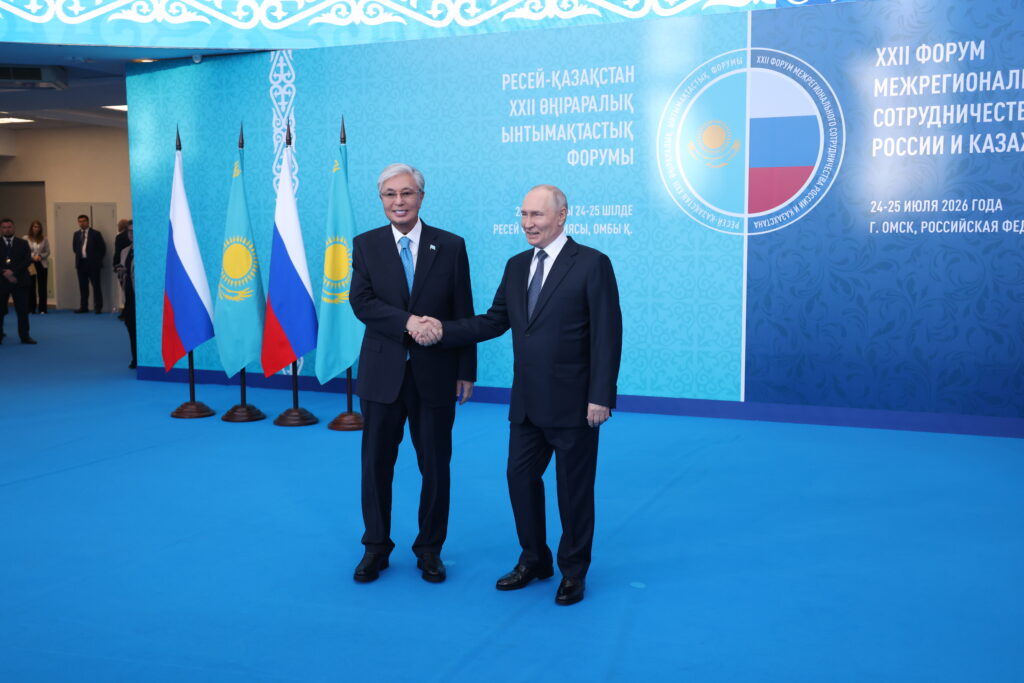
The symbolism is powerful. In Omsk, on 25 July 2026, Kassym-Jomart Tokayev publicly called on Vladimir Putin to reconsider his policy. Sitting alongside the Russian President, he suggested that it was “perhaps time to freeze this conflict” in Ukraine and return to an “Istanbul 2.0 formula”. “All this must stop”, he concluded. Unsurprisingly, the Kremlin quickly dismissed the proposal. Tokayev had, of course, couched his message in diplomatic language, praising Vladimir Putin’s “extreme diplomatic flexibility” and “humbly” offering his opinion. Yet the caution of his words does not diminish the significance of the scene. The leader of Central Asia’s foremost power was addressing the Russian President as a partner whose choices could be discussed. Although close to Moscow, Kazakhstan now refuses to behave as its periphery. A question therefore arises: how does Tokayev’s call to end the war simultaneously reveal the reconfiguration of Russian-Kazakh relations, the erosion of Russia’s centrality in the post-Soviet space and the growing assertion of middle powers in international relations?
A finely woven diplomacy
The statement in Omsk came in a particular context. A few days earlier, Ukrainian attacks had disrupted the Russian terminal at Novorossiysk, where the Caspian Pipeline Consortium (CPC) pipeline terminates. This infrastructure handles around 80% of Kazakhstan’s oil exports, demonstrating that the war is having a direct impact on the country’s revenues. Viewed through the prism of current events, Tokayev’s appeal therefore reflects both a humanitarian concern and an immediate national interest.
Yet this is not enough to understand the situation, and a broader timeframe is needed to grasp it more fully. Let us rewind. Since 2022, Kazakhstan has pursued a finely woven, multivector diplomacy aimed at establishing Kazakhstan as a centre in its own right. A few weeks before the invasion, Tokayev had called on the Collective Security Treaty Organization (CSTO) to contain unrest in his country, and Russian troops had entered its territory and stabilised his hold on power. Astana appeared likely to remain indebted to Vladimir Putin for the foreseeable future. Yet subsequent events disproved this interpretation. As early as June 2022, at the St Petersburg International Economic Forum, Tokayev refused, in Vladimir Putin’s presence, to recognise the self-proclaimed republics of Donetsk and Luhansk, describing them as “quasi-state territories”. In September of the same year, Kazakhstan also rejected the referendums held in the occupied territories and abstained in several United Nations votes, without supporting the annexations. Walking a tightrope, the country has not joined Western sanctions, but has undertaken to limit their circumvention. Then came 9 November 2023. In Astana, following a meeting with Vladimir Putin, Tokayev began his statement in Kazakh. He continued in Russian around twenty seconds later, but the delegation from Moscow was caught off guard. Sergei Lavrov, Dmitry Peskov and several Russian officials searched for their interpreting devices. It is important to understand that, until then, diplomatic exchanges between Russia and Kazakhstan had taken place exclusively in Russian. The change may appear insignificant. In a region marked by Russian political and cultural domination, emancipation also takes place through language. Tokayev is not erasing Russian, which is widely spoken and officially used. He is reminding his audience that Kazakh is the language of a sovereign state. For a few seconds, Moscow has to translate and adapt.
Care must nevertheless be taken not to draw conclusions too quickly, as strong dependencies remain between Moscow and Astana. First, there is geography. The two countries share more than 7,500 kilometres of border, the longest continuous land border in the world. Then there are institutions. Like Russia, Kazakhstan belongs to the Eurasian Economic Union (EAEU) and the CSTO. Finally, there is the economy. In 2024, trade with Russia reached 28.1 billion dollars. It is no coincidence that Rosatom will lead the consortium responsible for building Kazakhstan’s first nuclear power plant.
At the same time, however, Astana is developing alternatives to Russia. China has become its largest individual trading partner, while the European Union retains that position when the Twenty-Seven are considered as a bloc. The EU also remains the country’s principal source of foreign investment. Kazakhstan is developing the Trans-Caspian Corridor, which connects China to Europe without crossing Russian territory, and is strengthening its relations with Turkey, Azerbaijan and the Gulf states. At the regional level, its rapprochement with Uzbekistan and the “Central Asia 2040” project are intended to foster the emergence of a Central Asia capable of defending its own interests. This so-called “multivector” diplomacy seeks to distribute dependencies in order to preserve Kazakhstan’s sovereignty.
The end of Russia’s monopoly
Although this development supports the idea of a weakening Russia, the reality is more nuanced. Moscow retains considerable military, economic and cultural influence in Central Asia. It remains a major market, a transit route and a security partner. Moreover, sanctions have even increased the value of Kazakhstan and Kyrgyzstan to Russian companies, which use them as intermediaries and alternative routes.
Russia’s centrality is nevertheless now being challenged. For several decades after 1991, the Kremlin set the boundaries of acceptable autonomy within the post-Soviet space, but the war has weakened this hierarchy. The power that claimed to guarantee regional stability now threatens the sovereignty of its neighbours. In Kazakhstan, Russian rhetoric questioning the country’s borders is a particular source of concern in the north, where a large Russian-speaking population lives. Armenia’s difficulties in the face of Azerbaijan have also undermined the credibility of Russian guarantees. China is expanding its economic influence, Turkey is consolidating its networks across the Turkic world, of which Kazakhstan is a part, and the European Union is investing in transport, energy and critical raw materials. Their simultaneous presence is multiplying the options available to the states of the region. In practical terms, Russia’s weakening is a matter of competing power relations. Moscow now finds it more difficult to secure the alignment of its neighbours and is more dependent on them to redirect its trade. Tokayev can therefore express disagreement without overturning the entire partnership.
The very notion of a “post-Soviet space” is consequently being weakened. It places Russia at the centre of a region defined by a shared past. Yet national trajectories are diverging and new political regions are asserting themselves. Kazakhstan presents itself as a Central Asian state connected to both Europe and Asia. Although Russia remains a major pole in Eurasia, it is no longer its sole centre of gravity.
The moment of the middle powers?
Kazakhstan ultimately illustrates a transformation in international relations. Since 2024, Tokayev has presented his country as a “middle power”. The concept does not simply refer to an economic or military ranking. The work of Eduard Jordaan, as well as that of Andrew Cooper, Richard Higgott and Kim Nossal, emphasises a particular practice of power: multilateralism, mediation, coalitions and strategic sectors make it possible to exercise influence beyond a country’s material capabilities. Kazakhstan possesses several of these levers. Located between Russia, China, the Caspian Sea and Europe, it has oil, gas, uranium and critical minerals. Its renunciation of the Soviet nuclear arsenal supports its non-proliferation diplomacy. Astana hosts negotiations and seeks to turn its landlocked position into an intermediary role. In other words, Kazakhstan wants to establish itself once again as a crossroads.
More generally, the fragmentation and multipolarity of the world are increasing the room for manoeuvre available to such states. They negotiate on an issue-by-issue basis: security with Russia, infrastructure with China, investment with the EU, defence with Turkey and technology with the United States. This multi-alignment adapts Kazakhstan’s diplomacy to a less hierarchical world. Middle-power status cannot simply be declared. Kazakhstan remains dependent on Russian infrastructure, exposed to China’s influence and relatively weak militarily. Its authoritarian regime also limits the scope of its discourse on multilateralism. Tokayev can propose freezing the war, but he cannot impose it. Its power is therefore limited and lies in its freedom of decision, its strategic resources and its ability to engage with several sides.
The remarks made in Omsk continue a series of diplomatic and symbolic gestures. In 2022, Tokayev rejected Russia’s annexations. In 2023, Moscow’s leaders listened to a few words in Kazakh. In 2026, he asked Vladimir Putin to stop the war. Kazakhstan’s political assertion in relation to Russia is now supported by material transformations: the development of the Trans-Caspian Corridor is intended to reduce dependence on Russian routes, Chinese and European investment is diversifying the country’s partnerships, while closer relations with Uzbekistan, Azerbaijan and Turkey are strengthening its regional anchoring. The “Central Asia 2040” project also gives political substance to the emergence of a more autonomous Central Asia. Russia remains present in the region. But it is no longer the only voice.
Ultimately, across the former Soviet empire, this movement extends far beyond Kazakhstan. The post-Soviet space now appears fragmented: Ukraine is fighting Russia, Moldova is turning towards the European Union, the South Caucasus is reorganising around new power relations, Central Asia is asserting its own interests, while the Baltic states joined the EU and NATO long ago. The war in Ukraine is accelerating this fragmentation. Weakened and bogged down on the Ukrainian front, Russia retains a significant capacity for influence, pressure and destabilisation, but its centrality is declining. The former peripheries are building their own political spaces, alliances and transport routes. A new post-imperial era is thus opening in Eurasia. The end of the post-Soviet space is taking shape before our eyes.