
Interviews / Geopolitical Observatory of the Post-Soviet Space (French only)
8 September 2026
War in Ukraine: Between a Diplomatic Revival and the Conflict Becoming Bogged Down
-
Senior Research Fellow, IRIS
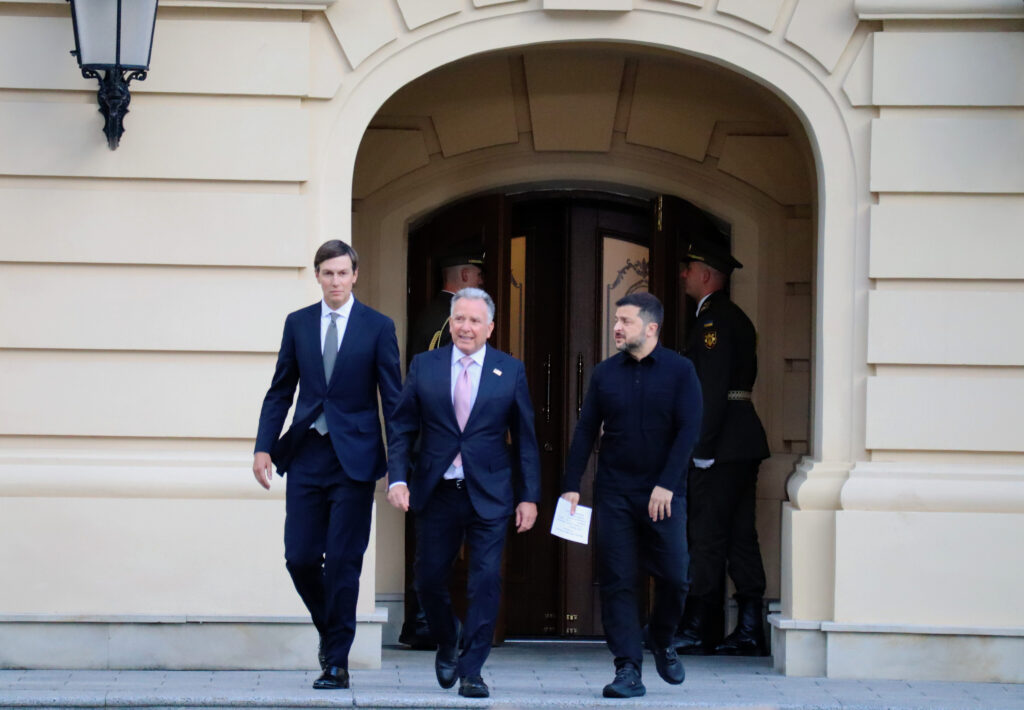
Following several months during which Washington had largely taken a back seat on the Ukrainian issue, the meetings between Jared Kushner and Steve Witkoff and Vladimir Putin, followed by Volodymyr Zelenskyy, on 5 and 6 September mark a resumption of US diplomatic efforts. However, whilst territorial differences remain deep-seated and both sides still appear determined to pursue their war aims, the prospect of a settlement remains a distant one. What can we expect from this new round of negotiations? What diplomatic, economic and military conclusions can be drawn from the conflict? And to what extent might the domestic challenges facing Russia and Ukraine influence its continuation? We take stock with Jean de Gliniasty, research director at IRIS and former French ambassador to Russia.
The US envoys Jared Kushner and Steve Witkoff met successively with Vladimir Putin and Volodymyr Zelensky on 5 and 6 September. Given that Washington had announced a plan aimed at ‘ending the war’, what can we take away from these discussions? Do the United States still appear to be a credible mediator in the eyes of both sides?
It will be recalled that Donald Trump had said he would resume negotiations on Ukraine following the war in the Gulf that he had started and which he believed would be over very quickly. Although nothing has been settled with Iran, we are seeing a resumption of negotiations, marked by: the visit of the CIA director, John Ratcliffe, in late August; contacts between the finance ministers on the sidelines of the G20 summit in Asheville (United States) on 2 September; and the visit by special envoys Steve Witkoff and Jared Kouchner, who were received by Vladimir Putin on 5 September, before travelling to Kyiv for the first time, where they were received the following day by President Zelensky. Both sides expressed satisfaction with the talks, which were also described as “frank” by the Russian side. Donald Trump’s envoys were expected to bring new ideas to the table, but nothing has been revealed. The crux of the problem remains the fate of the four provinces annexed by the Russians – though only partially occupied – which Putin is unwilling, and arguably politically unable, to relinquish. The Russian president has announced that the strongholds of Kramatorsk and Sloviansk in the Donetsk region will be taken before the end of the year, suggesting that he is not counting on a swift agreement. Russia, the United States and Ukraine have all stated that peace should not be expected before winter. However, Washington currently remains the only mediator capable of engaging with both sides and putting forward proposals. The Europeans, who were invited by Volodymyr Zelensky to take part in the talks in Kyiv on 6 September, have positioned themselves as the Ukrainians’ unconditional supporters. Unless a new proposal emerges that is acceptable to both sides – which is currently unlikely – the outcome will therefore be decided by military force (either a victorious Ukrainian resistance or the fall of the entire Donbas region, or even the Zaporizhzhia and Kherson oblasts, which are currently the subject of negotiations). However, dialogue has resumed with the prospect of a forthcoming three-way meeting (between Ukraine, Russia and the United States) or even talks involving Ukrainians, Americans and Europeans.
What assessment can be made of the war in Ukraine from a diplomatic, economic and military perspective?
Apart from the colossal loss of life on both sides, Russia’s attempted invasion of Ukraine has been a disaster: for the devastated Ukraine; for Russia, which is crippled by sanctions and whose civilian economy has been stalling for over a year; and for Europe, which is paying more for energy than its main competitors, losing market share globally, being permanently sidelined from the Russian market and suffering from anaemic growth rates. Once peace is restored, it will take years to rebuild Ukraine, to restructure Russia’s war economy and to revive the European economy in the face of the Chinese tidal wave and American diktats. The European Union has not equipped itself to play any diplomatic role other than supporting Ukraine, as evidenced by its inability to appoint a negotiator. It is marginalised in the peace settlement process, even though the next stage – namely, the definition of a peace architecture in Europe – will inevitably see its role return to centre stage. But we are a long way from that. At present, only the United States is speaking to everyone and is in a position to negotiate peace. It is worth noting the multitude of peace plans proposed in recent years by China, Brazil, Africa and the Vatican, all of which are looking with concern at the crisis afflicting a troubled continent. Finally, this conflict has changed the way war is waged by introducing the large-scale use of drones and non-nuclear missiles, making it possible to neutralise vast land areas (grey zones) or maritime areas (the Black Sea), preventing the concentration of offensive forces and enabling the weaker side to strike deep into the adversary’s infrastructure. The war has also sparked a widespread rearmament drive amongst European countries – the last bastion of growth – though this has also, and above all, benefited US arms exports.
With the Russian parliamentary elections just a few days away, and with the Russian army struggling to make significant headway on the front line, what role does the war in Ukraine play in domestic political debates?
The war plays a minimal role in the Russian parliamentary election campaign, if only because the only party opposed to the war, Yabloko, has not been allowed to field candidates. Furthermore, the intensification of Ukrainian air strikes on Russia, the destruction of refineries and distribution infrastructure, and the queues at petrol stations have, as is usually the case (as seen in London in 1940 or Iran in 2026), led to a strengthening of solidarity behind the government. According to the Levada Centre:
- Vladimir Putin’s approval rating rose from 74 per cent in July to 76 per cent in August;
- the proportion of Russians in favour of negotiations reached its lowest level in 18 months (58 per cent);
- the percentage of Russians who believe Russia is on the right track rose from 52 per cent in June to 56 per cent in August.
But the population is weary of the war, businesses are exhausted, the economy is stalling and economists are concerned: the warnings issued by Klepach, chief economist at Russia’s second-largest bank (VEB), led to his dismissal, and Boris Titov, the former representative for small and medium-sized enterprises, said that the Russian economy risked ‘going mad’. In the long run, this trend and the difficulties facing the non-defence sector could provide an incentive to negotiate in earnest, or even to compromise…. On the Ukrainian side, the series of corruption scandals uncovered by the National Anti-Corruption Bureau (NABU) – ‘Midas’ for the energy sector, ‘Forrest Gump’ for the huge bail sums paid by the presidency to secure the release of those charged with corruption, ‘Carthage’ for money laundering via so-called call centres) is tightening its grip on President Zelensky, who has been forced to part ways with the deputy head of the presidential administration, whilst the dismissal of his popular and dynamic Defence Minister, Mykhailo Fedorov, has sparked a sustained wave of protests. A new political opponent (following former Chief of the General Staff Valeri Zaloujny) is calling for elections and is set to seek endorsement from Washington.The International Monetary Fund (IMF) has delayed the disbursement of its next tranche of more than $5 billion due to the failure to implement 44 conditions relating to fiscal consolidation, thereby blocking part of the European aid, even as less than half of the 2027 budget remains unfunded. Yet despite all these difficulties, on both sides the determination to fight for the original war aims (notably the return of all occupied territories for Kyiv, and recognition of the annexation of the five oblasts for Putin) remains intact and is not openly challenged by public opinion.
This article has been translated from French into English using artificial intelligence.