
Editorials by Pascal Boniface
8 September 2026
Ukraine: Putin Favours the Military Option
-
Director, IRIS
US President Donald Trump’s special envoys, Jared Kushner and Steve Witkoff, announced that significant progress had been made during their trip to Europe, which took them first to Moscow and then to Kyiv. Whilst they have visited the Russian capital more than eight times before, this was their first visit to Ukraine.
Ukrainian President Volodymyr Zelenskyy used their visit to show them the damage caused by Russian strikes on his country and to plead for further deliveries of Patriot defence missiles, in order to minimise civilian casualties and damage to infrastructure.
The problem is that the United States has used up a large proportion of its own ammunition stocks in the context of the war against Iran. Whilst they have promised to grant Ukraine a licence that would allow the country to build the interceptor missiles itself, this will not yield any tangible results for several years.
Ukraine therefore finds itself in a highly vulnerable position in the face of escalating Russian attacks, which are causing severe damage to its industrial capacity and energy infrastructure. This situation leaves Ukrainians helpless in the face of the winter cold, which makes daily life almost unbearable.
The situation is also serious from a demographic perspective: there are now only 23 million people living in Ukraine, compared with 50 million when the country gained independence in 1991.
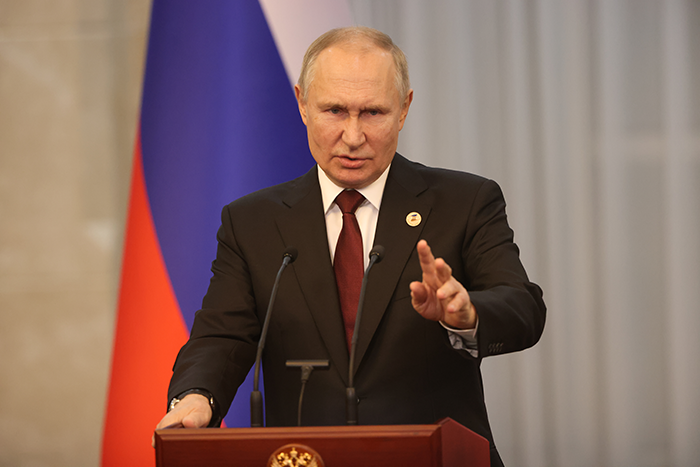
For his part, Russian President Vladimir Putin, despite his courtesy towards the United States, has conceded absolutely nothing. He believes that the balance of power is such that if he does not get what he wants through negotiation, he will resort to military force, whatever the cost.
He is therefore standing by his demands, in particular that the Ukrainian army withdraw from the part of the Donbas where it is still present (i.e. a quarter of that territory). This is deemed entirely unacceptable by Ukraine, both in terms of international law and the heavy sacrifices it has made. Vladimir Putin continues to insist on his determination to tackle the ‘root causes of the conflict’ – that is to say, the demands he set out from the outset. This concerns, in particular, Ukraine’s non-accession to NATO. In reality, NATO members themselves oppose Ukraine’s accession, but Volodymyr Zelensky continues to make this demand in a very clumsy manner.
Vladimir Putin is also calling for a relative demilitarisation of Ukraine so that it is no longer able to strike deep into Russian territory, as it has done recently in response to Russian strikes.
The Russian president is thus maintaining these demands despite a significant human and financial cost: 1 million dead and wounded, and an economy largely geared towards the war at the expense of other sectors.
This stubbornness stems primarily from the fact that he is banking on Ukraine giving in, and that the Europeans – who are still the only ones funding its war effort – will soon grow weary of it. The unprecedented victory of the far-right AfD party in the German state of Saxony-Anhalt is good news for him, as this party is calling for an end to aid for Ukraine. He is certainly counting on Marine Le Pen’s victory in the 2027 presidential election to reap the same benefits on a national scale in France.
Ultimately, his stubbornness stems from his failure. He had promised an easy victory in a ‘special military operation’ that has turned into a protracted war with a human cost 40 times greater than that of the war in Afghanistan. The Russian people are weary of the war, but propaganda and repression are preventing any real protest movement from emerging.
For US President Donald Trump, the fact that the war is still not over – even though he had pledged during the 2024 presidential campaign to bring it to an end ‘within 24 hours’ – is a failure. However, in his view, this is largely offset by the fact that Russia is bogged down and weakened in Ukraine, whilst Europe is agreeing to play a greater role in supporting Kyiv militarily, strategically and in terms of energy.
Vladimir Putin may ultimately get his way and gain control of the whole of the Donbas. Even if he cannot conquer Ukraine, he will be content simply to destroy it. In any case, this would be nothing more than a Pyrrhic victory, as continuing the war would further weaken Russia, which has become dependent on China and has lost ground in both the Middle East and Africa.
This article has been translated from French into English using artificial intelligence.