
Editorials by Pascal Boniface
25 September 2026
The EU and Canada Stand United Against Trump
-
Director, IRIS
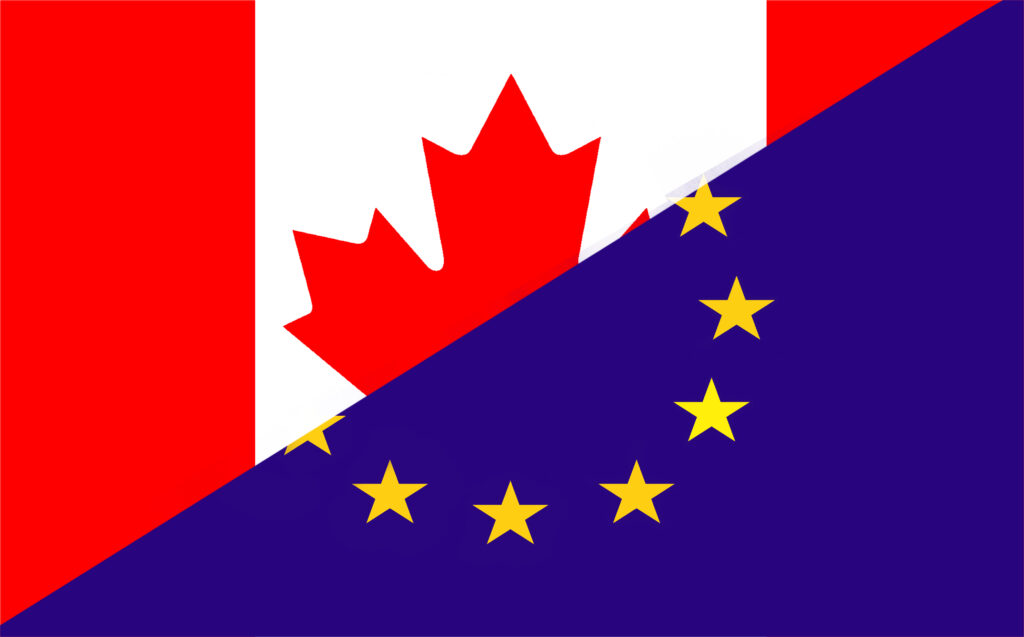
Could Canada become the 28th member of the European Union, thereby replacing the United Kingdom, which left in 2020? This scenario is legally impossible, as Canada is not situated on the European continent, which is an essential condition for membership. Nevertheless, the political, geopolitical and economic rapprochement between the European Union and Canada remains remarkable.
The Canadian Prime Minister, Marc Carney, attended the State of the Union address delivered to the European Parliament by Commission President Ursula von der Leyen on 16 September. This address is intended to mirror the traditional – though much more widely followed – State of the Union address delivered by the President of the United States every January. The following day, Marc Carney addressed the European Parliament, where he was warmly applauded.
Forty-eight hours later, he was received by President Macron in the French territory of Saint-Pierre-et-Miquelon, situated off the coast of Canada. They demonstrated their close rapport and solidarity. The Canadian Prime Minister called for the swift conclusion of a free trade agreement between the European Union and Canada.
How can such a strong rapprochement be explained?
In reality, it is Donald Trump who is acting as a catalyst and amplifier of this phenomenon. Canada is often perceived as a European country, situated on the American continent. It shares the same values as European countries, the same civilisational foundations, the same commitment to multilateralism and international law, and it lacks the capacity to be an imperial power like the United States. There is also a strong bond linking Canada to the United Kingdom and France. This closeness is based on long-standing colonial ties, which were dissolved in a harmonious and non-confrontational manner.
Canada and the Europeans are allies of the United States within the Atlantic Alliance, and both are dismayed by Donald Trump’s attitude towards Washington’s traditional partners. For the US President, the alliance is a source of automatic obligations from which he wishes to free himself, as he believes it undermines his country’s sovereignty.
Furthermore, he has openly declared his intention to annex Canada and Greenland, which belongs to Denmark, a member state of the European Union.
In a map he published recently, the French territories in the Caribbean and Saint Pierre and Miquelon are also shown as part of the United States.
These attacks by Washington explain the idea that a united front is needed to resist an ally that could turn into a predator.
On 20 January, Marc Carney delivered a much-noted speech at the Davos Summit, calling for an alliance of middle powers to stand up to the imperial powers – an alliance in which he also included Russia and China.
He has even shown greater resolve than the Europeans. The latter have accepted an unequal trade agreement under which US exports to Europe are not subject to tariffs, whilst European exports to the United States are subject to a 15 per cent tariff. In contrast, when Donald Trump decided to impose a 50 per cent tariff on Canadian goods, Mark Carney stated that he would do the same ‘to the last dollar’.
This is an extremely bold move on his part, given that Canada’s economy is heavily dependent on the US market, which accounts for 75 per cent of Canadian exports. Marc Carney wants to diversify the economy and has managed to reduce this figure to 70 per cent.
Canada and the European countries hope that by presenting a united front, they will carry more weight with Washington.
That did not stop Donald Trump from announcing last week that he had taken full control of Greenland. That is a very peculiar way of putting it. The United States already had military bases on the territory, and the agreement signed still recognises Denmark’s full and complete sovereignty over it. It stipulates that there will be no Russian or Chinese military bases in Greenland, which was inconceivable to Copenhagen in any case.
The Europeans have decided to let Trump have his media moment, the main thing for them being that he is becoming increasingly unpopular with the public, both in Europe and in Canada.
Governments are therefore making the best of a bad situation, believing it is essential to maintain ties with the US president, even if this involves a few setbacks.
This article has been translated from French into English using artificial intelligence.