
Analyses / Geopolitical Observatory of the Post-Soviet Space (French only)
18 March 2026
The “Narva People’s Republic”: Estonia in Russia’s crosshairs?
-

Senior Research Fellow at IRIS, Head of the Sport and Geopolitics Programme
Since March 2026, the idea of a hypothetical “Narva People’s Republic” on the Estonian border has been circulating across Russian-speaking social networks. Memes, fictional flags, coats of arms… all the ingredients are there. While these digital provocations are reigniting tensions between Russia and Estonia, this informational staging raises a question: could Narva become a laboratory for the hybrid warfare conducted by Moscow in the Baltic States?
Narva, a geopolitical border under tension
Since the beginning of March 2026, an unusual narrative has been circulating in the Russian-speaking digital sphere. On Telegram, VK and TikTok, several accounts have referred to the emergence of a so-called “Narva People’s Republic”, modelled on the People’s Republics of Donetsk and Luhansk in eastern Ukraine. Imaginary flags, stylised maps, pseudo-military insignia and political memes make up the iconography of a fictional state whose contours immediately recall the separatist entities that have emerged across the post-Soviet space since the end of the Cold War. At first glance, the affair could appear almost amusing: a few hundred subscribers, visuals that are sometimes ironic and a deliberately provocative aesthetic. Yet here, geopolitical fictions are taken seriously in the era of the war in Ukraine.
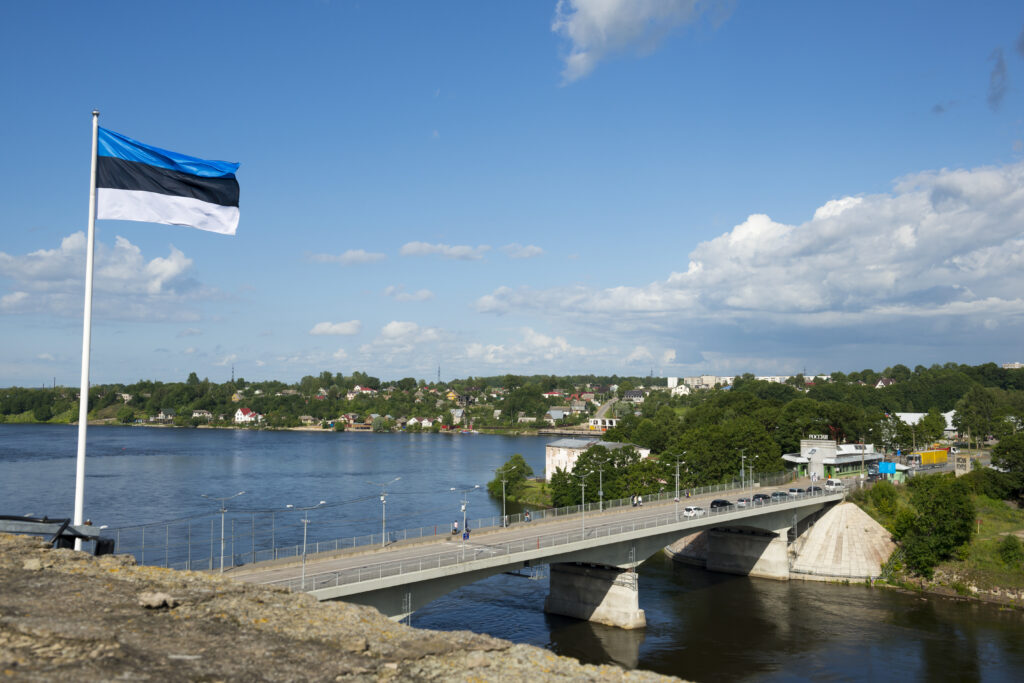
Narva is not a city like any other. Located in the far east of Estonia, it marks the eastern border of the European Union and the North Atlantic Treaty Organisation (NATO). Its eponymous river separates the city from the Russian town of Ivangorod. Vestiges of an imperial past that has now become a strategic fault line, two medieval fortresses face one another on either side of the river. Since the invasion of Ukraine in 2022, this border landscape has taken on a new significance. Narva has become one of the main observation points for tensions between Russia and the West. The city has around 55,000 inhabitants and possesses a major demographic characteristic: its population is overwhelmingly Russian-speaking. According to data from the 2021 Estonian census, barely 2% of inhabitants declare Estonian as their mother tongue. A direct legacy of the Soviet era, Narva was in fact an industrial centre that attracted labour from different republics of the USSR. Since the restoration of Estonia’s independence in 1991, the question of the political and linguistic integration of this Russian-speaking population has remained a sensitive issue. Moscow has never hesitated to mobilise the rhetoric of protecting its “compatriots abroad”, coupled with that of its “near abroad”, in order to denounce what it presents as the marginalisation of Russian speakers in the Baltic States and justify its influence over the post-Soviet space, an argument already used in Georgia and Ukraine. In this context, Narva regularly appears in Western strategic scenarios as a potential point of vulnerability in the confrontation between Russia and NATO.
The digital construction of a “People’s Republic”
It is within this landscape that the narrative of the “Narva People’s Republic” emerged. The content disseminated since March 2026 reproduces, in an almost methodical manner, the imagery of the separatist entities of the Donbas that appeared in 2014. A green, black and white flag appears throughout – sometimes inverted depending on the version – alongside a coat of arms and imaginary military insignia. Certain maps depict the city of Narva or the Ida-Viru region as a territory distinct from the rest of Estonia, while other visuals suggest the abandonment of the city by its Western allies. One of the messages circulated states, for example, that “NATO will not come”. The objective? To sow doubt over whether the Atlantic Alliance would come to defend the region in the event of a crisis.
The dissemination of this content takes place primarily on Telegram before being relayed on VK and TikTok. Some accounts encourage the distribution of leaflets or propose anonymous contact via Telegram bots. One channel entitled “Нарвская Народная Республика” even explicitly claims the provocative dimension of the initiative, asserting that it seeks to “impress” and attract media attention. The analogy with the Donbas “people’s republics” is openly embraced as a central narrative mechanism. For the Estonian authorities, however, the phenomenon remains limited. The Estonian Internal Security Service (KAPO) considers it above all to be a simple and low-cost informational operation designed to provoke and test the reactions of Estonian society. Initial observations appear to confirm this interpretation: the audience of the accounts involved remains relatively small, the content relies heavily on memetic and humorous codes and no sign of structured local organisation has been identified. At this stage, the phenomenon amounts more to a test of informational resonance than to the emergence of a genuine separatist movement. In other words, the objective is less to create a new political entity than to observe the ability of a narrative to circulate, polarise and provoke.
Narva, a laboratory for hybrid warfare
Even marginal, this type of narrative can nevertheless fulfil several strategic functions. It may serve as a political probe, making it possible to measure the reaction of authorities, media and public opinion to a fictional scenario of secession. It may also contribute to polarising internal debate surrounding language policies and the place of the Russian-speaking minority. Finally, it may feed into a broader narrative concerning the alleged discrimination against Russian speakers in the Baltic States, a theme regularly mobilised by Moscow in its strategic communication. In prospective hybrid warfare scenarios, Narva moreover appears as a textbook case. A Russian-speaking city located on the Russian border and at the heart of a NATO member state constitutes an ideal environment for testing strategies of ambiguous destabilisation. A local incident, whether demonstrations, acts of sabotage or the presence of unidentified forces, could create a situation in which informational confusion precedes political escalation.
In order to determine whether this narrative remains a simple digital phenomenon or forms part of a broader dynamic, several signals deserve close monitoring: the transition from digital visual grammar to concrete operational instructions, the amplification of the narrative by high-profile pro-Kremlin relays, the emergence of identifiable local structures or even synchronisation with official Russian discourse on the protection of Russian speakers. For the moment, none of these indicators is truly observable. Consequently, the most probable hypothesis remains that of an opportunistic and low-cost informational provocation, while the idea of a more coordinated influence campaign remains plausible but less likely, and the hypothesis of a pre-signal for physical action remains marginal. In other words, the “Narva People’s Republic” appears for the moment to belong more to the realm of cognitive warfare than to that of insurrectional preparation.
But in contemporary strategies of hybrid confrontation, the battle is often fought long before any military confrontation. It is fought in the informational sphere. Beyond Narva itself, the issue is therefore systemic. A manufactured and deliberately ambiguous crisis could aim not at conquering territory but at testing the cohesion and credibility of the Atlantic Alliance, slowing collective decision-making, complicating the attribution of responsibility and sowing doubt within public opinion. From this perspective, the “Narva People’s Republic” currently resembles a limited digital provocation. But in the post-Soviet space, provocations are never entirely innocent. The question may not be whether Narva will become a new “people’s republic”. The real issue is broader: how far is Russia prepared to test NATO’s red lines in the Baltic States?