
Interviews / Middle East / North Africa
21 September 2026
A New Chapter in the War in Yemen
-

Scientific Adviser at IRIS, Head of the Middle East/North Africa Programme
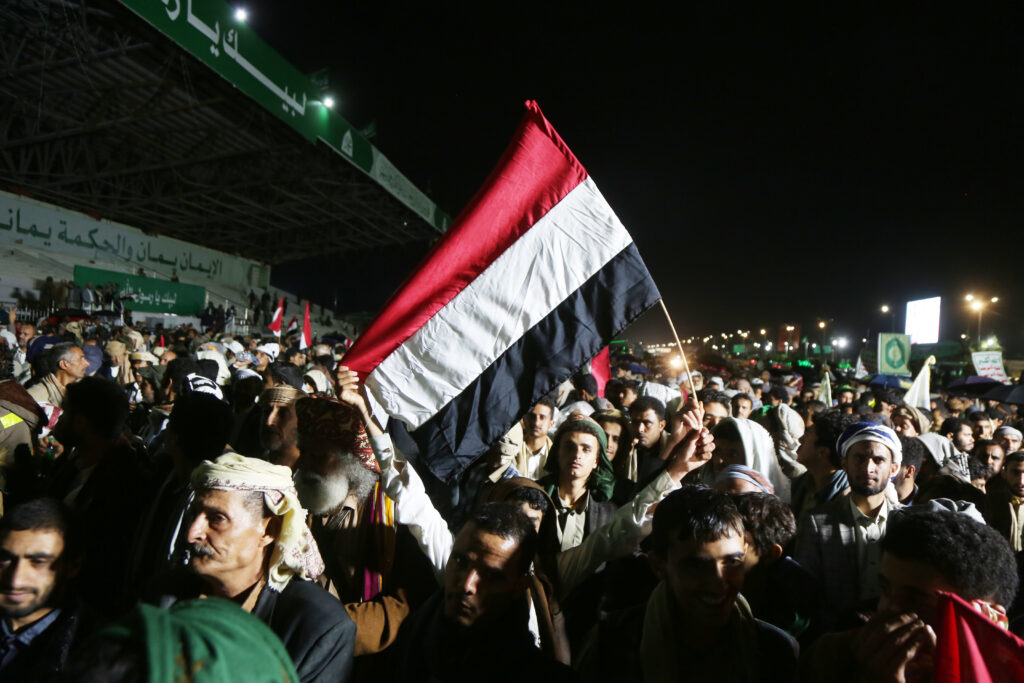
On Friday 11 September 2026, the Iran-backed Houthi rebel group seized control of the Red Sea coastline, including the strategic Bab-el-Mandeb Strait. These military advances, which have been intensifying since July 2026, are raising new questions at an international level. What are the consequences of the strait being blocked for the international community, and more specifically for Donald Trump’s credibility? What are the roots of the Yemeni conflict and its confrontation with Saudi Arabia? Finally, could this latest escalation open up a second front in the region? We take stock with Didier Billion, scientific adviser and head of the Middle East/North Africa Programme at IRIS.
What are the consequences of the Houthis taking control of the Bab el-Mandeb Strait? How does the blockade of this second strait undermine US credibility in the Middle East, particularly in the run-up to the mid-term elections?
In the short term, the consequences could prove to be of considerable significance for the global economy. It is worth noting that around 20 per cent of commercial maritime freight passes through this strait, given the large number of ships that use it to sail up the Red Sea and then through the Suez Canal. Furthermore, maritime traffic flows are also directed from north to south, as, following the partial blockade of the Strait of Hormuz, the Saudi authorities had decided to export as much of their oil as possible via the kingdom’s eastern ports towards the Indian Ocean and Asia. The Houthis’ takeover of Bab-el-Mandeb jeopardises this option, which is bound to push up the price of a barrel of oil on international markets even further.
It should be noted that the Houthis’ ban on the passage of ships currently applies only to vessels flying the Saudi or Israeli flag – or linked to the interests of those two states. Furthermore, a specific agreement has been reached between the United States and the Houthis guaranteeing freedom of passage for US ships. It is easy to see why the Trump administration is trying by every means possible to counter the negative effects of soaring oil prices on how voters will cast their ballots in the mid-term elections, scheduled for 3 November.
Apart from the blockade of Saudi ports, the Houthis have been accused by Riyadh of launching a drone attack on Mecca. What are the historical roots of this conflict between Saudi Arabia and the Houthi militias, and how has the balance of power between the two sides evolved?
This information has been categorically denied by the Houthis. These conflicting accounts are typical of wartime propaganda, and it is difficult to ascertain the truth of the matter. Nevertheless, given that part of their identity is clearly linked to the Islamic faith, it seems unlikely that the Houthis would have deliberately targeted Islam’s holy sites. On the contrary, they have bombed the capital, Riyadh, in the last few hours.
Before even addressing Saudi Arabia’s conflict-ridden relationship with the Houthis, it is worth recalling the Saudis’ wariness towards Yemen. Yemen, a country with a long history and the most populous Arab state on the Arabian Peninsula, is made up of turbulent tribes and clans resistant to any central authority, and has long been viewed with suspicion by the Saudis. It is claimed that Ibn Saud – the first king of modern Saudi Arabia, who died in 1953 – is said to have declared on his deathbed that ‘the kingdom’s happiness lies in Yemen’s misery’ … Whilst doubts remain as to the authenticity and accuracy of the quote, it nevertheless provides a fairly clear indication of the nature of the relationship between the two countries.
As far as the Houthis are concerned, the current conflict is more specifically rooted in recent history and is linked to the wave of Arab uprisings of 2011–2012. Yemen was then undergoing a genuine democratic transition, notably with the election of a new president, Abdrabbo Mansour Hadi, in 2012. Perceiving themselves as marginalised within the new power structure, the Houthis organised yet another uprising against the newly elected Yemeni authorities, advanced across part of the country and captured the capital, Sana’a, in September 2014. The elected president and his government then sought refuge in Saudi Arabia, and subsequently in Yemeni regions ‘secured’ by Saudi Arabia. It was in the wake of these events that the young and inexperienced Mohammed bin Salman, who at the time had only just earned his stripes as Minister of Defence – and who, incidentally, was very poorly advised by Mohammed bin Zayed, Crown Prince of Abu Dhabi – formed a coalition of around ten Arab countries and attacked Houthi positions. The Saudi campaign, conducted exclusively by air, quickly became bogged down but caused considerable damage. The toll to date is appalling: 400,000 dead, 2.5 million displaced, and two-thirds of the population dependent on humanitarian aid that is only reaching them with great difficulty.
A truce between the warring parties was agreed in April 2022, but the ensuing negotiations have stalled. The internationally recognised government – represented by the Presidential Executive Council – is deeply divided in the face of a united and demanding Houthi bloc. In July 2026, the truce is officially broken, leading two months later to the Houthis taking control of the Bab el-Mandeb Strait. The Houthis, initially driven by both anti-imperialist demands and a Zaidi sectarian identity – a branch of Shia Islam dating back to the 8th century AD – also express a patriotic response to what is perceived by part of the population as foreign aggression.
What are the regional implications of this offensive? Given the fragmented nature of the Middle East, could this latest escalation open up a new front in the region?
Despite a complete asymmetry in military strength, these events demonstrate, first and foremost, once again that para-state organisations are capable of resisting and securing victories against forces that are, in theory, infinitely more powerful than themselves. This does not detract from the fact that the Houthis suffer from fragile authority within Yemen, not only because of sectarian factors, but also because of the country’s deeply fragmented sociological reality. Ali Abdallah Saleh, who led the country for 33 years (1978–2012), explained that ‘governing Yemen is like dancing on a nest of snakes’.
Furthermore, contrary to many hasty commentaries, the latest political developments show that the forces of the ‘Axis of Resistance’ – that is to say, all the forces aligned with Iran – are certainly weakened but far from being wiped out. The fact, for example, that the Saudi east-west oil pipeline was bombed by Iraqi Shia militias in support of the Houthis is a fairly clear indicator of the prevailing situation and of the coordination that exists between these groups.
Whilst the religious dimensions of this conflict cannot be denied, the main root cause of the conflicts lies, above all, in political and geopolitical power struggles. The Sunni–Shia divide as the primary framework for explaining conflicts in the Middle East simply does not hold water.
Whilst we may consider that a new phase in the war between the Houthis and Saudi Arabia has just begun, the events of recent days are still part of the course of the war that began in 2015, which will not have a purely military outcome. This underlines the urgency of a political solution and the implementation of a ceasefire as soon as possible. Donald Trump’s refusal to provide military assistance to Saudi Arabia, despite requests from Mohammed bin Salman, will certainly force the latter to resume negotiations with the Houthis, who, for their part, will raise the bar on their demands.
Finally, in addition to purely domestic issues and the Houthis’ own political agenda, their advance also forms part of the Islamic Republic’s regional policy. In this sense, taking control of the Bab-el-Mandeb Strait is a strategic boon for Iran and provides an additional lever to revive genuine negotiations with the United States. The war launched by the United States and Israel on 28 February 2026 has undoubtedly been an absolute fiasco.
This article has been translated from French into English using artificial intelligence.