
Interviews / Asia-Pacific
18 May 2026
Trump’s visit to Beijing: a failure foretold?
-

Senior Research Fellow, co-Head of Asia-Pacific Programme, IRIS
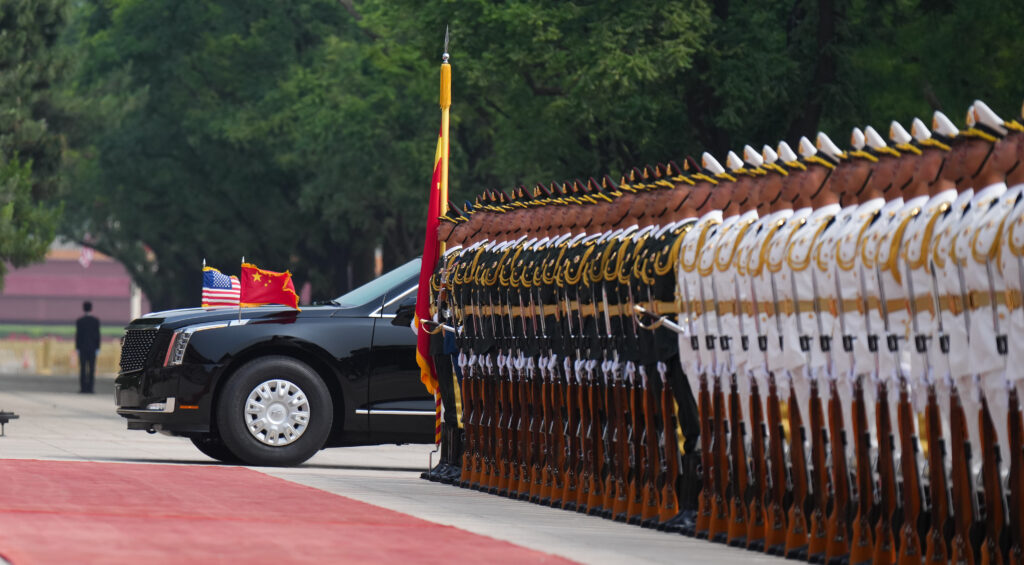
Donald Trump’s visit to China, on Wednesday 13 May, takes place in a particularly tense international context, marked both by the conflicts in the Middle East and by the intensification of rivalries between Washington and Beijing. Postponed following the outbreak of the war in Iran, this visit comes a few days before Vladimir Putin’s arrival in Beijing, at a time when the strategic rapprochement between Russia and China continues to strengthen. Beyond the Iranian issue and Beijing’s close ties with Tehran, this meeting is particularly important given the many sources of tension between the two powers, from trade disputes and technological issues to the sensitive question of Taiwan. What can be taken from Donald Trump’s visit to China? What were the main issues addressed by the two leaders? And what consequences could this diplomatic meeting have for US policy towards Taiwan and for regional stability? Emmanuel Lincot, Senior Research Fellow at IRIS and co-head of the Asia-Pacific Programme, explains.
In what context is Donald Trump’s visit to China taking place?
This is Donald Trump’s second visit to China since 2017. It should be recalled that this state visit had initially been postponed a month ago by the Americans because of the war in the Middle East. The visit comes only a few days before Vladimir Putin’s trip to Beijing, on 19 and 20 May.
In retrospect, we can already say that Donald Trump’s trip to the Chinese capital has been a failure. Only two hundred Boeing aircraft were sold, whereas the sale of five hundred aircraft had initially been expected. No contracts were signed in the grain sector or in high tech, although seventeen business leaders, including Elon Musk, were part of the presidential delegation. Donald Trump may have publicly declared that Xi Jinping was a “friend”, but that view quite clearly appears to be his alone, given how firm, even threatening, Xi Jinping was about Washington’s stance on Taiwan. The American President also found that his hopes of securing greater cooperation from China on the Iranian issue had come up against a wall. With regard to Iran, Donald Trump will therefore have to “pursue diplomacy by other means”, to borrow Clausewitz’s language, by once again choosing war. As with the conflict in Ukraine, China can only welcome this. By materially assisting the Russians and the Iranians through the supply of components needed to assemble drones, while continuing to put forward peace plans that the belligerents nevertheless reject, China is watching the world’s leading power become bogged down.
All eyes are now naturally turning towards China, including those of the countries of the European Union, France among them. This is all the more the case as China feels vindicated in the choices it made more than twenty years ago in favour of the green transition, and will seek to develop alternative corridors to secure its energy supplies. Among these corridors is the route through the middle regions of Eurasia, namely the Caucasus, which explains China’s strong rapprochement with countries deemed strategic, such as Azerbaijan and Turkmenistan.
What bilateral and international issues were raised during this meeting, and what conclusions can be drawn from it?
There has been no significant progress. For Donald Trump, the conclusion is clear: he must now strike a major blow against Iran in order to extricate himself from this quagmire as quickly as possible, and in doing so indirectly deal a blow to the Chinese economy. For even though around thirty Chinese ships managed to pass through the Strait of Hormuz unhindered, oil imports from the Middle East have become much scarcer, and the impact is being felt in China’s plastics factories.
Vladimir Putin’s visit to Beijing, for its part, will lead to a strengthening of the partnership between the two countries, perhaps even to the realisation of the much discussed Power of Siberia 2, the gas pipeline intended to connect Russia and its oil and gas fields, via the Altai, to the province of Xinjiang. This would mean a renewed drive to strengthen interconnections between China and the western and northern regions of Central Asia.
The question of Taiwan remains a major point of tension between Washington and Beijing, particularly over the sale of US arms to Taiwan. What influence could this visit have on US policy towards the island and on regional stability?
There was a noticeable degree of tension on Xi Jinping’s part over the Taiwan issue, as he warned his American counterpart against taking any action that would run counter to Chinese interests. Does this firm verbal warning suggest that the Chinese are ultimately not ready to take military action? That is not impossible. The dismissal of He Weidong, Chief of Staff responsible for Taiwanese strategic affairs within the People’s Liberation Army (PLA), and the recent announcement that former Defence Minister Li Shangfu has been sentenced to death, help explain Xi Jinping’s highly unusual nervousness on this issue, especially as it was expressed publicly. On the return flight, Donald Trump in turn warned Taiwan against proclaiming independence. Does this mean that he will have to give up honouring the Taiwan Relations Act, in force since 1979, and the export of US weapons to the island? That is far from certain.
In any case, Xi Jinping has offered reassurance to a highly nationalist section of Chinese opinion by adopting a combative stance, whereas in my view the most likely scenario for relations across the Taiwan Strait is the economic strangling of the island, rather than the use of force.