
Interviews / Asia-Pacific
13 June 2026
China–North Korea Summit: Why Is China Seeking to Strengthen Its Partnership with North Korea?
-

Senior Research Fellow, co-Head of Asia-Pacific Programme, IRIS
Chinese President Xi Jinping travelled to North Korea on 8 June for a summit with North Korean leader Kim Jong-un. Since the beginning of the war in Ukraine, Pyongyang has significantly strengthened its cooperation with Moscow, particularly in military and diplomatic terms, contributing to heightened tensions in the region. Through this visit, China is seeking to consolidate its alliance with North Korea in order to preserve its influence in the region and assert its power regarding Russia. At the same time, North Korea’s continued pursuit of its nuclear programme and ballistic missile tests represents a growing threat to neighbouring countries and regional stability. What conclusions can be drawn from the Chinese President’s visit to North Korea? What strategic objectives is China pursuing in response to the rapprochement between Moscow and Pyongyang? What consequences could strengthened Sino–North Korean cooperation have for regional security? Insights from Emmanuel Lincot, Research Director at IRIS and Co-Director of the Asia-Pacific Programme.
How would you assess the current state of Sino–North Korean relations and what were the main political, economic, diplomatic and security issues at stake in this meeting between Xi Jinping and Kim Jong-un?
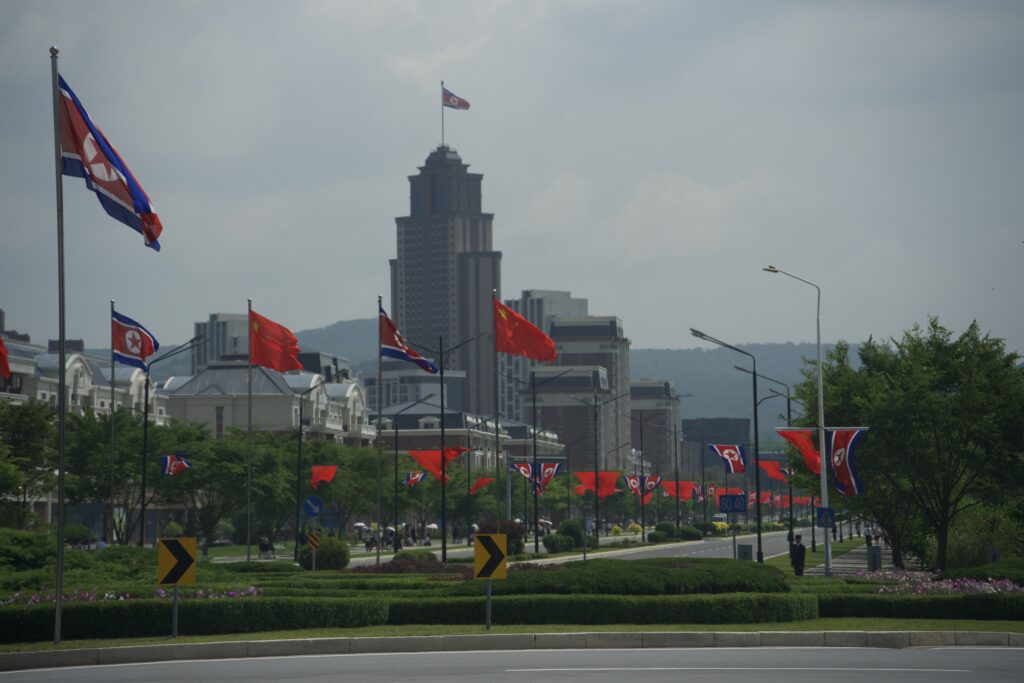
This meeting took place on 8 and 9 June in Pyongyang. On the Chinese side, it was prepared by the Party Affairs Department, a specific branch of foreign affairs largely managed by the intelligence services. It was the Chinese leader’s first foreign visit since the beginning of the year. Xi Jinping and Kim Jong-un had already met in the presence of Vladimir Putin on 3 September last year in a display of strength staged in Tiananmen Square, officially to commemorate the end of the Second World War and victory over Japan, and to remind Pyongyang that it should not slip from China’s orbit solely for the benefit of Russia. Moscow’s setbacks on the Ukrainian front have cemented an unprecedented rapprochement between Pyongyang and the Russian capital and, at the risk of being marginalised, Beijing clearly understood that China could find itself excluded from the strategic competition unfolding in North-East Asia, at a time when its relations with Japan continue to deteriorate month after month. In any event, Pyongyang now finds itself at the centre of both Russian and Chinese attention. This triumvirate is taking advantage of US difficulties in the Middle East to strengthen cooperation involving the delivery of North Korean weapons to Russia in exchange, in all likelihood, for Russian assistance in the construction of nuclear submarines. As regards Sino–North Korean relations, these have now become more transactional than hierarchical. Xi Jinping is seeking to rebalance the relationship at a time when Kim Jong-un has gained diplomatic autonomy and increased international standing. This state visit also provides Beijing with an opportunity to promote North Korea as a tourist destination, thereby strengthening Pyongyang’s economic dependence on China. In short, the visit serves simultaneously as an exercise in political courtship towards Kim Jong-un, an attempt to reassert Chinese primacy in relation to Russia, and a means for Beijing to maintain its influence in a region undergoing major geopolitical change. An interesting detail: Xi Jinping, accompanied by his wife Peng Liyuan and visibly captivated by the socialist realist choreography staged in honour of the Chinese presidential couple, appeared publicly for the first time with greying hair and was seen conversing with Kim Jong-un while wearing glasses. From a protocol perspective, this was no doubt intended to convey, in both a paternalistic and Confucian register, that the Chinese leader retained authority over his younger North Korean counterpart.
Against the backdrop of growing ties between Moscow and Pyongyang, what objectives is China pursuing through strengthening its relationship with North Korea?
North Korea has repeatedly reaffirmed that its status as a nuclear power is “irreversible”. Xi Jinping, while praising the “invincible” friendship between the two countries forged during the conflict between the North and the South of the peninsula from 1950 to 1953, emphasised the need for regional stability. Although China has traditionally supported denuclearisation, it now appears to accept the fait accompli of North Korea’s nuclear programme while seeking to prevent any escalation of tensions. For Pyongyang, reunification with the South is no longer being discussed. This is a troubling signal directed at Seoul. Any attempt at reconciliation with its “enemy brother” now appears destined to fail. Relations between China and North Korea are also tied to significant economic interests, including intensified commercial air links and the development of border port areas, particularly Dandong–Sinŭiju. This is a major logistical hub for North Korea, used for importing oil and other goods. The Ponghwa oil refinery, located in Sinŭiju itself, processes part of the crude oil imported from China. The development of tourism infrastructure in the city of Samjiyon was almost certainly discussed. In the same spirit, the Masik Mountain ski resort is ultimately expected to welcome a substantial flow of Chinese tourists. These projects form part of Kim Jong-un’s “Byungjin” economic doctrine, based on the parallel development of the economy and nuclear weapons. It should be recalled that trade with China still accounts for by far the largest share of North Korea’s total foreign trade. Conversely, China will eventually need to secure its access points along the North Korean coastline in order to make use of the Arctic route linked to the Polar Silk Road through Siberia.
To what extent could a strengthening of the Sino–North Korean alliance affect strategic balances across Asia?
This is indeed an alliance that has been in force since the signing of the Treaty of Friendship, Cooperation and Mutual Assistance in 1961. In the event of aggression, China is obliged to provide military assistance to North Korea, and vice versa. Xi Jinping reportedly told his host that he was ready to “maintain close strategic communication and continue guiding relations between China and North Korea to new heights”, according to China’s official news agency Xinhua. He added that “both sides should strengthen their diplomatic, police and military exchanges”. This means that Beijing is distancing itself from Washington’s objective of pursuing denuclearisation of the peninsula. This position reflects China’s determination to preserve a stable buffer state facing US forces in South Korea and to consolidate its alliance with Pyongyang. In short, China is implicitly recognising North Korea as a nuclear power while seeking to avoid any regional conflict that could threaten its interests. Unlike in 2019, when Kim Jong-un still hoped to negotiate with the United States through China, the situation has evolved: North Korea is now focusing on strengthening its nuclear arsenal and is no longer seeking to normalise relations with Washington. This approach reduces diplomatic room for manoeuvre for the Americans, who must contend with a more cohesive Sino-Russian bloc. Japan fears that this strengthened alliance between China and North Korea could encourage Pyongyang to continue missile testing, some of which has already passed over Japanese territory, and to disregard international sanctions with China’s tacit support. The resumption of rail and air links between the two countries in 2026 is also viewed as a way of circumventing economic pressure imposed by the United Nations. Finally, Xi Jinping’s visit forms part of a broader dynamic in which Beijing, Moscow and Pyongyang are seeking to present a united front against the West, further isolating Japan and South Korea in their hard-line policy towards North Korea, which in this context reiterated that its status as a nuclear power was “absolutely non-negotiable”. In other words, in Tokyo the Pyongyang meeting is viewed as an alarming signal of the consolidation of a Sino–North Korean bloc, or even a Sino–Russian–North Korean bloc, one that destabilises the regional balance and directly threatens Japan’s security. The nuclear issue remains the principal source of tension, accompanied by a sense of powerlessness in the face of Chinese inaction on the matter.