
Analyses / Political and Geostrategic Observatory of the United States
2 June 2026
Trump and Africa: From Trade to Deportations
-

Associate Research Fellow, IRIS
The Trump administration has outlined the main elements of its “America First” policy toward Africa. The focus is on the principle of “trade rather than aid,” with priority given to U.S. access to African rare earths and primary resources, cooperation with certain partners in the health sector, conflict-resolution efforts in select areas (notably in the Democratic Republic of the Congo and Sudan), and collaboration with African partners in combating terrorist threats. Given the importance of this issue to the president and his team, immigration has also become a major priority in Washington’s relations with the continent.
Most notably, the administration has sought to drastically reduce the number of African immigrants coming to or residing in the United States. In January 2026, the U.S. government unilaterally suspended the issuance of all visas to nationals of eleven sub-Saharan African countries and imposed a partial ban on fourteen others. These measures apply to both visitor and immigrant visas and affect some of the United States’ most important partners in the region (Angola, Nigeria, Senegal, Tanzania, etc.). Even where visitor visas can still be issued to Africans, the administration has introduced particularly restrictive new restrictions. In Nigeria, for instance, applicants whose visas are approved must now post a $15,000 bond before their visas are issued. The deportation of Africans already present in the United States has also increased significantly under Trump. These policies clearly run counter to other stated U.S. objectives in the region, particularly the strengthening of economic ties, but they fit perfectly within the broader framework of Trump’s domestic agenda.
Surprisingly, Africa also plays a role in Trump’s global immigration policy. The administration, with direct support from the president himself, has actively sought African partners willing to accept deportees from third countries, even when those individuals have no connection to the receiving country—or even to Africa itself.
This practice is generally legal under U.S. immigration law, although there are certain exceptions where it is not. In 2025, the Supreme Court upheld the government’s authority to carry out such deportations; more recently, a lower court ruled that immigrants must be given time to challenge removal to a third country, although this case remains under review. International law does not prohibit this type of deportation either, provided there is no substantial risk of persecution or torture. Trump administration officials may have been inspired by a 2022 British proposal, supported by Boris Johnson’s government, to deport large numbers of third-country nationals to Rwanda in exchange for hundreds of millions of pounds in British aid. (That policy was ultimately abandoned following legal challenges and the Conservative Party’s loss of power.)
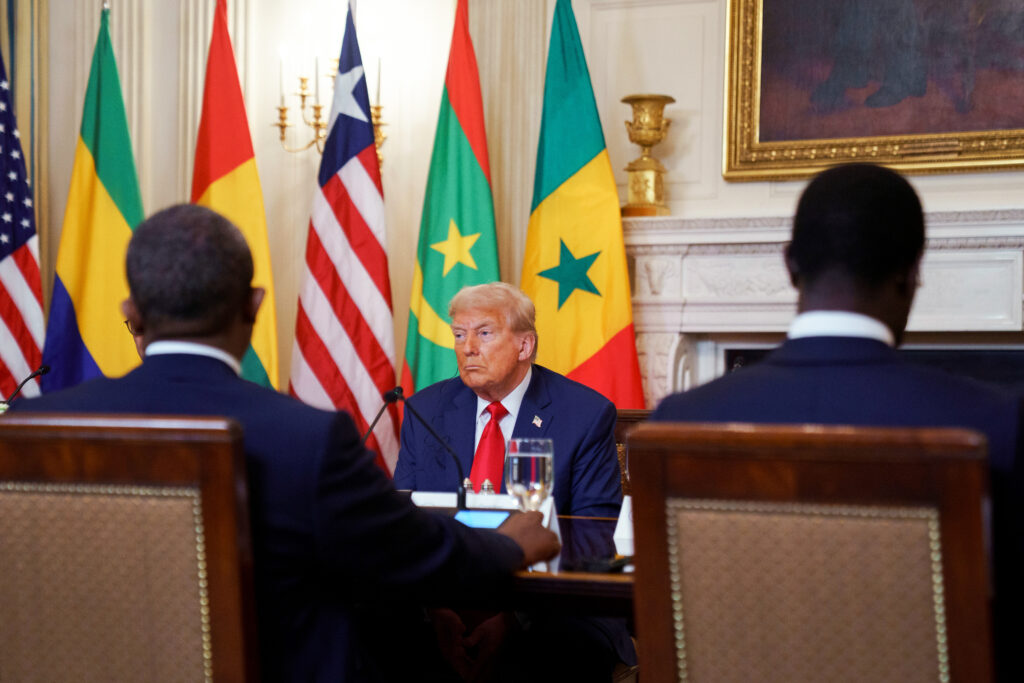
So far, the administration has reached agreements with at least seven African countries, although the State Department has provided few details. These include Rwanda, South Sudan, Eswatini, Uganda, Ghana, Cameroon, and the Democratic Republic of the Congo. Media reports also indicate that Equatorial Guinea, Sierra Leone, and Liberia may have agreed to receive deportees from the United States. These arrangements include modest amounts of U.S. assistance — typically between $5 million and $7 million — to support the reception of deported individuals. President Trump reportedly promoted third-country deportations personally during his July 2025 “mini-summit” in Washington with the leaders of Mauritania, Gabon, Senegal, Guinea-Bissau, and Liberia. However, the number of deportations carried out under these agreements appears to be limited so far, probably amounting to only a few dozen people per country at most.
Given that the administration is seeking to deport thousands of immigrants every day, why devote so much effort to only a handful of removals to Africa? There are several plausible explanations.
Firstly, exile to Africa has a deterrent effect. Regardless of the actual number of immigrants deported to the continent, many prospective migrants may be frightened by the possibility. A young Mexican or Venezuelan seeking a new life in the United States might be willing to risk being sent back to their home country—or even to a neighbouring country they are familiar with—in pursuit of the American dream. That calculation may change dramatically if arrest by ICE means being sent to a distant African country with uncertain human-rights protections.
Secondly, the administration is almost certainly seeking to develop reception capacity in anticipation of possible future needs, particularly in countries that are unlikely to challenge potential abuses. Under intense pressure from the White House and the Department of Homeland Security to deport millions of immigrants, U.S. immigration officials are likely desperate to find places where they can quickly transfer the most problematic cases. One may also assume that they wish to offload responsibility for such cases entirely once individuals arrive on the continent, even if all procedural requirements have not been scrupulously followed. In May, ICE deported a Colombian woman to Kinshasa, despite the Congolese government had previously refused to accept her for health-related reasons. (A U.S. judge later ordered her return to the United States, but it remains unclear whether ICE complied with that ruling.)
Finally, some critics argue that these agreements may be designed to circumvent U.S. or international law. More specifically, they fear that deportations to third countries could subsequently result in removals to states where the individuals concerned face persecution. This concern is especially acute for asylum seekers, who could ultimately be returned to their countries of origin and exposed to the very persecution they had sought to escape. In February 2026, the Democratic minority of the Senate Foreign Relations Committee published a highly critical report on the practice. The authors emphasised that the majority of individuals deported to third countries by the Trump administration were protected by court orders. The report cites cases of protected immigrants who were sent to Ghana and Equatorial Guinea before being returned to their countries of origin later. The judge overseeing those cases stated in her ruling:
“These actions also appear to be part of a broader pattern and a widespread effort to circumvent the legal obligations of the United States government by indirectly doing what it cannot do directly.”alement s’inscrire dans un schéma plus large et dans un effort généralisé visant à contourner les obligations légales du gouvernement américain en faisant indirectement ce qu’il ne peut pas faire directement. »
Follow Jeff Hawkins’ editorials regularly in his series Notes from a State Department Veteran. Hawkins is a former U.S. diplomat and an associate researcher at the Institute for International and Strategic Affairs (IRIS).