Analyses / Political and Geostrategic Observatory of the United States
16 July 2026
The Board of Peace’s “creative ambiguities”
-
Director of Research, IRIS
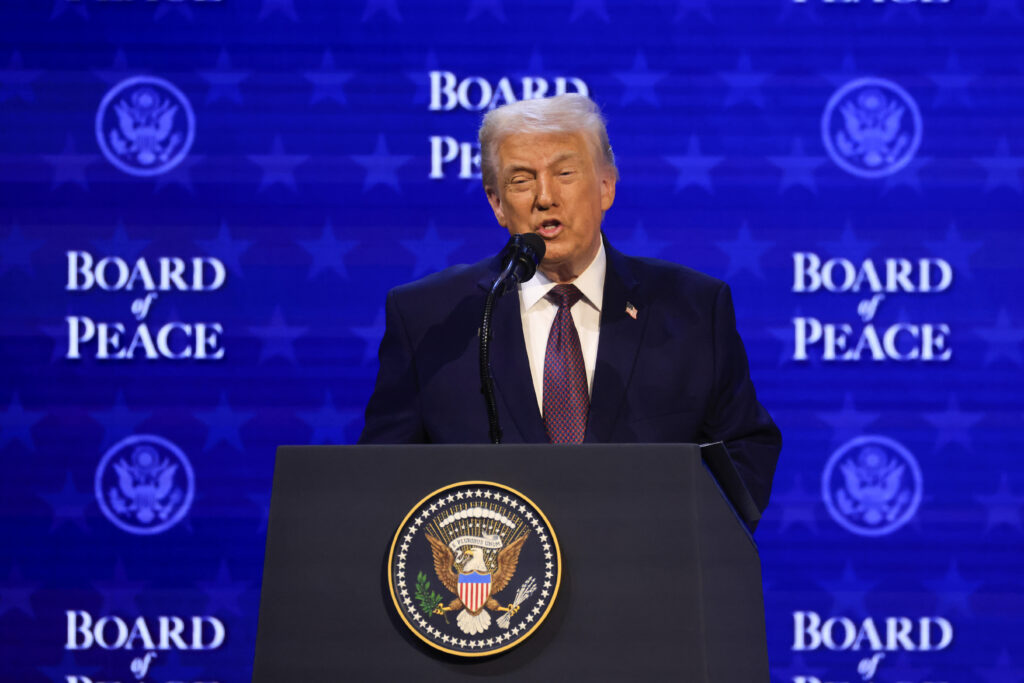
The Board of Peace, inaugurated in Davos on 22 January, derives its legitimacy from United Nations Security Council Resolution 2803 (2025), adopted on 17 November 2025. The resolution “welcomes its establishment” – even though it had not yet been formally established – and presents it as a transitional administration with international legal personality, tasked with guiding the reconstruction of Gaza and coordinating its financing. Yet the Board’s Charter, published in the Israeli press a few days before the World Economic Forum in Davos, makes no mention of either Gaza or the Palestinians, while its preamble calls for “departing from approaches and institutions that have too often failed”. The superstructure, chaired by Donald J. Trump in his personal capacity, rather than in his capacity as occupant of the White House, has been designed as a US alternative to the United Nations: an Assembly of States, an Executive Board composed of individuals appointed directly by Donald Trump, and an International Stabilisation Force (ISF)[1] reminiscent of UN peacekeepers. The UN was, moreover, directly targeted by President Trump in his opening address at the Board’s first meeting in Washington on 19 February 2026. On that occasion, he referred first to the escalators at UN headquarters, which had allegedly nearly caused him to fall, and then to the microphone being cut off while he was at the podium: everything had supposedly been done to sabotage his “wonderful speech”. Clearly, there, in the requisitioned premises of the United States Institute of Peace, renamed in gold lettering the “Donald J. Trump Institute of Peace”, things were much better.
UN legitimacy: the original ambiguity
There is little doubt that the Board of Peace is a US instrument intended to circumvent and hollow out UN multilateralism[2]. It should also be noted that, alongside Ambassador Mike Waltz, the US President appointed another ambassador, Jeff Bartos, to the United States Mission to the United Nations, with a portfolio specifically covering “UN management and reform”. On 30 June, during the pledging conference of the United Nations Relief and Works Agency for Palestine Refugees in the Near East (UNRWA), while the UN Secretary-General called for urgent support for the UN agency, Jeff Bartos urged countries to turn away from it, accusing it in particular of spreading hatred of Jews and glorifying terrorism through its schools, and instead to fund the Board of Peace. In addition to suffocating a UN agency already in jeopardy, the aim is also to replenish the empty coffers of the Trumpian entity. Although 17 billion dollars in donations were announced at the meeting of 19 February, and despite the signing of a declaration by the “founding donor” states (United Arab Emirates, Qatar, Kuwait, Saudi Arabia, Kazakhstan, Uzbekistan, Bahrain, Morocco), as well as an MoU with FIFA, the Board’s official fund, administered by the World Bank, has reportedly received no contributions in practice. According to a Financial Times investigation published on 27 May, the few donations that have materialised have passed through a JPMorgan account, and to date, only funds from Morocco (3 million dollars) and the United Arab Emirates (20 million dollars) have reportedly been mobilised: they are said to be financing the activities of the Board of Peace’s High Representative for Gaza, Nickolay Mladenov, as well as the salaries of the Palestinian technocrats who are members of the National Committee for the Administration of Gaza, incorporated into the Board of Peace and mentioned in the “20-point Trump Plan”, who, to date, have still been unable to enter Gaza. The first ambiguity, which consists of deriving the legitimacy of this Board from Resolution 2803, which clearly describes it as a body whose framework for action is the war between Israel and Hamas in Gaza, even though the Charter establishing it mentions neither Gaza nor Palestine, but is intended at the very least to compete with the UN, is no longer in doubt: it is sufficient to consult, on the one hand, the resolution in question and the Trump Plan appended to it and, on the other, the Charter of the Board of Peace. This ambiguity is compounded by a paradox: having failed to mobilise the promised funding, the promoters of the Board of Peace are seeking to capture funds intended for UNRWA, thereby demonstrating a clear intention to replace a United Nations agency, even though the Board claims its legitimacy from a UN resolution.
A body with an uncertain legal status
In addition to this issue, another dimension calls into question the legal status and legitimacy of the Trumpian Board. The mere fact that the UN resolution on which it relies describes it as a transitional administration with international legal personality is not, in itself, sufficient to confer that status upon it in practice.
Several elements tend to support the view that this represents a problem which the US administration has attempted to circumvent. First, Article 11.2 of the Board’s Charter states that the United States is the depositary of the Charter. All notifications relating to signatory states are, moreover, centralised by the State Department. Second, applications were filed with the United States Patent and Trademark Office (USPTO) to register the Board of Peace’s logo and typography, a US federal agency headed by John A. Squires since his appointment by Donald Trump in March 2025. In a highly unusual development, it was the USPTO itself that had submitted these applications to the USPTO, before reversing course and announcing their withdrawal at the very beginning of July. These elements appear to indicate that the Board does not operate as an international organisation, but as a structure whose management remains largely in the hands of US authorities, administrations and federal agencies.
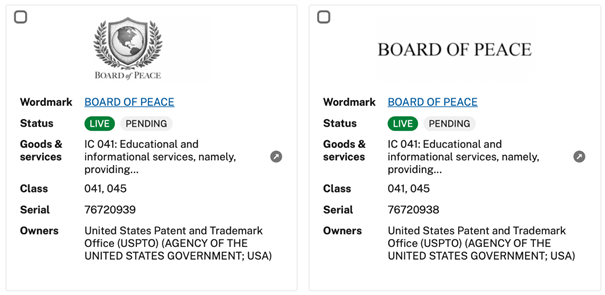
Screenshot taken from the USPTO website on 28 January 2026
Under Article 11.1 (a) of the Board’s Charter, three states must consent to be bound by the Charter before it can enter into force. The first states to express their consent were the United States (21 January), El Salvador (21 January), Morocco, Kuwait and Belarus (22 January). The Charter therefore entered into force on 22 January 2026. Furthermore, a report addressed to the Security Council by the US representative to the UN, Mike Waltz, on 15 May (see below), states: “the Charter was launched at the signing ceremony in Davos, Switzerland, on 22 January 2026, marking the establishment of the Board of Peace as an international organisation”[3]. Yet it was through an Executive Order signed on 16 January 2026, six days before its entry into force and its launch ceremony, that President Trump designated the Board of Peace as a public international organisation entitled to enjoy certain privileges, exemptions and immunities[4]:
By the authority vested in me as President by the Constitution and the laws of the United States of America, including section 1 of the International Organizations Immunities Act (22 U.S.C. § 288), and having found that the Board of Peace is a public international organisation in which the United States participates within the meaning of that Act, it is hereby ordered as follows:
Section 1. Designation. I hereby designate the Board of Peace as a public international organisation entitled to enjoy the privileges, exemptions, and immunities provided by the International Organizations Immunities Act. This designation is not intended to restrict in any manner the privileges, exemptions, or immunities that the Board of Peace has already acquired or may acquire by law.
It should be emphasised here that, in his capacity as President of the United States, Donald Trump, “having found”[5] that the Board is a “public international organisation”, grants privileges, exemptions and immunities to the body that he chairs in a capacity separate from his presidential mandate. Yet the authority granting the privileges, exemptions and immunities and the body benefiting from them are connected through the same person: this overlap inevitably raises questions. It will also be for legal scholars to determine whether the reference to the International Organizations Immunities Act, 22 U.S.C. § 288 is legally founded, and whether the Board meets the criteria required to qualify as an international organisation under US law, even though its establishment and operation remain closely linked to the United States, whose institutional involvement appears difficult to reduce to that of mere “participants” (see Executive Order above).
Although this Executive Order went largely unnoticed, the existence of a Board of Peace resolution [No. 2026/3], which once again raises the issue of immunity, was recently revealed in an article published by The Guardian on 27 June 2026. The status of this resolution remains uncertain and, for the time being, it is not possible to state that it has been adopted or signed. Under its provisions, immunity would be granted to members of the Board, the Office of the High Representative for Gaza (Nickolay Mladenov), members of the national committee of Palestinian technocrats, and members of the ISF. This immunity would protect them from arrest, detention or legal proceedings before Palestinian courts. It would also provide that the Board of Peace could use, free of charge, the public buildings and facilities required to carry out its mission, which could involve the requisition or confiscation of Palestinian public property. Finally, Section 7 of the resolution, entitled “Third-Party Liability / Claims”, establishes a mechanism enabling the Board of Peace to examine and rule on any claim or request for compensation concerning “property loss or damage, as well as personal injury, illness or death” arising from its activities in Gaza.
One might have expected the ongoing war in the Gulf to bring the Trumpian project to a standstill, but this has clearly not been the case. The Board appears to have paid particular attention to consolidating its legal framework even before the effective deployment of the ISF, the entry of the National Committee into Gaza, the Israeli withdrawal and the promised reconstruction. The Board’s ambiguities and lack of transparency appear to constitute a political resource: the initial opacity surrounding its status, composition and scope of action seems to give it a capacity for action and room for manoeuvre that allow it to develop its legal framework and institutional architecture.
An opaque and unfinished architecture
The architecture of the Board has gradually expanded, but it remains subject to change, since Security Council Resolution 2803 authorises it to establish any subsidiary entity deemed necessary for the implementation of the Trump Plan. Members of the executive branch are appointed by Donald Trump as the process unfolds, without any clearly established channel of communication. The first members of the Executive Board were announced on the White House website, while the first states to join the Board were announced on the Board of Peace’s X account, as its official website was not yet operational. The day after the Washington meeting of 19 February, it was on the Board’s newly launched website that it was announced that Suzie Wiles, White House Chief of Staff, was joining the Executive Board, and that the Saudi Foreign Minister, as well as businessman and Benjamin Netanyahu adviser Michael Eisenberg, were joining the Executive Board for Gaza. The appointment last March of the Board’s spokesperson, Brad Klapper, managing partner of the strategic communications firm Qorvis, was not officially announced by the Board. The same applies to departures: it was in The Times of Israel (which had obtained the exclusive publication of the Charter) that it was reported in June, while a Board meeting was being held in Cyprus, that Jason Olson, the director responsible for the deradicalisation of Gaza, was leaving the body: his appointment itself had never been officially announced. These appointments and departures, most often announced in a fragmented manner, without identifiable procedures or transparent institutional channels of communication, reinforce the image of opaque, improvised, even chaotic governance. In his capacity as Chair of the Board, Donald Trump appears to be imposing the communication style he favours elsewhere: fragmentary announcements, disseminated most often outside traditional channels.
Ambiguity as an instrument of flexibility?
This apparent disorganisation does not merely create uncertainty surrounding the functioning of the Board: it may also sustain an ambiguity capable of giving its leaders room for manoeuvre in presenting and managing the arrangement. UN Security Council Resolution 2803 required the Board of Peace to submit a report to it every six months. Accordingly, on 15 May, the United States Permanent Representative to the UN, Mike Waltz, transmitted a letter (S/2026/418) to the members of the United Nations Security Council, to which he attached a report outlining the Board’s achievements since its establishment. Both the substance and the elements highlighted raise questions, but so does the form, beginning with the title: “Annex to the letter dated 15 May 2026 from the Permanent Representative of the United States of America to the United Nations addressed to the President of the Security Council. Implementation of United Nations Security Council Resolution 2803 (2025). Report of the Board of Peace through the Office of the High Representative for Gaza.”
If further confirmation were needed, this method of transmission once again highlights Washington’s predominant role in the operation and representation of the Board. The use of the phrase “Report of the Board of Peace through the Office of the High Representative for Gaza” tends to downplay the centrality of the United States within the arrangement, while also maintaining a degree of confusion: the fact remains that it was Mike Waltz, the representative of the United States, who submitted the Board of Peace’s first six-monthly report to the UN Security Council.
Another point that should be examined is that the annex states that 28 Heads of State are members of the Board of Peace[6]. et Articles 2.1 and 2.2 of the Charter specify the conditions for membership: these apply to states invited by the Chair of the Board, which may be represented only by Heads of State or Government. A state’s membership becomes effective upon “notification of consent to be bound by the Charter”. By presenting “28 Heads of State” as members of the Board, the report creates confusion between membership, which belongs to states, and the representative role exercised by their leaders.
Another ambiguity concerns the actual number of states that have effectively acquired full membership status (with voting rights), as well as the extent of their legal commitment. Chapter XI of the Charter specifies the conditions under which it applies to states required to submit their accession to domestic procedures:
Article 11.1 (b) States whose internal procedures require ratification, acceptance or approval of this Charter agree to apply its provisions provisionally, unless those states have informed the Chair of the Board, at the time of signature, that they are unable to do so. States that do not apply this Charter provisionally may participate in the work of the Board of Peace as non-voting members, pending ratification, acceptance or approval of the Charter in accordance with their domestic legal requirements, subject to the approval of the Chair of the Board.
A state that has not yet completed the necessary domestic procedures may therefore nevertheless be considered a member of the Board. The US State Department monitors the notifications submitted by states invited by the Chair of the Board, but communicates them only retrospectively: there is no consolidated and up-to-date information making it possible to determine clearly which states have, to date, acquired voting membership and which have participatory status without voting rights. Whether concerning its scope of action, its legal status or even the status of its members, ambiguity and a lack of transparency therefore characterise the decisions and appointments surrounding the Board. Furthermore, it appears to be developing according to a logic reminiscent of certain so-called “agile” management methods: structures, appointments and rules are adjusted as the project progresses, through successive iterations. Applied to an organisation intended to exercise multilateral governance functions, this method, specific to corporate management, contributes to maintaining institutional ambiguities whose effects extend beyond mere management “flexibility”.
The gradual redefinition of the UN “mandate”
Since the signing of the “ceasefire” in Sharm el-Sheikh in October 2025, nine months ago, more than 1,110 Palestinians have been killed by the Israeli army. Furthermore, Benjamin Netanyahu recently stated that he had ordered the army to occupy 70% of the Gaza Strip (it already occupies more than 60% of the territory). Yet Point 16 of the Trump Plan states that “Israel will not occupy or annex Gaza”… In reality, only the provision concerning the return of the Israeli hostages was implemented and completed in January 2026; the other points of the Plan have not received the same degree of attention. On 21 May, during his second “briefing” to the UN Security Council, Nickolay Mladenov, the Bulgarian diplomat appointed High Representative for Gaza by Donald Trump, presented a new roadmap for the implementation of the Trump Plan. It is essential to emphasise that this roadmap does not derive from Resolution 2803 and therefore has no UN legitimacy – which is why Mladenov asked the Security Council, during this “briefing”, to “support” it, and why Hillary Clinton recently published an opinion piece advocating the same position. Unlike the Trump Plan and the UN resolution, this roadmap presents the disarmament of Hamas as a prerequisite for the recovery and reconstruction of Gaza. The contradiction here is fundamental, since Resolution 2803 had assigned the ISF, which, although announced, has still not been deployed, the task, among others, of ensuring:
the demilitarisation of the Gaza Strip, including by destroying military, terrorist and offensive infrastructure and preventing it from being rebuilt, as well as ensuring the permanent decommissioning of weapons belonging to non-state armed groups.[7]
Yet nearly eight months after the adoption of the November 2025 resolution, the ISF has still not been deployed, despite commitments to participate made last February by Indonesia, Albania, Kazakhstan, Morocco[8] and Kosovo. Mladenov’s roadmap therefore introduces a discreet but significant shift: by making the disarmament of Hamas a prerequisite for the recovery and reconstruction of Gaza, it imposes a sequencing absent from Resolution 2803, while presenting it as necessary for its implementation. In doing so, it creates a deadlock: the prerequisite it introduces depends on the intervention of a Force provided for in the resolution which, besides the fact that it has still not been deployed, is not expected to be deployed, according to The Wall Street Journal, for several weeks, if not months. Should the announcement by Hamas on 6 July that all its political bodies would be dissolved therefore be understood as a consequence of this new roadmap?
Following the episode of the Charter, which revealed that the scope and purpose of the Board of Peace extend beyond those provided for in the UN resolution, the Board has thus confirmed that it is not merely implementing Resolution 2803 (2025): it is gradually expanding its normative content without any further intervention by the UN Security Council. The question therefore no longer concerns only the ambiguities produced by the Board of Peace, but also those that the Security Council’s silence allows to flourish. Does this silence reflect a form of powerlessness in the face of these developments, or should it be interpreted as tacit consent both to the redefinition of the nature and scope of the Board of Peace, and to the conditions governing the implementation of the resolution it adopted?
[1] The first states to have declared that they would contribute to the ISF are Albania, Indonesia, Kazakhstan, Kosovo and Morocco: https://boardofpeace.org/gaza-pledges
[2] On this subject, see also this interview: https://www.iris-france.org/board-of-peace-ou-trump-world/
[3] See Point 18 of the report: https://www.un.org/unispal/document/implementation-of-united-nations-security-council-resolution-2803-2025-report-of-the-board-of-peace-through-the-office-of-the-high-representative-for-gaza-s-2026-418/
[4]“Executive Order 14375 of January 16, 2026. Designating the Board of Peace as a Public International Organization Entitled To Enjoy Certain Privileges, Exemptions, and Immunities”.
[5] The Executive Order does not state the legal basis on which the President relies in “finding” that the Board is a public international organisation. It may, however, be assumed that he is referring to UN Security Council Resolution 2803: [The Security Council]: “welcomes the establishment of the Board of Peace, as a transitional administration with international legal personality”.
[6] See paragraph 18 of the report: “Twenty-eight Heads of State are Members of the Board of Peace from the following States: the Republic of Albania, Argentine Republic, Republic of Armenia, Republic of Azerbaijan, Kingdom of Bahrain, Republic of Belarus, Republic of Bulgaria, Kingdom of Cambodia, Arab Republic of Egypt, Republic of El Salvador, Hungary, Republic of Indonesia, State of Israel, Hashemite Kingdom of Jordan, Republic of Kazakhstan, Republic of Kosovo, State of Kuwait, Mongolia, Kingdom of Morocco, Islamic Republic of Pakistan, Republic of Paraguay, State of Qatar, Kingdom of Saudi Arabia, Republic of Türkiye, United Arab Emirates, United States of America, Republic of Uzbekistan, and the Socialist Republic of Viet Nam.”
[7] It should be noted here that Point 13 of the Trump Plan states: “Gaza will be demilitarised under the supervision of independent monitors; in particular, weapons will be permanently put beyond use through an agreed process of decommissioning, supported by an internationally funded buyback and reintegration programme, all subject to verification by the independent monitors.”
[8] According to a post published on the Board’s X account on 16 July 2026, Morocco formally signed an agreement to participate in the ISF.