
Analyses / Political and Geostrategic Observatory of the United States
3 March 2026
The Other “State of the Union”
-

Associate Research Fellow, IRIS
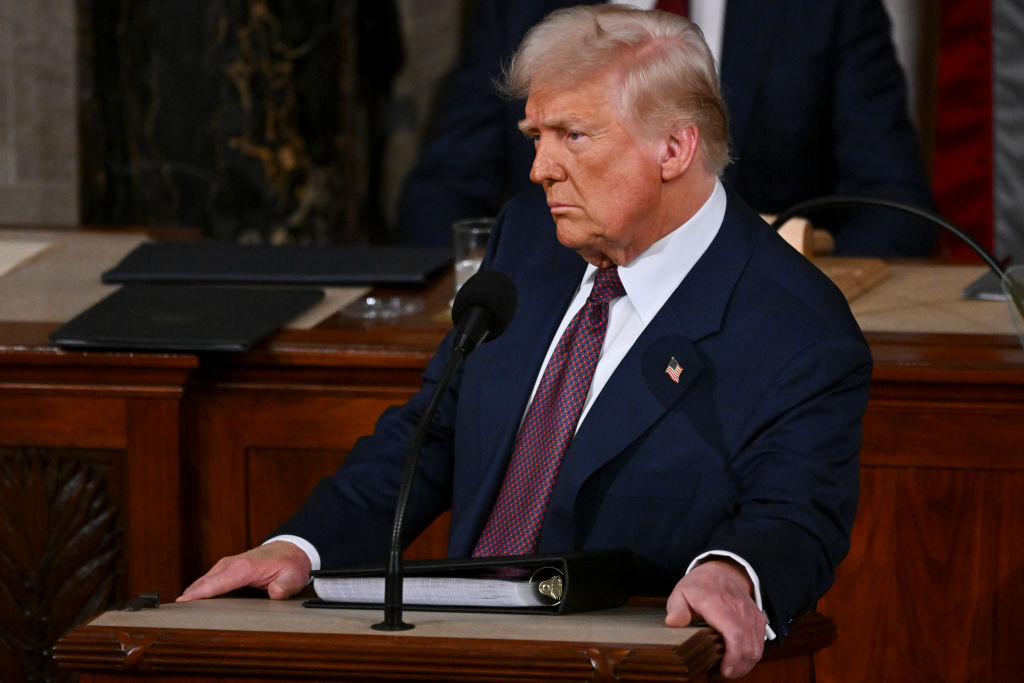
On 24 February, President Donald Trump delivered his annual “State of the Union” address before both chambers of Congress, one year into his second term. The speech was lengthy and disjointed, marked by euphoric self-congratulation and hyperbolic attacks against his opponents, in a style characteristic of the president. The themes addressed came as no surprise to those following the administration: tariffs, immigration, the possibility of “electoral fraud” allegedly committed by Democrats, the president’s economic successes, crime in Democrat-led cities, the risks posed by the Iranian regime, the wars Trump claims to have “ended”, the strength of the US military under his leadership, and so on. As usual, the president boasted of all the “victories” achieved by the American people under his direction.
That same evening, the Democrats delivered their own response. Unlike the presidential “State of the Union” address—which fulfils a constitutional requirement obliging the president to report to Congress “from time to time”—the opposition’s reply is a relatively recent tradition. Since 1966, as television became an increasingly powerful political medium, the party not holding the White House has presented a response to the president’s official address. This year, the Democratic spokesperson, Abigail Spanberger, was tasked by the party leadership in Congress with delivering it. Trump’s speech, which lasted nearly two hours, was the longest in the history of the Republic. Spanberger’s response—around twelve minutes in length—was direct and concise.
The governor’s address, delivered in the chamber of the lower house of the Virginia legislature, reveals much about how Democrats intend to position themselves in the months ahead. What can be drawn from it?
First, the Democratic leadership in Congress does not appear inclined to make waves. Spanberger represented a relatively safe and moderate choice to speak on behalf of the party. A former CIA officer, the Governor of Virginia is a centrist from a Southern state that has gradually become more favourable to Democrats in recent years, and she won her election comfortably last year. The Democratic Party is going through a difficult period, and its leaders are hesitant to take risks in an era shaped by Trumpian upheavals. Yet many younger figures, disappointed by the party’s mixed results in the 2024 elections, have advocated for a more dynamic and populist approach. Combative and uncompromising progressives, such as New York Representative Alexandria Ocasio-Cortez and New York City Mayor Zohran Mamdani, embody the vanguard of this orientation. However, Senate Minority Leader Chuck Schumer and House Minority Leader Hakeem Jeffries have, for the time being, chosen not to pursue this path.
Why? In part because attention is clearly focused on the midterm elections next November. The Republican majority in the House now rests on a single seat, and Democrats hope to regain control of the chamber. They even see a narrow, albeit difficult, path to retaking the Senate. Trump is polling poorly, including on issues that have often worked in his favour, such as immigration and the economy, and historically the party of the sitting president tends to lose seats in midterm elections. Democrats have recently secured several electoral successes, notably the election of Spanberger and that of her gubernatorial counterpart in New Jersey. For congressional leaders, this does not appear to be the moment to jeopardise what could prove a promising performance. This does not, however, mean that the debate is settled as the 2028 presidential election approaches.
Spanberger’s speech also highlighted the Democrats’ line of attack. The governor posed three fundamental questions to her audience: “Is the president working to make life more affordable for you and your family? Is the president working to ensure the safety of Americans, at home and abroad? Is the president working for you?” It is no surprise that she began with the issue of the cost of living, a weakness for Joe Biden and likely to prove one for Trump as well. The president appeared clearly on the defensive on this point and spoke at length about falling prices under his administration, claiming that Democrats were responsible for the problem. She argued that the tariffs imposed by Trump in fact constitute a massive tax on Americans, increasing the cost of goods for consumers.
Spanberger also emphasised the risks associated with the deployment of immigration agents in American cities and warned against the dangers of Trump’s policies towards Iran and China. She further denounced the president’s personal corruption. These are all themes likely to feature prominently throughout the campaign.
Readers can regularly find editorials by Jeff Hawkins, former US diplomat and associate researcher at IRIS, in his Notebooks of a State Department Veteran.