Cartographies / Observatoire géopolitique de l’espace post-soviétique
4 September 2025
The Baltic Sea: A Key Economic Interface amid NATO–Russia Tensions
-

Head of Data, Mapping and Infographics
-

Deputy for Communication
-

Deputy Director of IRIS
-

Head of Publishing at IRIS, Editor-in-Chief of La Revue internationale et stratégique
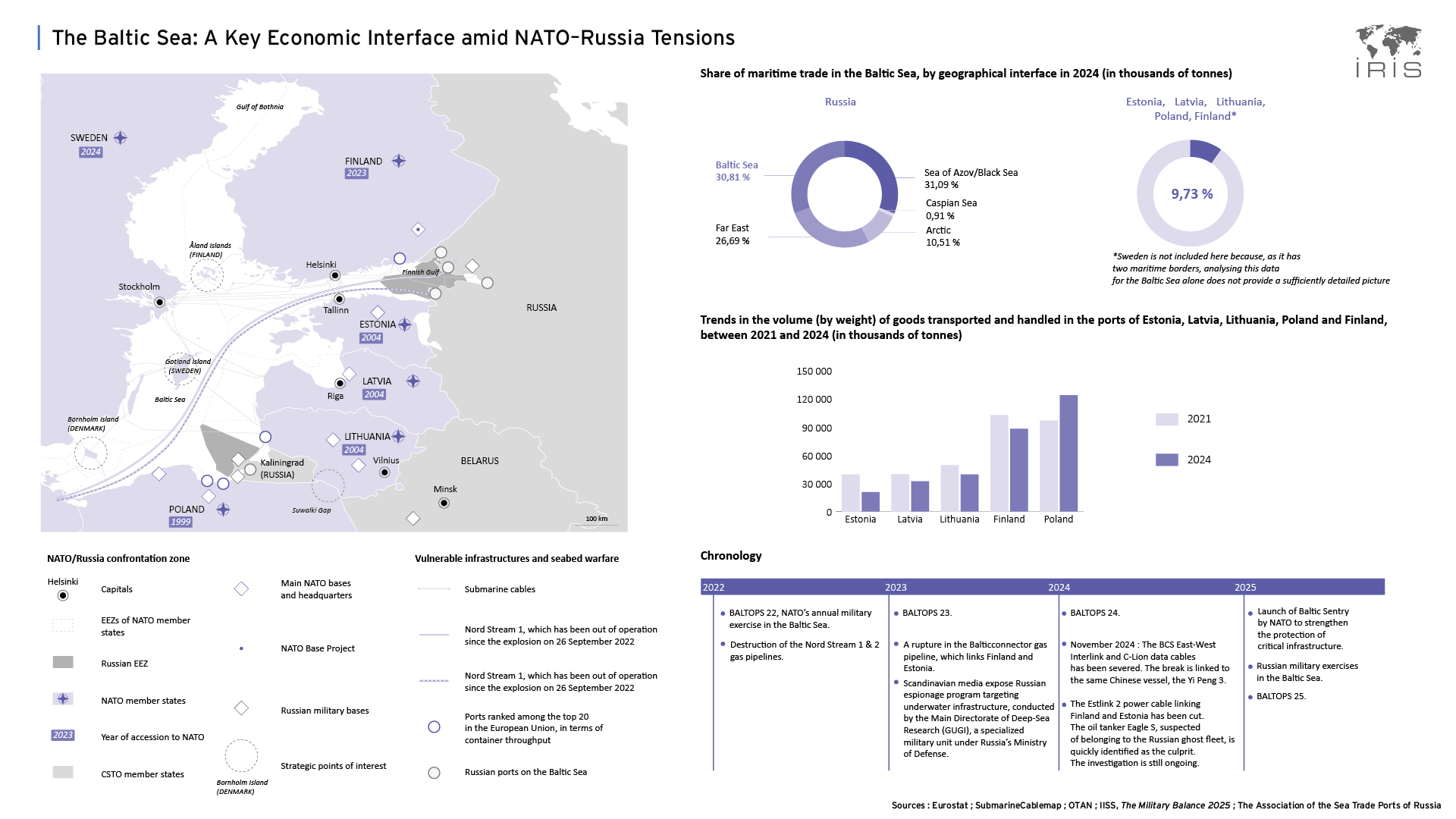
The geographical proximity of the territories and maritime zones of the states bordering the Baltic Sea makes it a focal point for geopolitical, economic and digital tensions. The effects of the war in Ukraine and the tensions between NATO member states in the region and Russia are playing out in this maritime area. The attacks on the Nord Stream gas pipelines and the damage to the numerous submarine cables in the Baltic Sea are concrete examples of this. This growing conflict is reflected in the intensification of various military exercises in the Baltic, notably NATO’s annual BALTOPS exercise, the Joint Expeditionary Force’s military exercises and the Russian military exercises scheduled for June 2025. There is also a correlation between these attacks, threats and tensions and trade through the Baltic ports. As the sole access point for maritime trade for the Baltic states, Poland and Finland – and accounting for over 30 per cent of Russian maritime trade – the region is indeed the scene of tensions that appear to be reshaping the balance of power in this area.
This map is an excerpt from L’Année stratégique 2026.