Cartographies / Human Security
11 May 2026
America First Global Health Strategy: Is Global Health Dependent on U.S. Funding?
-

Research Fellow at IRIS, Head of the Human Security Programme
-

Head of Data, Mapping and Infographics
-

Deputy for Communication
-

Deputy Director of IRIS
In practice and in terms of funding, international health cooperation has never separated the humanitarian imperative from the underlying geopolitical considerations. The tension between international solidarity and national interest is a defining feature of the history of global health cooperation. What has changed with the US ‘America First Global Health Strategy’ (AfGHS), published in September 2025, is the sovereignist rhetoric, which has become radically more pronounced. One of the world’s major powers is openly acknowledging that its health aid is a strategic instrument.
Washington intends to sign multi-year bilateral agreements setting out specific health targets, strict deadlines and consequences for non-compliance. This approach comes against the backdrop of a overhaul of US health policy, following the United States’ withdrawal from the World Health Organisation (WHO) in January 2025 and the dismantling of the United States Agency for International Development (USAID) in the first half of 2025.
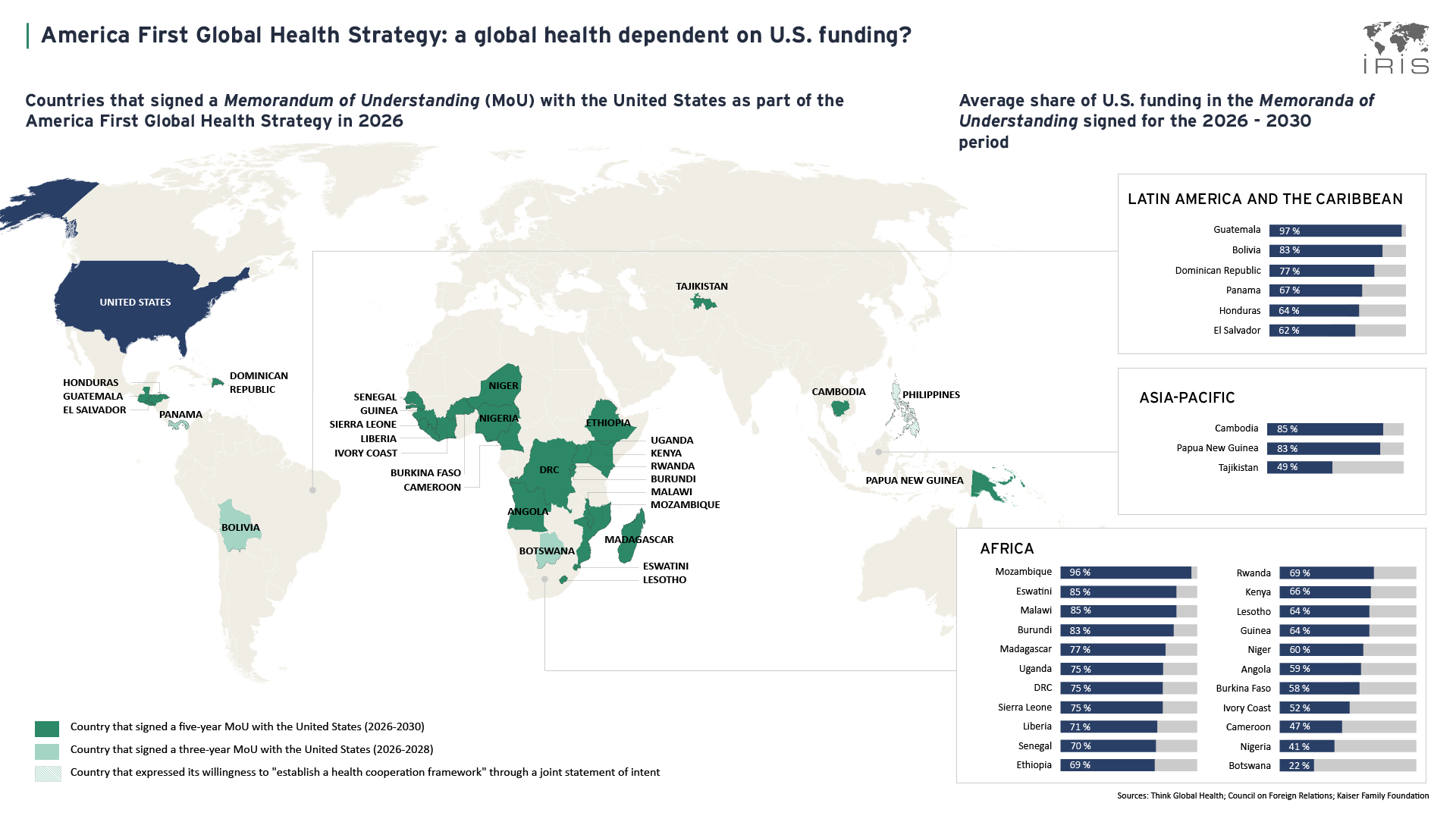
The United States has therefore established Memoranda of Understanding (MoUs), a bilateral format for agreements with beneficiary countries that are structured around five-year plans (2026–2030). As at 6 May 2026, 32 bilateral agreements had potentially been signed, including 22 agreements documented in sub-Saharan Africa to date, but the negotiation process is still ongoing. The bilateral agreements concluded under the America First Global Health Strategy represent a total value of at least $20 billion over the period 2026–2030, of which approximately 63 per cent is funded by the United States and 37 per cent by partner countries.
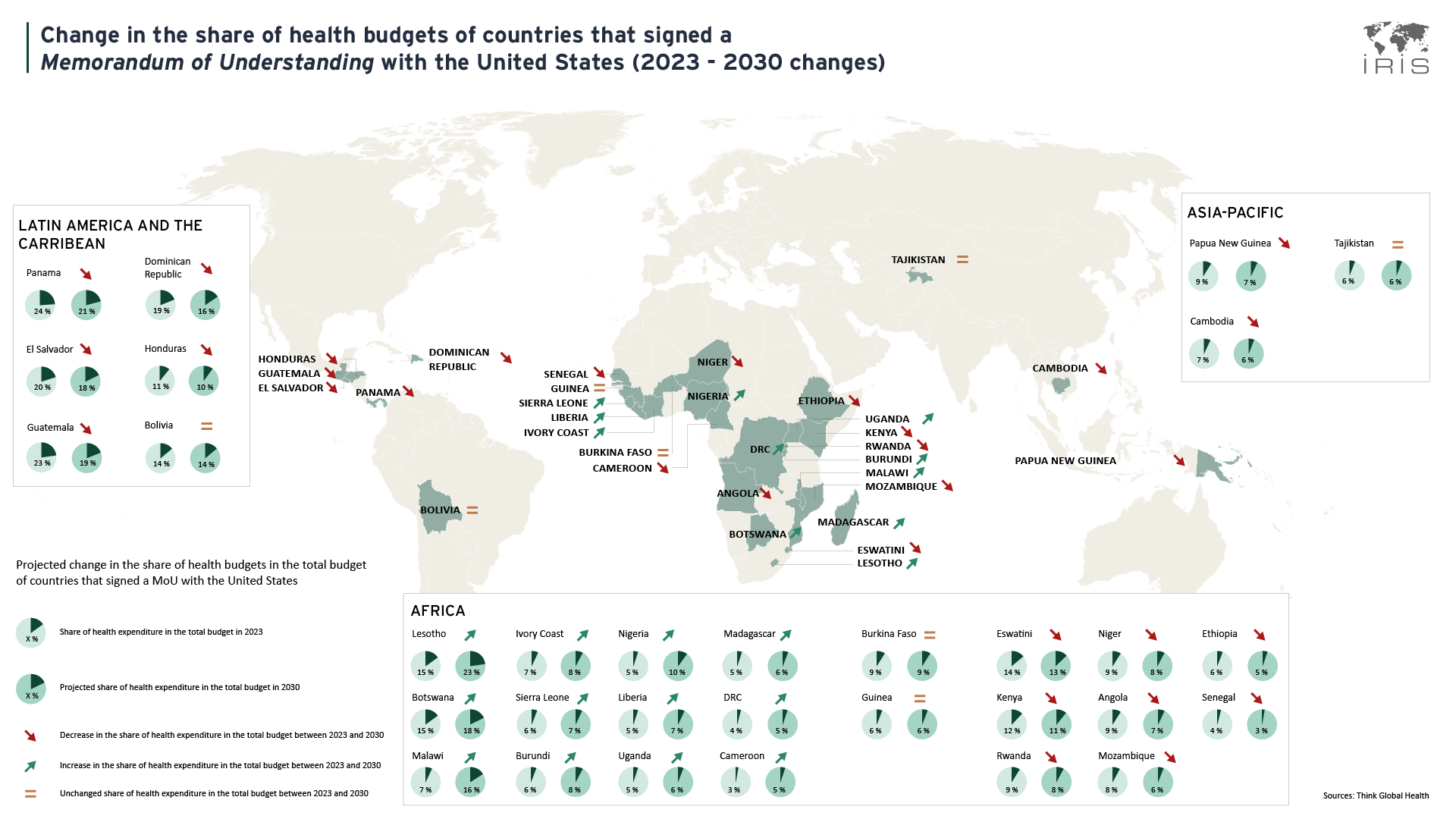
These co-financing agreements, which generally involve a gradually decreasing US commitment, require the countries concerned to reassess the proportion of their national budget allocated to health. These agreements also appear to align with a number of US strategic interests in the countries concerned.
A map-based analysis and infographic of this ongoing overhaul of US health policy.