Cartographies / Europe, European Union, NATO
15 December 2025
Assessment of Russian Hybrid Attacks in Europe

-

Head of Data, Mapping and Infographics
-

Deputy for Communication
-

Senior Research Fellow at IRIS, Head of the Europe, EU and NATO Programme on political developments in European countries
-

Deputy Director of IRIS
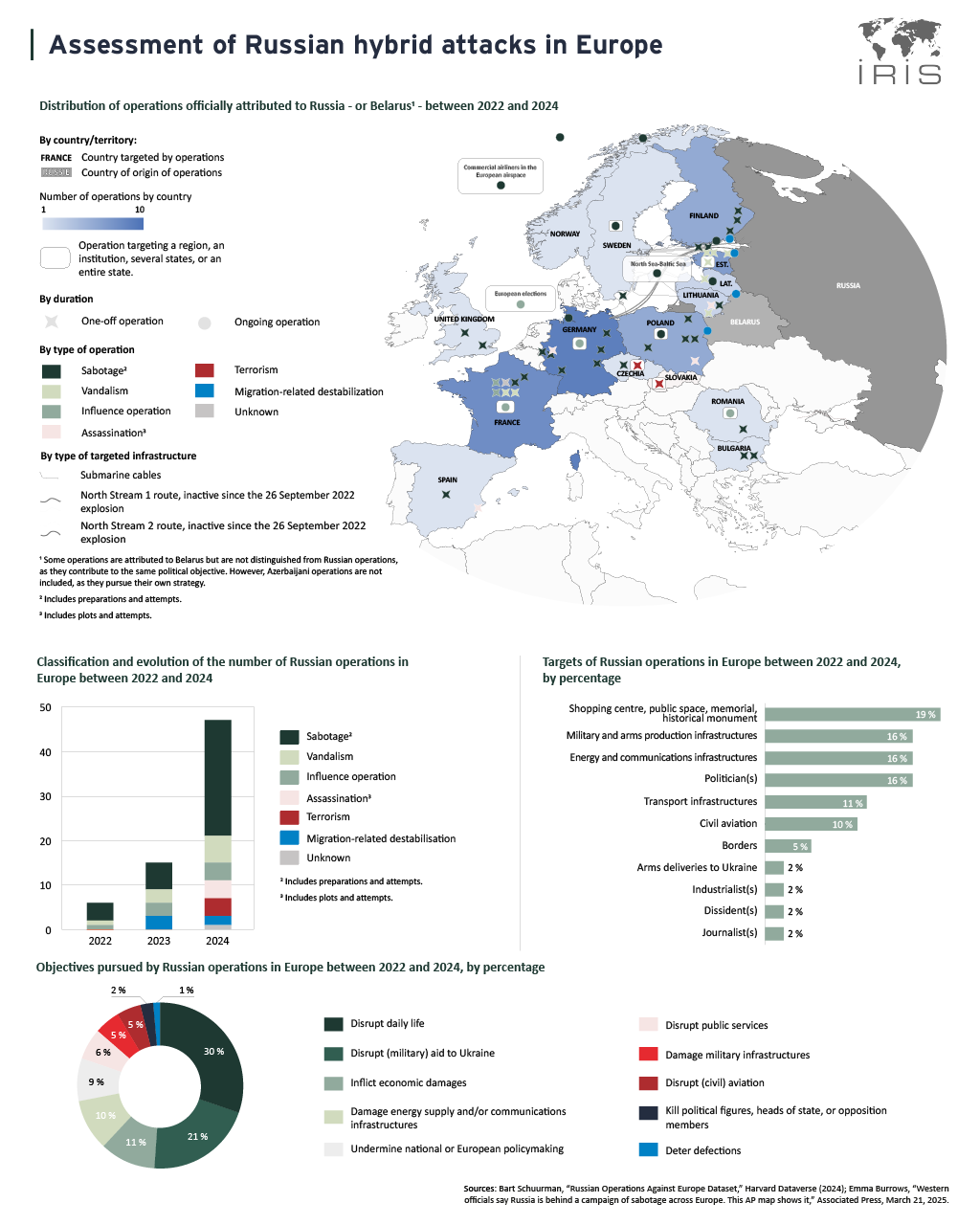
Russia’s invasion of Ukraine on 24 February 2022 marked the return of war to the European continent. Beyond developments on the Ukrainian front, Europe is facing various forms of conflict that are proving difficult to understand. Described as ‘hybrid’, these conflicts involve objectives such as influence, interference, intimidation and coercion. Affecting mainly Germany, France, Poland, the Baltic Sea region and Finland, hybrid attacks attributed to Russia and Belarus on the European continent increased sevenfold between 2022 and 2024 (Bart Schuurman, 2024). Ranging from attempts at or acts of sabotage and vandalism to influence operations and the manipulation of migration flows, the nature of these attacks is diverse, as are their targets – public spaces, military, energy, healthcare and communications infrastructure, etc. – or their intended effects – disrupting the daily lives of citizens, disrupting (military) aid to Ukraine, inflicting economic damage, etc.
An opportunity to take stock of Russian hybrid attacks and their consequences in Europe, illustrated with maps and charts.