
Analyses / Asia-Pacific
24 November 2026
Japan at the 2026 Apec Summit: Diplomatic Coldness That Reveals the Extent of Sino-Japanese Tensions
-

Senior Research Fellow, co-Head of the Asia-Pacific Programme, Director of the Indo-Pacific Geopolitical Observatory, IRIS
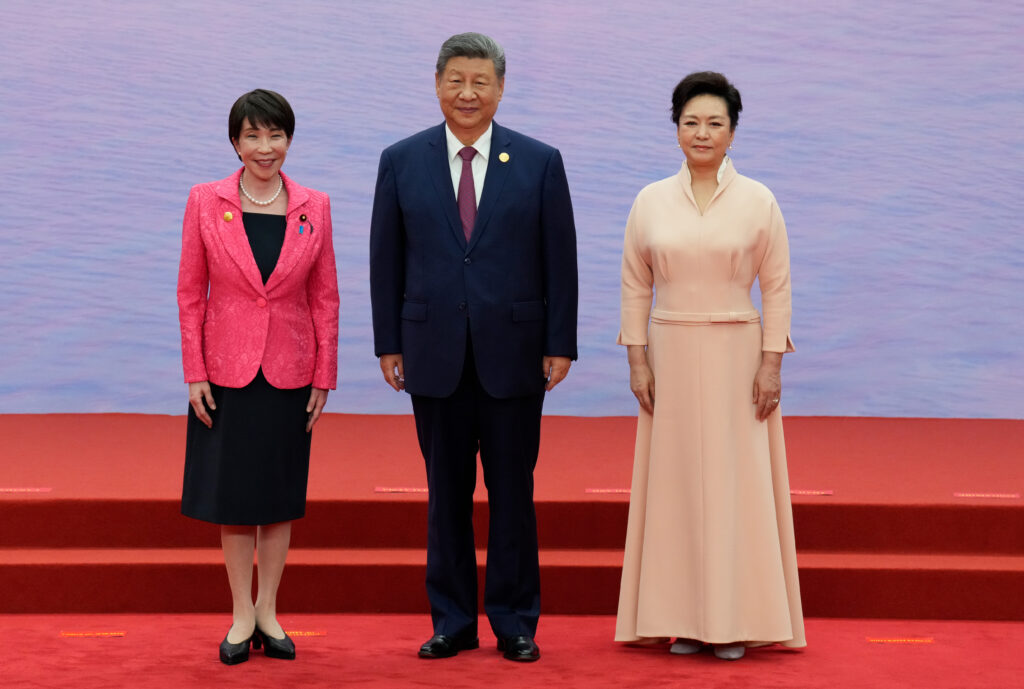
The reception given to Japanese Prime Minister Sanae Takaichi at the Asia-Pacific Economic Cooperation (APEC) summit in Shenzhen highlighted the sharp deterioration in relations between China and Japan. Amid historical disputes, power rivalries in East Asia and growing disagreements over Taiwan, the two neighbours are experiencing one of the most tense periods in over a decade. Whilst economic interdependence still prevents a complete breakdown in relations, the logic of strategic competition now appears to be gaining the upper hand.
From the moment Japanese Prime Minister Sanae Takaichi arrived, several protocol-related details were interpreted as signs of Chinese disapproval, or even calculated humiliation. The absence of a ceremonial welcome comparable to that accorded to other leaders – with the exception of President Donald Trump and Vladimir Putin, who were deliberately highlighted – caught the attention of the Japanese media. Even more significantly, Sanae Takaichi was not granted a bilateral meeting with Xi Jinping, whilst several heads of government from the region, including the South Korean President, were able to hold direct talks with the Chinese leader.
These multiple ‘signals’ from Beijing sent a clear message and underlined that improving relations with Tokyo was not among the Chinese regime’s immediate priorities.
The weight of history and geopolitics
The current tensions reveal the rise of regional nationalisms. On the Chinese side, this is underpinned by a collective memory that has been extensively exploited. Echoing the ‘century of humiliations’, the Japanese invasion of China between 1931 and 1945 continues to shape Chinese national discourse, which now denounces Tokyo’s ‘neo-militarism’. For its part, Japan often considers that the official apologies made on several occasions since the 1970s, as well as the official development assistance (ODA) granted to China, are not sufficiently acknowledged. Between 1979 and 2022, Tokyo provided China with approximately 3,660 billion yen in ODA (equivalent to 23 billion dollars, at the prevailing exchange rate), mainly in the form of preferential-rate loans which helped to finance major infrastructure projects such as the Beijing Metro, Shanghai Pudong International Airport and several port facilities. However, these initiatives have done little to change mutual perceptions amongst the general public.
Beyond the past, it is contemporary geopolitical rivalries that are fuelling mistrust today. The main point of contention concerns the Senkaku Islands, which are administered by Japan but claimed by China under the name Diaoyu. Since the Japanese government nationalised three of these islets in 2012, incursions by Chinese coastguard vessels into waters claimed by Tokyo have increased.
According to the Japanese authorities, Chinese vessels are now patrolling near the archipelago on an almost daily basis. Fighter aircraft from the Japan Air Self-Defence Force carry out several hundred interceptions a year in response to Chinese aircraft approaching the archipelago’s airspace. This air and maritime pressure forms part of a broader context of China’s military modernisation. China’s defence budget is estimated to be several times larger than Japan’s, which stood at $62 billion in 2025 compared with $336 billion for Beijing (SIPRI figures, global budgets 2025). China has also developed one of the world’s largest naval fleets in terms of the number of vessels, including three aircraft carriers and a fourth under construction, which are becoming increasingly visible in the Indo-Pacific.
A crisis-prone regional context: from Taiwan to the Beijing–Moscow–Pyongyang rapprochement
Whilst tensions were already high, they took on a new dimension with the Taiwan issue. In November 2025, Sanae Takaichi acknowledged before the Diet that a crisis involving Taiwan would constitute a situation threatening Japan’s survival (or an ‘existential crisis’), thereby opening the way for collective self-defence and the deployment of the Self-Defence Forces (JSDF). Whilst this statement reflected a widely shared strategic concern in Tokyo, it provoked Chinese anger. Geography, however, explains Japan’s concern. The Japanese island of Yonaguni, the country’s westernmost island, lies just 110 kilometres from Taiwan. The Nansei Islands, which stretch between Okinawa and Taiwan, are now regarded by the JSDF as a vital strategic line of defence.
For several years now, Tokyo has been strengthening its deterrence capabilities in this region. New anti-ship missile units have been deployed to Amami-Oshima, Miyakojima and Ishigaki. In 2024 and 2025, joint US-Japanese exercises simulated scenarios involving the defence of the south-western islands in the event of a conflict in the Taiwan Strait. But in Beijing’s view, this development is bringing Japan dangerously close to the US strategy of containing China.
The growing cooperation between China and Russia is another source of mounting concern for Tokyo. Since the invasion of Ukraine in 2022, joint Russian-Chinese military exercises have increased in the Western Pacific. Chinese and Russian strategic bombers have carried out several joint patrols near the archipelago. In September 2024, a joint Sino-Russian naval task force circumnavigated the Japanese archipelago via the Tsugaru Strait before continuing on its way to the Sea of Japan. Japanese officials believe that this military coordination increases the risk of a simultaneous regional crisis involving China, Russia and, potentially, North Korea. The partnership agreement signed between Vladimir Putin and the North Korean leader in 2024 has further deepened Japan’s isolation by expanding the range of potential threats perceived by the archipelago in its immediate vicinity.
Sanae Takaichi’s strategic dilemma
Faced with this situation, Sanae Takaichi faces a complex political challenge. She cannot be seen to be yielding to Chinese pressure without undermining her credibility amongst her conservative electorate. At the same time, she must prevent relations with Japan’s main trading partner from deteriorating excessively.
Unlike previous bilateral crises, including that of 2010, China now believes it has a more favourable balance of power. One of its main areas of leverage concerns rare earths, which are essential to Japan’s high-tech industry. These minerals are used in the manufacture of batteries, semiconductors, electric motors and military equipment. Some major Japanese industrial groups, such as Toyota, Hitachi, Mitsubishi Electric and Panasonic, remain heavily dependent on Chinese supplies despite their efforts to diversify.
China also remains Japan’s largest trading partner. Bilateral trade still amounts to nearly $300 billion a year. Several Japanese companies generate a significant proportion of their profits in the Chinese market. This interdependence gives Beijing the ability to exert significant economic pressure without resorting to blanket sanctions.
Japan’s predicament is exacerbated by the changing international landscape. Whilst Tokyo has always relied on Washington’s security guarantee, Donald Trump’s transactional approach and his critical remarks on ‘burden-sharing’ are fuelling doubts about the extent of US commitment in Asia.
This context is prompting Japan to diversify its strategic partnerships. Australia has become a key security partner through the Reciprocal Access Agreement signed in 2022. Defence cooperation with India has intensified. Ties with the Philippines have also been strengthened through the supply of coastal radars and maritime surveillance equipment. More recently, cooperation has been initiated with the United Kingdom and Italy on the Global Combat Air Programme (GCAP), a next-generation fighter aircraft programme which Germany may join.
A relationship that is set to remain conflictual yet interdependent
Sino-Japanese relations are thus entering a new phase: neither strategic cooperation nor a full-blown Cold War. The two powers are engaged in a growing competition for regional influence, whilst remaining bound by economic interdependencies that neither side can easily sacrifice. The industrial value chains linking China and Japan remain deeply integrated. China has remained Japan’s largest trading partner for nearly two decades. Conversely, Japan remains a key supplier of machine tools, semiconductor equipment, advanced materials and high-tech components on which Chinese industry still relies heavily. This interdependence limits the scope for a genuine strategic break.
The Shenzhen episode illustrates this new reality. Behind the limited ceremonial gestures lies a relationship characterised by mistrust, rivalry and economic coercion. But it also reveals a fundamental paradox: the more China and Japan perceive each other as strategic competitors, the more difficult it becomes for them to ignore one another or do without one another.
This article has been translated from French into English using artificial intelligence.