Analyses / Asia-Pacific
9 September 2026
Lee Jae-Myung’s State Visit to France: What Are the Prospects for France-Korea Cooperation?
-

Senior Research Fellow, co-Head of the Asia-Pacific Programme, Director of the Indo-Pacific Geopolitical Observatory, IRIS
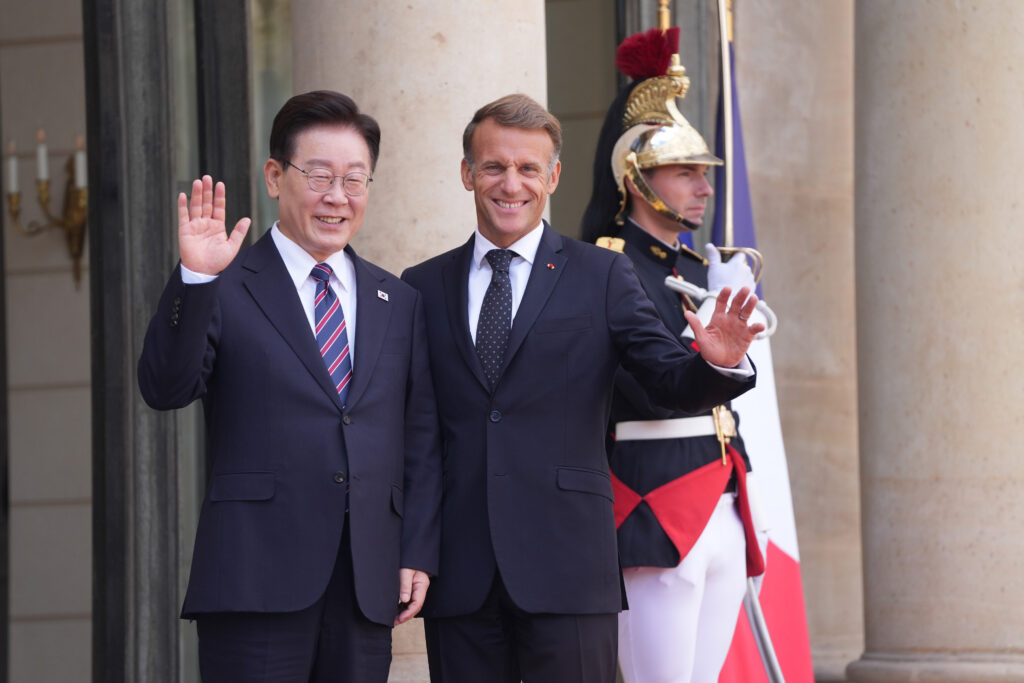
Following Emmanuel Macron’s visit to Seoul in April 2026 and the South Korean president’s participation in the G7 summit in Évian last June, Lee Jae-myung was in France for a 3-days visit (7–9 September 2026) to mark the 140th anniversary of the establishment of diplomatic relations between France and Korea. Together with Emmanuel Macron, he co-chaired the first international summit on cinema and the moving image in Saint-Paul-de-Vence on the 7th of September. With cultural cooperation at its heart, can this high-level visit help to revitalize a bilateral relationship that has so far been lacklustre? At this stage, the relationship between Paris and Seoul – elevated to the status of a ‘Comprehensive Strategic Partnership’ at the start of the year – rests more on a convergence of interests and potential in the fields of defence, energy, quantum technology and semiconductors than on formalized and structured exchanges. This suggests that whilst there are significant opportunities between the two countries, without sustained practical implementation, the vulnerabilities of the bilateral relationship also appear considerable.
France–South Korea: a promising partnership, yet one subject to the test of reality and international crises
President Lee Jae-myung’s state visit to France and the celebration of 140 years of Franco-South Korean diplomatic relations illustrate an undeniable qualitative shift in the bilateral relationship. There are numerous areas of common ground: a desire to secure value chains, the pursuit of greater strategic autonomy, technological ambitions, shared concerns regarding geopolitical tensions, and commitment to a multilateral international order. Against a backdrop of growing Sino-American rivalry, France and South Korea are keen to assert their status as “developed middle powers”and industrial democracies that share a common need to diversify their partnerships.
However, it would be an exaggeration to speak today of a genuine “Franco-South Korean strategic partnership”. Despite political rhetoric about ‘partnerships based on trust’ and “effective multilateralism” (multilatéralisme efficace) the relationship remains characterized by a certain ambiguity. The two countries cooperate in the very areas where they compete most fiercely: civil nuclear power, defence, semiconductors, the car industry, aerospace and artificial intelligence. This structural competition limits the scope of certain forms of cooperation. Each state seeks to safeguard its national interests, protect its leading industrial firms and strengthen its technological sovereignty.
Furthermore, the geopolitical constraints faced by the two partners are not the same. France enjoys a relatively high degree of diplomatic autonomy thanks to its nuclear deterrent, its permanent seat on the Security Council and its capacity for military projection as far as the Indo-Pacific, where it also wields influence due to its territories and permanently deployed armed forces. South Korea, on the other hand, continues to face an immediate existential threat from North Korea and remains heavily dependent on the US alliance for its security. This asymmetry limits the possibility of full strategic convergence. Seoul may wish to diversify its partnerships, but it finds it difficult to adopt positions that could undermine its relationship with Washington. This dependence was illustrated by Donald Trump’s unilateral decision last August to scale back the major annual US-South Korean military exercise, Ulchi Freedom Shield, in retaliation for Seoul’s lack of support for the US war against Iran.
The issue of implementation also poses a major challenge. There are numerous declarations of intent, but concrete achievements are limited. The success of the partnership will depend less on an increase in summits and presidential meetings than on the ability of businesses, universities, research centres and government bodies in both countries to build lasting and mutually beneficial partnerships.
Furthermore, the international context could also undermine this rapprochement. US trade tensions, technological restrictions, energy uncertainty linked to the Middle East and the persistent blockade of the Strait of Hormuz, or the growing ties between China, Russia and North Korea and their impact on the regional situation in Europe and North-East Asia may influence the priorities of both countries. Faced with these external shocks, each country might be tempted to prioritise its traditional alliances over emerging partnerships.
France and South Korea: strengthening “Strategic Autonomy” in the face of the United States and China?
Lee Jae-myung’s state visit comes at a time when both countries face the same strategic dilemma: how to preserve their decision-making sovereignty and room for manoeuvre whilst competition between Washington and Beijing increasingly shapes international relations?
For South Korea, the issue is particularly sensitive. Its Alliance with the United States remains indispensable in the face of the North Korean threat, but US pressure on trade, technology and security issues limits its room for maneuver. At the same time, China remains a major economic partner, making any policy of direct confrontation difficult. France finds itself in a different situation. As a member of the European Union and an ally of the United States, it has for several years been championing the concept of ‘strategic autonomy’ to reduce dependencies in critical areas such as energy, defence, technology and raw materials. However, being deeply integrated into the EU, it cannot afford the luxury of a “Canadian style” standoff with Donald Trump.
In this context, Paris and Seoul appear to be “natural partners”. They do not seek to confront the major powers head-on, but rather to create a space for cooperation amongst countries that share democratic values, an open economy and a desire for strategic independence. Enhanced prospects for cooperation thus appear possible with the creation of diplomatic coordination mechanisms on major international crises; South Korea’s participation in the “Multinational Peace Mission” (Mission multinationale pacifique) to secure the Strait of Hormuz – developed by France and involving a large number of states – could serve as an example of this. We can also expect greater coordination within multilateral forums (G20, OECD, UN) and a more assertive role for South Korea within the G7. More specifically, the development of a shared diplomatic approach to economic security, involving the establishment of technological partnerships that reduce dependence on American or Chinese suppliers, would be a telling indicator of how the bilateral relationship is evolving. The aim is not so much to create a geopolitical bloc as to build a network of partners capable of defending their interests without being subject to the decisions of the major powers.
Which technology sectors offer the greatest potential for strategic cooperation?
The technology sector is generally regarded as one of the most promising pillars of Franco-Korean relations, in which both countries are investing heavily. Their two economies possess highly complementary strengths. France excels in fundamental research, applied mathematics, space technology, civil nuclear power, artificial intelligence and biotechnology. South Korea, for its part, possesses the capacity for large-scale industrialization, global exports and the rapid transformation of innovations into industrial products. Closer ties were announced during the summit between the two presidents.
This complementarity is particularly evident in the field of semiconductors. South Korea is now one of the world leaders thanks to Samsung Electronics and SK Hynix, whilst French groups such as Air Liquide and Schneider Electric hold strategic positions in industrial equipment, materials and processes. Artificial intelligence also represents a major area for cooperation. Both countries are seeking to avoid excessive dependence on major US platforms and Chinese technologies. The agreement between Samsung and Mistral AI opens new prospects. Targeted cooperation could lead to the development of independent solutions applicable to industry, healthcare, defence and energy.
Other sectors worth mentioning include the space and aerospace industries (where cooperation is likely to develop between CNES, Airbus, Thales Alenia Space and Korean organisations). Civil nuclear power – whether in terms of nuclear fuel supply or the management of the full fuel cycle – has led to a number of contracts, notably between the South Korean operator Korea Hydro and Nuclear Power (KHNP) and Orano, a major French player in the sector.
If this technological cooperation materializes, it could become the cornerstone of a genuine economic security partnership between the two countries. However, in several of the sectors mentioned, French and South Korean companies are direct competitors, and each state quite naturally seeks to protect its critical technologies. Korean companies are deeply integrated into US technological ecosystems. Furthermore, US regulations on the export of advanced technologies may restrict certain forms of cooperation, including the previously discussed possibility of French involvement in the construction of the propulsion system for South Korea’s future SNA.
Are they genuine partners in defence despite their competition?
At first glance, and in the eyes of many observers, defence appears to be an area of rivalry between the two countries. The two nations are vying for contracts in the nuclear, aerospace and armaments sectors. South Korea has become the world’s fourth-largest arms exporter. Korean manufacturers are experiencing spectacular growth in international markets, particularly in the arms sales sector in Eastern Europe, where they are in direct competition with French firms. It is to be hoped, however, that North Korea’s increased provision of troops and military equipment to Russia may lead South Korea to provide greater support for Europe’s defence efforts in favor of Ukraine and, more broadly, for Europe’s rearmament drive.
Competition is not necessarily an obstacle to cooperation. South Korea is now home to global industrial leaders such as Hanwha Aerospace, Hyundai Rotem and Korea Aerospace Industries (KAI). France, for its part, has extensive operational experience, recognized expertise in complex systems and a strong diplomatic and military presence on the global stage. However, whilst France undertakes direct military engagement in several overseas theatres, South Korea generally remains more cautious and prefers indirect involvement.
Beyond industrial issues, the two countries also share a common concern regarding developments in the global security environment: the war in Ukraine, tensions in the Indo-Pacific, instability in the Middle East and the rise of hybrid threats. However, on the issue of relations with Ukraine, it is evident that Seoul is endeavoring to maintain good relations with Moscow whilst indirectly supporting Western efforts through its sales of arms and heavy equipment to Poland (FA-50 fighter jets, K2 tanks, howitzers) and the United States. Seoul is thus the second-largest arms exporter to the European market, behind the United States.
To date, regular strategic dialogue between the diplomatic and military leaders of the two countries has helped to maintain active defence diplomacy and numerous military cooperation initiatives, particularly in the areas of military training and the exchange of operational experience. Updating the agreement on the exchange of classified information could boost military and industrial cooperation. Finally, cyber security and the protection of critical infrastructure constitute another area of fruitful exchange.
To what extent are the energy crisis and tensions in the Middle East bringing Paris and Seoul closer together?
The crisis in the Middle East has highlighted the energy vulnerability of many industrialized countries. South Korea is particularly exposed as it relies heavily on imports of oil and gas transported by sea. The Strait of Hormuz is one of the key chokepoints in this dependency. A prolonged disruption to maritime traffic would have immediate consequences for the South Korean economy, particularly its energy-intensive manufacturing sector. Against this backdrop, strengthening nuclear cooperation between the two countries has taken on new significance. In the face of geopolitical uncertainties, nuclear power appears to be a means of achieving energy sovereignty, enabling a reduction in dependence on imported hydrocarbons.
France shares a similar concern regarding global energy security and maintains a significant joint military presence in the Indian Ocean, owing to its bases in Djibouti and Abu Dhabi and its territories of La Réunion and Mayotte. Whilst for South Korea the Middle East is primarily an energy issue, for France it is also a significant regional diplomatic and security challenge. France was instrumental in establishing the European anti-piracy mission off the coast of Somalia, Atalanta, in 2008, which remains active in 2026 with an expanded mandate. It was also a driving force behind the creation, in 2024, of another European Union air and maritime mission, Aspides. Dedicated to escorting civilian vessels through the Bab el-Mandeb Strait, in the Red Sea and in the Gulf of Aden, it has just been extended. This is why the current discussions between Emmanuel Macron and Lee Jae-myung on the regional maritime situation and the Strait of Hormuz go beyond the mere diplomatic sphere. They focus quite specifically on securing global trade flows via major Sea lanes of communication (SLOCs) and the stability of strategic supplies, with the possibility of South Korean participation in the “multinational peace mission” that Emmanuel Macron is striving to assemble to help secure international shipping in the region. This is a delicate situation for President Lee, who is under considerable pressure from a belligerent Donald Trump. Without yet making any formal commitment, either to the United States or to Emmanuel Macron, Lee Jae-myung has indicated that he might eventually consider sending ships and troops to the region once the fighting has ceased. Seoul is not, however, prepared to take part in an operational deployment or in any fighting, and its contribution is expected to lie outside the scope of combat operations (mine clearance, intelligence gathering). To finalize its potential participation, Seoul will need to hold formal consultations and obtain the consent of the South Korean National Assembly.
Conclusion
Relations between France and South Korea are currently at a turning point. They hold considerable potential, fueled by the complementary nature of their economies and the convergence of certain geopolitical concerns. However, their future will depend on the two countries’ ability to transform a relationship born of circumstance into a lasting strategic partnership, capable of withstanding both pressure from the major powers and the economic rivalries that pit them against one another. Despite its desire for autonomy, Seoul remains closely tied to Washington in military and technological terms, which limits its room for maneuver. The real challenge, therefore, is not whether France and South Korea can cooperate more closely, but whether they will be able to build a relationship strong enough to simultaneously manage cooperation, the risk of industrial competition and the uncertainties of a world that has become more fragmented and conflict-ridden.