
Interviews / Asia-Pacific
25 November 2026
Apec Summit: A Diplomatic Success for China?
-

Senior Research Fellow, co-Head of Asia-Pacific Programme, IRIS
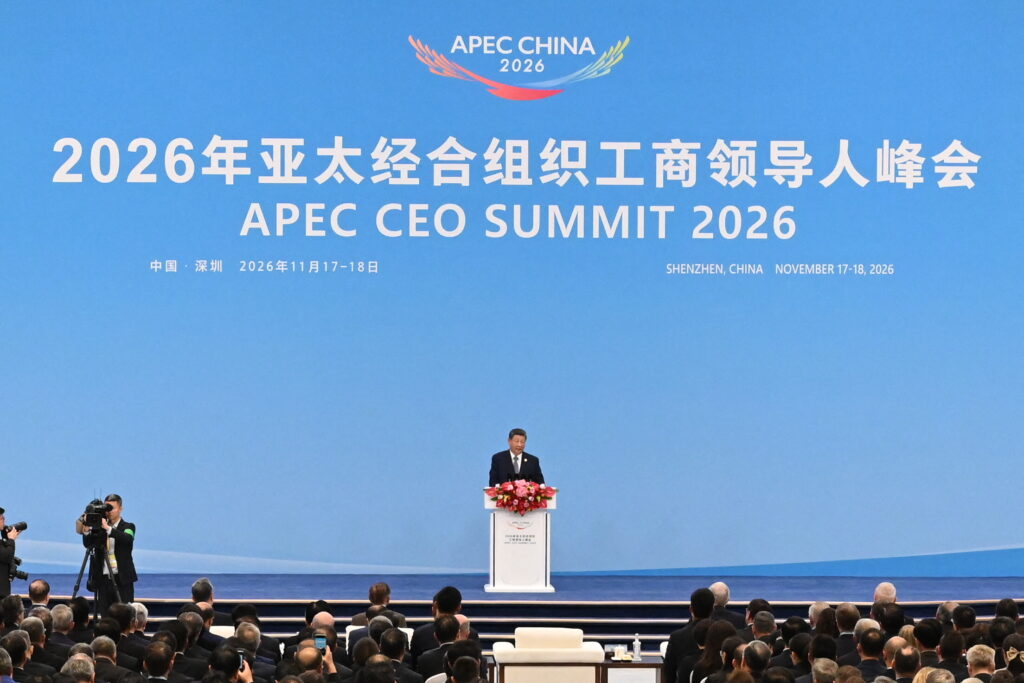
The Asia-Pacific Economic Cooperation (APEC) summit was held in Shenzhen from November 18 to 19, 2026, to discuss issues related to clean energy, supply chains, artificial intelligence, and free trade. China is hosting this summit for the third time; this year’s event was notable in particular for an unprecedented trilateral meeting between the United States, China, and Russia. What conclusions can be drawn from the 2026 APEC summit? What is the political message behind the trilateral meeting of the three major powers? Consequently, in what direction is the Sino-American rivalry evolving? Interview with Emmanuel Lincot, research director at IRIS and co-director of the Asia-Pacific Program.
What are the key takeaways from this summit?
The Chinese press has spoken of a “new Yalta,” which is nothing more than a figment of the imagination. It is worth recalling that, historically, the Yalta Conference was convened to organize elections in the countries liberated at the end of World War II. In this regard, the spirit of Yalta was betrayed a few months later by the Potsdam Conference, which effectively divided the world. None of that happened in Shenzhen, even though the three leaders signed a joint “peace declaration” on strategic stability, without directly addressing Ukraine. The status quo—or nearly so—remains, even though the three powers declared their intention to engage in dialogue on nuclear risk reduction and nonproliferation. Xi Jinping advocated for the removal of trade barriers and globalization as a counter-model to Donald Trump’s “America First” policy. Targeted gestures were made, such as Beijing’s temporary suspension of tariffs on $400 million worth of Canadian exports. However, the trade truce between China and the United States, which expires in January 2027, has not yet been extended.While Xi Jinping succeeded in capturing the attention of the international media and enabled Shenzhen—sometimes referred to as the “Chinese Silicon Valley”—to benefit from a real economic boost on this occasion, much like Shanghai did in 2008 during the World Expo, in reality, there has been no significant progress in his rivalry with Donald Trump. Furthermore, a few days earlier, Trump had met with members of the Association of Southeast Asian Nations (ASEAN) and held discussions with the Quadrilateral Security Dialogue (QUAD) against a backdrop of tensions between China and the Philippines and Taiwan, respectively, as well as amid an alarming deterioration in relations between Tokyo and Beijing. As for Vladimir Putin, the opportunity was too good to pass up to return to the forefront of the international stage, in accordance with Beijing’s wishes. In short, the diplomatic and media showdown between the major powers largely overshadowed the multilateral agenda, which nevertheless revealed that China is actively engaged in the region and, together with the 21 member countries, has expanded its cooperation in the field of artificial intelligence (AI) and intensified trade with small and medium-sized enterprises (SMEs). This objective will undoubtedly be pursued at the 2027 APEC Summit, to be held in Vietnam on the island of Phu Quoc.
The Declaration of Peace, AI governance, Taiwan, Russia’s return to APEC… What conclusions can we draw from the trilateral meeting between Xi Jinping, Donald Trump, and Vladimir Putin on the sidelines of this summit? What message was it intended to convey on the international stage?
Essentially, Beijing and Washington are trying to buy time on the most critical issues related to AI, rare earths, and supply chains. The sudden reinstatement of Jensen Huang, CEO of Nvidia—who was temporarily ousted from his own company due to his alleged ties to a woman suspected of spying on behalf of Beijing—clearly shows that the matter is too sensitive to allow Beijing to offer Jensen Huang a golden parachute. Furthermore, each key player will be keen to develop partnerships with countries that will be pitted against one another. Thus, Beijing will continue to develop the World Artificial Intelligence Cooperation Organization (WAICO), an international organization for cooperation on artificial intelligence created in July 2026, seen as a response to the Pax Silica established by Washington. In just a few months, the number of WAICO member countries has grown from 29 to 44 signatories. As a proponent of open source, China is using this intergovernmental organization and its working groups to facilitate the sharing of computing power, multilingual models, and regulatory harmonization. Countries as diverse as Senegal, Algeria, and Pakistan are members of WAICO. Although no Chinese statement was made in Shenzhen regarding WAICO, it is highly likely that the momentum of this organization will be accelerated as a result. The same is true for the member countries of Pax Silica, launched in December 2025 by the United States, which aims to counter China’s influence. Australia, Japan, India, and the European Union are all partners in this initiative. Far from focusing on reconciliation among the three major powers, the Shenzhen summit underscores the significance of these issues, though it does not yet suggest a division of the world among these various players. Thus, and quite significantly, Philippine President Ferdinand Marcos Jr. stated that no data center would be built at the site originally planned in the Philippines as part of the Pax Silica initiative. This may be an early sign of a wait-and-see approach, if not a reversal, in the decision made regarding one or the other of these competing projects. For Vladimir Putin, Shenzhen offered him the opportunity to express his desire to reform the United Nations and to make his case before business leaders from the Asia-Pacific region, who now account for 53% of Russia’s foreign trade. He also proposed strengthening logistics corridors (notably the Northern Sea Route) and announced a unified preferential economic regime for the Russian Far East and the Arctic, effective January 2027. He also challenged the arrest warrants and court rulings issued by the Hague tribunal, particularly those against him. A sign of the times, and in terms of protocol…
While the U.S. and Chinese presidents displayed a certain degree of closeness during this meeting, their positions continue to diverge on many issues. How has the bilateral relationship between Beijing and Washington evolved since Donald Trump returned to the White House?
In Shenzhen, we witnessed a display of cordiality between Donald Trump and Xi Jinping, as well as a shared commitment to establishing “strategic stability.” We have emerged from the difficult period marked by the tariff escalation of 2025 (with U.S. tariffs on Chinese goods raised to 145%, compared to 125% on the Chinese side for U.S. goods). The October 2025 meeting in Busan, South Korea, between the two leaders led to a partial reduction in tariffs, a Chinese moratorium on certain rare-earth restrictions, and a targeted U.S. easing of restrictions on the sale of certain artificial intelligence chips. In reality, and despite a superficial diplomatic truce, structural tensions remain high: economic, as we have noted, but also strategic, particularly regarding support for Taiwan. Donald Trump froze a $14 billion arms sale to the island and assured his Chinese counterpart that the United States would never recognize Taiwan’s independence. However, a Democratic victory in the November 2026 midterm elections (giving them control of Congress in January 2027) could significantly limit the U.S. president’s room for maneuver and decision-making.
This article has been translated from French into English using artificial intelligence.