
Analyses / Energy and Raw Materials
10 September 2026
Humanoids: Agricultural and Food Revolutions?
-

Associate Research Fellow, IRIS
En quelques mois, les robots humanoïdes sont devenus l’une des vitrines de l’accélération technologique et de la course mondiale en matière d’innovation, sur fond de poussée de l’intelligence artificielle d’un côté et de rivalités sino-états-uniennes de l’autre.
Plusieurs éléments concourent à relier le développement des humanoïdes avec les enjeux de l’agriculture et de l’alimentation, de la recherche à la production, de la transformation à la consommation, en passant par la logistique et la distribution. Tour d’horizon synthétique et prospectif d’un espace de réflexions appelé à s’élargir[1] et qui interrogera fortement l’interaction entre les machines et les humains dans les mondes de demain, notamment agricoles et alimentaires.
Take the broader context into account
To understand why the emergence of humanoids in the agricultural and food sectors should not be underestimated, let’s take a moment to review certain trends currently at work, focusing on five that we believe are particularly significant:
First, an observation. Feeding the planet is the world’s largest employer. Nearly 1.4 billion people work in the agriculture and food sectors—that is, about four out of every ten workers. Primary agriculture alone employs nearly 900 million people, in addition to those working in fishing and aquaculture, processing, logistics, distribution, and the food service industry. This is a massive number in absolute terms, even though agriculture’s share of global employment is gradually declining: from over 40% in the early 1990s, it now stands at around one-quarter. Envisioning the arrival of humanoid robots in these sectors therefore means considering the future of work, skills, and incomes for hundreds of millions of people.
Next, a trend. The global population is aging, and the agricultural and food sectors—in all their aspects—are no exception to this trend. Add to this the fact that, for many years now, the appeal of jobs in agricultural production and the food industry has been declining. We still have a large workforce in agriculture and the agri-food sector, as noted in the previous point, but these workers are aging; they are often undervalued both socially and in terms of wages, even though they perform essential and demanding jobs, and their skills and know-how are becoming increasingly difficult to pass on or renew. When discussing humanoids in agriculture and the agribusiness sector, one inevitably touches on the challenge of attitudes toward work in these demanding fields—fields to which few young people are now drawn…
In addition, a reminder: Technology, digital solutions, and artificial intelligence have long been deeply embedded in the agricultural and food sectors. To delve into the details of this interplay and grasp both its scope and significance, one need only examine a few recent global studies[2] or even certain educational publications from France[3]. Envisioning a future with humanoids means anticipating the transition from artificial intelligence (AI) that assists farmers or factory workers to AI that will potentially act on its own, autonomously, and might even decide which tasks to perform. It also involves AI that guides and shapes eating habits—perhaps even with robots in the kitchen that combine nutritional recommendations with the ability to prepare just the right portion to serve people…
On another note, a question: Expectations for agriculture and food are immense at a time when major ecological transitions must be undertaken. The preservation and regeneration of ecosystems, the optimization and resilience of yields, the decarbonization of operations, the circular economy, and the reduction of losses and waste are all strategic frameworks that agricultural and food sector stakeholders must navigate. Introducing the concept of humanoids into this context raises the question of whether they would be better equipped than humans to lead these transitions, accept the changes, and adapt to them. They could work in extreme temperatures, instantly modify their practices, optimize water and energy use, or implement new protocols without resistance. In other words, they could sometimes do better, faster, and more consistently what humans—bound by their habits, interests, and economic or social constraints—struggle to accomplish.
Finally, geopolitical competition is the fifth factor shaping our overall thinking on the subject. Behind the humanoids lie power struggles between China and the United States in particular—but not exclusively. Japan, facing significant sociodemographic and agricultural shifts, and Saudi Arabia, eager to invest in the future with AI and to have an army of home-based workers, are already participating—each in their own way—in this great technological adventure currently underway. Beijing appears to be stepping up the pace to industrialize its production of humanoids[4]. Tesla is taking a major step toward expanding from automobiles to robotics. Physical AI, with the deployment of humanoids, will not only revolutionize the world of work but also become a major arena of competition among powers—both nations and companies. In fact, Bill Gates recently emphasized just how profoundly the rapid rise of AI will transform societies, going so far as to argue that certain jobs should remain reserved for humans. He nevertheless highlights the incredible potential of AI in certain strategic sectors, including agriculture[5].
From Curiosity to Anticipation
Demographics, employment, climate, technology, and power dynamics are sufficient to frame the bulk of the issues surrounding the arrival of humanoids in our lives, in the short and medium term. It would be wise to prepare for this. For agriculture and food, five areas potentially define the scope of our considerations: research, production, processing, distribution, and consumption.
AI is boosting scientific capabilities. In agricultural and plant research, in biotechnology, in animal health and welfare, and in sustainable soil fertilization, the progress could prove to be significant. Reducing experimentation time, accelerating the analysis of results, and promoting the development of solutions that can be applied in the field more quickly: these are all concrete advances that have already been observed. The arrival of humanoids could open up a new phase. Capable of manipulating, testing, observing, measuring, and repeating experiments—potentially on a continuous basis—they could help bring AI even closer to the physical work of the laboratory or the field. What will become of research and development (R&D) strategies when AI is no longer content to merely analyze experimental results but can also physically participate in conducting them? Companies, technical institutes, and scientific organizations would then be affected. The automation of scientific computation could thus be followed by the automation of part of the scientific process itself. If humanoids enable laboratories to operate longer, conduct more experiments, and shorten R&D cycles, then geopolitical competition in robotics will also become a competition over the speed of innovation. Whoever has the best AI models and the best physical capabilities for experimentation could learn faster than their competitors.
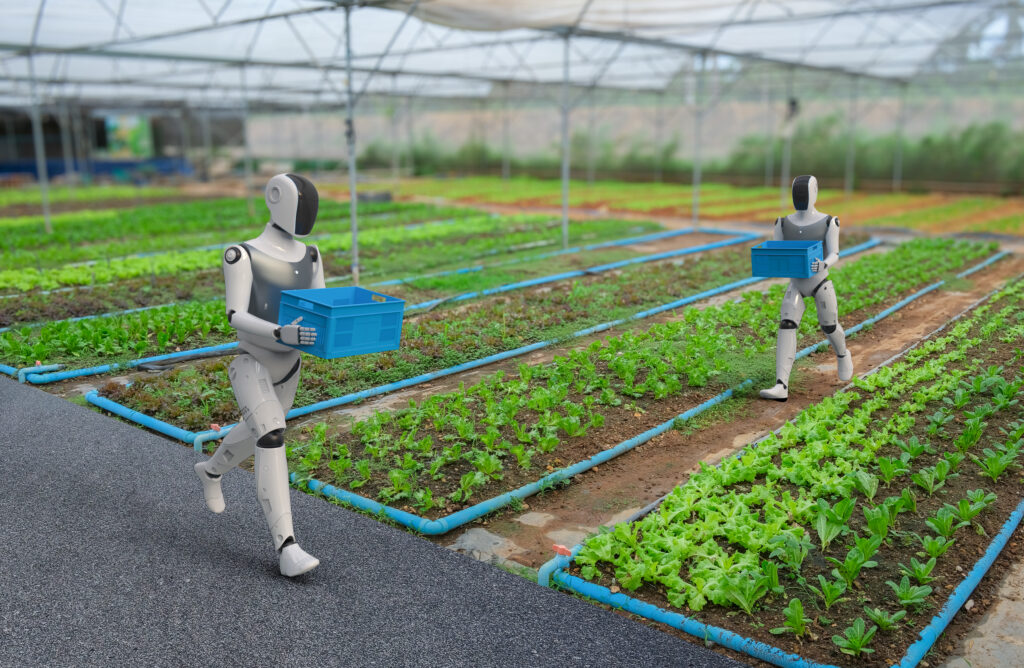
When it comes to production, the agricultural sector already has strong ties to machinery and robots. Let’s not overlook mechanization (symbolized by the tractor), which over the long term has been one of the driving forces behind past agricultural revolutions and is still eagerly awaited in many countries, where limited access to technology prevents many farmers from achieving higher yields and finding solutions to reduce the physical strain of their work. In this regard, let’s pay close attention to the development of exoskeletons, which help relieve pain, make tasks easier, and allow farmers to work longer. These innovations are being closely watched in societies where the farming population is aging. In Japan, the average age of farmers is now nearly 70! It’s no surprise that the Panasonic conglomerate, through its subsidiary Atoun, began actively pursuing this area as early as the 2010s, as Japanese universities and startups are now doing as well. While Japan seems intent on “dressing” humans in robots before considering replacing them with robots, this approach raises questions about the effectiveness of such a system and its cost. Because ultimately, when it comes to performing difficult, potentially dangerous, and above all repetitive tasks, robots will prevail—in Japan, as elsewhere. It’s also worth noting that while field crops (grains, oilseeds, etc.) are already heavily reliant on machines and robots, other sectors are capitalizing on these trends to move forward. This is particularly true of the fruit and vegetable sector, where much work remains to be done. The fragility of these crops—whether grown in open fields or in greenhouses—partly explains this situation. But the concentration of harvests into short periods, during which months of cultivation come into play, requires a workforce that is available, skilled, and capable of sustained effort over just a few days. There is no doubt that robotic innovations will be deployed in this sector, especially if the reliance on foreign workers diminishes and it becomes necessary to maintain supply volumes on the shelves for consumers eager for produce. There is no doubt that Unitree Robotics will be keeping a close eye on this development—if it isn’t already.
In terms of manufacturing, robotization will certainly make more significant strides within the labyrinthine structures of food-processing and agro-industrial plants. It remains to be seen what specific role humanoids will play there. Their advantage will likely not lie in the repetition of standardized movements—an area where conventional industrial robots already excel—but rather in their versatility and their ability to navigate spaces designed for humans. But unlike humans, they will undoubtedly have the advantage of never having to stop, except to change or recharge their batteries… This raises a broad question about the increased automation of these factories in the future, even though men and women will not disappear from them but will instead take on more roles in supervision, monitoring, and management. We will see a coexistence of robots and humans, where each will have to find its place, its role, and its added value. This, too, is the challenge: knowing how to identify the moments, places, and actions where human decision-making will remain essential—or decisive—even as physical AI and humanoids take the lead. But as two experts on these issues have clearly explained[6],The debate should primarily focus on feasibility, on the one hand, and acceptability, on the other. In the case of the agri-food industry—where processed products are derived from living organisms and where safety and traceability issues are immense—will we all be comfortable if what becomes food no longer passes through human hands at all? Some may find this reassuring, while others, on the contrary, will be troubled by it. Just as in healthcare and medicine, computing power, AI, and robots are improving diagnostics, production rates, and speed of execution in the agri-food sector. But the interdependence with the human species remains necessary—unless we assume that everything can be gradually replaced, including responsibility. Yet in the food sector, is the consumer prepared to lose track of origins, processes, and points of contact if machines muddy the waters, provide little accountability, and fail to offer after-sales service?
These are all challenges that players in the food logistics and distribution sectors will also have to prepare for, given the speed at which embedded AI is taking hold in their industries as well. Let’s take this a step further: will humanoids be everywhere in stores tomorrow? After all, checkout counters have become increasingly automated, efficiently scanning customers’ items on their own—and customers are sometimes happy not to have to exchange a single word with the machine interface that coolly identifies their purchases, presents the total, and offers several payment options. Nevertheless, we still have people working on the sales floors… even though in China and elsewhere, tech giants have already set up supermarkets without any human staff. Is this what all consumers want? How far can this trend go? Will we see humanoids manning the checkout counters, to breathe a little life back into this necessary chore? Or will we mainly see them doing the grocery shopping for those who don’t enjoy it, don’t have the time, and are looking to diversify their home grocery options? Home delivery has skyrocketed in recent years, particularly among younger generations, but also among individuals and couples who want to streamline their daily lives without having to cook or go out to buy food. Let’s even dare to turn the argument on its head: Is replacing humans with machines always synonymous with dehumanization? The sometimes extremely precarious working conditions of delivery workers for digital platforms suggest that this assumption should be qualified[7]. A robot performing a strenuous, dangerous, or socially devalued task does not necessarily destroy humanity. It all depends on what society does with the men and women thus freed from that task. In any case, it will certainly be interesting to see how retail and restaurant companies adapt to the humanoid revolution. Imagine the world’s largest fast-food chain—a U.S.-based company with a presence on every continent, currently employing 2.5 million people, including 75,000 in France—choosing to go fully digital, fully robotic, and featuring a humanoid version of Ronald greeting customers at the restaurant entrance or at the drive-thru window…
As for the home… “Do we even need spaces for cooking or eating anymore?” some might ask. If everything is delivered and no one shares meals at the same time in a dedicated room anymore, architects have some beautiful, innovative designs to consider. Before we get there, let’s take a clear-eyed look at the fact that kitchen appliances had already taken over our kitchens long before the invention of the smartphone, but that increasingly sophisticated robots have been taking up more and more space there in recent years! Let’s just mention the Thermomix to cut to the chase—each new model comes with additional digital features. Who knows—perhaps future versions will feature a Thermomix with two legs and two arms, capable of cooking, serving, tidying up, cleaning, and ordering online any food items that are running low in the owner’s home. Or maybe that’s exactly what Tesla has in mind with Optimus, its humanoid robot designed to provide unprecedented assistance around the house. What will it say about our societies and our social relationships—which often revolve around a meal—and what will it record about our most intimate lives, if such a thing even exists anymore? In fact, posting a photo of one’s plate is already one of the most common types of images on Instagram. Nutrition, health, and assistance will thus converge. The robot would know our tastes, our allergies, our nutritional goals, and possibly certain medical data. It could adjust portion sizes, reduce salt, monitor sugar intake, limit waste, or tailor a menu to each person’s physical activity. We would then move from personalized nutrition to personally administered nutrition. Otherwise, we’d face additional costs for medical care or insurance due to a lack of appropriate behavior!
Conscious Openings
Until now, we have mainly adapted the environment to machines: production lines, automated warehouses, milking robots, autonomous tractors, and robotic arms. With humanoids, this logic can be reversed. We are now seeking to build a machine capable of adapting to a world designed for the human body. Few sectors illustrate this revolution as clearly as agriculture and food production. To feed ourselves, we must sow, observe, harvest, milk, care for animals, fish, carry, sort, cut, process, transport, store, cook, and serve. In short, we must draw on nearly the entire range of human actions.
Agricultural automation is already a reality. This is also true in livestock farming. These technologies address several simultaneous challenges: productivity, labor shortages, physically demanding work, reducing inputs, and adapting to climate change. With that in mind, what if robots adapted faster than we do? Agricultural and food systems must simultaneously reduce emissions, conserve water, protect soil, limit certain inputs, preserve biodiversity, and maintain sufficient production. Yet the paradox of transitions is well known: we often know what needs to be changed, but things change… slowly. Machines, robots, and humanoids will not be afraid to change habits. This obviously doesn’t mean they’ll solve the climate crisis, especially since their manufacture and use will be energy-intensive… But they could become powerful catalysts for adaptation. The ecological question would then converge with that of delegation: are we ready to let machines carry out certain transformations more quickly than we can collectively accomplish?
So yes, the future of robotic agriculture won’t necessarily be humanoid. Why give a machine two legs when a wheeled system is more stable? Why replicate a human hand when a specialized tool is more efficient? On a grain field spanning several hundred hectares, the autonomous tractor will likely retain the advantage for a long time to come. But in a greenhouse, livestock facility, wine cellar, laboratory, workshop, or horticultural operation designed around human movement, the versatility of humanoids could prove valuable—likely sooner than we think. And why stop at land-based operations? Fishing and aquaculture are also seeing increasing automation: fish monitoring, automated feeding, cage inspection, underwater robots, sorting, handling, and processing. In an aquaculture farm or a port, harsh and sometimes dangerous environments are a powerful driver of robotization. Operating at sea, on a ship, may prove less favorable, however—unless the humanoids demonstrate an unexpected ability to keep their sea legs…
After precision agriculture, we might see the rise of delegated agriculture. In the agri-food industry, embodied AI is also expected to play a role. Robots are already serving food and drinks in some restaurants, and humanoid robots are poised to enter the home. Let us prepare for all of this if we wish to strike the right balance, for the point is not to reject technological progress, but rather to anticipate these potential disruptions as best we can and to define the contours of future responsibility. This, in fact, is the main message of Pope Leo’s encyclical published this year[8], which is well worth reading even if one is not a believer. In it, the Pope reminds us that AI systems, however advanced they may be, lack a moral conscience and cannot “bear the weight of the consequences” (paragraph 99). Humanoids aren’t going to invade our fields, factories, stores, and kitchens tomorrow morning. But they are already forcing us to ask a fundamental question: not just what we will allow them to do, but what we will allow them to decide. For producing, processing, transporting, or preparing our food always entails a responsibility. As machines become more autonomous, we will therefore need to determine where delegation ends and where human decision-making must remain.
On the geopolitical front, the race is on between China—which aims to be the world leader in industrial robotics and intends to outpace the United States in the development of high-performance, low-cost humanoids—and Europe, which will undoubtedly seek to establish ethical guidelines for these technologies while exploring the benefits of these innovations for sectors it deems strategic. It will undoubtedly be tempted to pursue a humanistic approach to robotics and draw strict boundaries to limit the scope of humanoids’ operations. A question of sovereignty will also arise. Who will control the data collected by these machines, the AI models that drive them, their components, their updates, and potentially their remote control? Food sovereignty could therefore one day include control over the intelligent machines that help feed us. As for Africa, are we going to automate a young continent where agriculture remains the largest employer and where millions of jobs will need to be created in the coming years given the socio-demographic trends? Robots and humanoids will not be the answer to the labor shortage there. If they are deployed there, let us prepare ourselves in Europe to become more humanistic.
[1] The 2028 edition of Déméter, an annual forward-looking publication on agricultural and food issues, produced and published jointly by the DEMETER Club and IRIS Éditions, will focus specifically on the dialectic between the humanities and humanoids. This volume will be published in February 2028.
[2] FAO, The State of Food and Agriculture, “Leveraging Automation in Agriculture to Transform Agrifood Systems,” SOFA Report, 2022; Drew Ashton, AI-Powered Agriculture: The Next Green Revolution, eBookklt, 2024; Alka Arora, Rajender Parsad, Rajni Jain, Sudeep Marwaha, Harvesting Intelligence: The AI Revolution in Agriculture. From Fields to Algorithms, Cultivating Future Harvests, Springer, 2026.
[3] Manon Longvixay, François Brun, Christian Germain, Nouha Jeema, Guy Waksman, Generative Artificial Intelligence in Agriculture: Challenges, Principles, and Applications, Joint Report by the French Academy of Agriculture, ACTA, and the AgroTic Chair, 2026; Karine Cailleaux-Breton, David Joulin, and Hervé Pillaud, AI in the Fields. The Seeds of a Possible Future, La France Agricole Editions, 2026.
[4] The Economist, „China bildet Tausende humanoider Roboter aus“, 23. August 2026.
[5] Bill Gates, „Das turbulente Zeitalter der KI ist angebrochen. Die Entscheidungen, die wir jetzt treffen, sind entscheidend“, Blog, Gates Notes, 26. August 2026.
[6] Eric Hazan und Olivier Sibony: „Muss man sich noch entscheiden? Die menschliche Entscheidung im Zeitalter der künstlichen Intelligenz“, Flammarion, 2026.
[7] Marwân-Al-Qays Bousmah, Kevin Poperl, Anne Gosselin, Katy Fenech, Ana Rivadeneyra u. a., Gesundheit sowie Lebens- und Arbeitsbedingungen von Lieferkräften digitaler Plattformen in Frankreich: Bericht zur Umfrage „Santé-Course“, INED, CoopCycle-Association, Maison des Coursiers, Maison des Livreurs, Médecins du Monde, Stadt Paris, 2026.
[8] Papst Leo XIV., Magnifica Humanitas, Enzyklika zum Schutz des Menschen im Zeitalter der künstlichen Intelligenz (französische Ausgabe, Artège, 2026).
Results That Defy Predictions
First, voter turnout stood at nearly 78 percent, showing that Israeli citizens considered the stakes of this election to be crucial. Palestinians in Israel, for their part, voted at a rate of nearly 80 percent, expressing a total rejection of the policies of Benjamin Netanyahu, the outgoing prime minister.
The electoral system, based on near-full proportional representation, once again highlights the difficulty of securing a clear majority without resorting to coalitions—where, traditionally, secret negotiations are the norm, accompanied by their share of broken promises, betrayals, and shifting alliances.
However, beyond the parameters related to the rules of the electoral system itself, the results of these elections are above all an expression of the divisions plaguing Israeli society over domestic policy issues. A wide variety of scenarios are therefore possible in the days and weeks ahead, and it would be futile to make any predictions with even a modicum of certainty in the context of this article.
The officially announced results show that the coalition led by Benjamin Netanyahu, composed of five parties, came in first with 53 elected seats out of the 120 in the Knesset, the Israeli parliament; the opposition coalition led by Gadi Eisenkot, composed of four parties, won 48 seats; and finally, the two Arab lists won 19 seats. Since an absolute majority requires 61 members of the Knesset, negotiations are now beginning to determine the composition of the future government.
Several observations can be made at this stage.
Although it has seen a significant reduction in the number of its members—the outgoing majority coalition had 64—the fact remains that the bloc led by Netanyahu has not collapsed, despite the various accusations leveled against it throughout the election campaign: corruption, violations of democratic principles—notably embodied by its judicial reform plan aimed at bringing the Supreme Court to heel—and, above all, its responsibility for failing to prevent the October 7 attacks, or worse, for having been informed of Hamas’s preparations and failing to alert the relevant security services. Despite these accusations, a significant portion of the electorate has absolved him of responsibility for the genocidal policy implemented in Gaza and the ethnic cleansing carried out in the West Bank.
Nevertheless, the other 67 members of the Knesset, representing the opposition, point out that the coalition led by Netanyahu has been rejected by a majority of the electorate.
The coalition led by Gadi Eisenkot, the former chief of staff, has failed to meet the goals it set for itself and is also unable to form a government on its own. It is also worth noting that most polls were once again incorrect, as they had placed this coalition ahead of the one led by Netanyahu. During the campaign, Gadi Eisenkot distinguished himself from his main opponent on numerous domestic policy issues. For instance, he called for the establishment of a commission of inquiry into the security failures that led to the October 7 attacks, even though Netanyahu has stubbornly refused to do so; he expressed support for the conscription of ultra-Orthodox Jews—the “God-fearing”—who have been exempt since 1948; and he has frequently emphasized the need to respect the principle of the separation of powers. Gadi Eisenkot has also frequently stated that, if he were to win the election, he would relentlessly return to the foundations of the Declaration of Independence of the State of Israel, which he defines as “Jewish and democratic.” We can therefore conclude that, in addition to his condemnation of Netanyahu’s populist and illiberal excesses, he also distances himself—at least publicly—from the Basic Law on “Israel, the Nation-State of the Jewish People,” adopted in 2018, which codifies the existence of two categories of Israeli citizens with different rights based on ethnic criteria: Jews and non-Jews. If he comes to power, the coming weeks will confirm—or not—whether he keeps this promise on a matter of paramount importance.
The Palestinians of Israel, however, are the real surprise of this election due to their strong showing. Arab parties have won a total of 19 seats, compared to just 10 in the previous legislature. This result can be explained by their very strong turnout, which in turn was driven by the increasingly stigmatizing situation they face in Israel, particularly since October 7. As has been frequently noted in recent days, they are de facto the “kingmakers” of the future government structure. Benjamin Netanyahu is well aware of this, and during his October 28 press conference, he stated bluntly that “the Arabs stole the election.” The meaning of this statement is crystal clear and confirms that, for him and his coalition—composed of racist and supremacist parties—the Palestinians of Israel possess no legitimacy.
In light of these results, one of the key questions is whether Gadi Eisenkot’s “Change” bloc will agree to form an alliance with Arab lawmakers. The answer is difficult to discern, given the deep divisions within the bloc. One of its components—Avigdor Liberman’s party, with 7 seats—has, for example, repeatedly expressed its opposition to such a prospect, while Yair Golan’s Democrats, with 8 seats, would be more inclined to support it. A possible solution could take the form of support without the participation of the parties representing the Palestinians of Israel, but what assurances would Gadi Eisenkot then be able to offer them?
The Palestinian issue: conspicuously absent from the campaign
While there are many differences among the various Jewish electoral coalitions on domestic policy issues, these differences are clearly less pronounced when it comes to the Palestinian question.
Benjamin Netanyahu’s convictions have long been known, and one must acknowledge his unwavering obsession with the subject. Since the signing of the Oslo Accords in 1993, he has consistently opposed any form of compromise with the Palestinians and the prospect of a sovereign Palestinian state. He has never deviated from these positions, and the other members of his coalition fully share them. The methods used against the Gaza Strip since October 7 and the ongoing ethnic cleansing in the West Bank show just how far this policy can go.
Gadi Eisenkot, for his part, has also clearly rejected the prospect of a Palestinian state, ultimately reflecting the conviction of the majority of Israeli public opinion. The difference between him and Benjamin Netanyahu lies in the fact that he does not rule out the possibility of negotiations a priori, though their goal would be to determine the status of a hypothetical “autonomous region” or “quasi-state” that would remain under Israel’s exclusive security control. While he has certainly condemned the policy of terror organized by the outgoing government in the West Bank—which encourages daily abuses by fanatical settlers against the Palestinian civilian population—he does not oppose the very principle of settlement. For him, it is, in a sense, a matter of settling “properly.”
There is therefore no agreement on methods, but the shared disregard for international law appears to be the same in both rival coalitions. Despite the nuances—and even the differences—the outgoing head of government and the leader of the opposition essentially hold the same position: no Palestinian state between the Jordan River and the Mediterranean Sea, and an open disregard for international law. It is also striking to note that none of the Israeli political leaders—aside, of course, from those representing the Palestinians in Israel—bothers to formulate specific, positive proposals to break the deadlock and reverse the deterioration currently plaguing the Israeli-Palestinian conflict. The trauma of October 7 is so profound within Israeli society that a national consensus exists among the country’s Jewish parties, preventing any critical reflection.
Upcoming Episodes
Now that the official results have been announced, the Israeli president must meet with political leaders and appoint the person he deems suitable to form a government. It will be up to that person to find a way to secure the 61 Knesset members needed to achieve a majority in the Knesset. The negotiations could be lengthy and, if they fail, could lead to the calling of new early parliamentary elections. President Herzog has certainly urged political leaders to find a solution as soon as possible, but nothing is certain, and speculation is futile.
In the meantime, Benjamin Netanyahu, the outgoing prime minister, remains in office. He has proven over the past few years that he is capable of making the worst possible decisions to stay in power, and we cannot rule out yet another attempt to charge ahead regardless of the consequences. Unfortunately, the possibility of a new campaign of strikes against Iran—following the U.S. midterm elections—which would undoubtedly provoke a response from Tehran and help foster the reestablishment of a national unity government in Tel Aviv, cannot be ruled out.
This article has been translated from French into English using artificial intelligence.