
Interviews
10 July 2026
France harvests amid heatwaves and cold snaps
-

Associate Research Fellow, IRIS
This year, harvesting began several weeks early, raising concerns about the consequences for crop yields. Between drought in the spring and heatwaves in the summer, 2026 has been marked by particularly contrasting weather conditions, which have disrupted crop development. This could affect yields, but also increase the risk of fires during the harvesting period. These phenomena are occurring in a context in which cereal growers have already been weakened by rising production costs, international competition and the decline in French wheat exports. What effects are these exceptional climatic conditions having on the wheat harvest in France? Can wheat remain a strategic asset for French agriculture? What position does France occupy on the global market and what are the risks to global wheat food security? Insights from Sébastien Abis, Director of Club DEMETER and Associate Research Fellow at IRIS.
We are in the midst of the wheat harvest in France. Why is there so much concern about this year’s harvest?
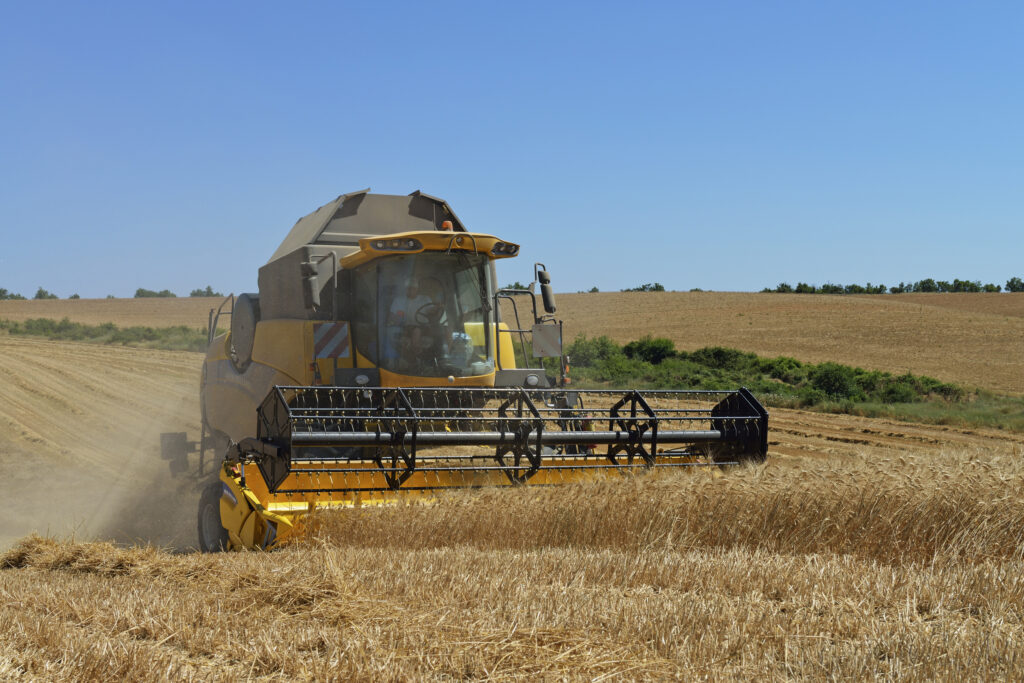
Because several production factors are unfavourable… First, the climate, with highly contrasting weather conditions since the spring, a lack of rainfall in April, early peaks in temperature at the end of May and, of course, the historic heatwave across mainland France in late June, all of which accelerated the growing cycle. In many areas, grain filling came to a halt. This phase is crucial for wheat grains to grow and accumulate reserves, as the plant transfers starch and proteins into the grain at this stage. All this could potentially be detrimental to yields. It should be emphasised that the considerable variation in circumstances, already observable in recent years, is likely to become more pronounced between regions, with, of course, greater difficulties in those where soil moisture reserves are very low. This climatic context also explains the early start of the 2026 wheat harvest, which began as early as June in some regions. Here too, this is a trend that has been intensifying for more than a decade: wheat in France is being cut increasingly early in the summer. Nor should we underestimate the danger of fires, when extreme heat and drought make harvesting hazardous. Several departments have restricted the hours during which machinery can operate in order to limit outbreaks of fire. This is unavoidable, but it complicates the organisation of the harvest and all the necessary logistics that must be mobilised within such a short period of time (transport, delivery to silos…). It is too early to estimate the size of the 2026 harvest and provide a precise, comprehensive and accurate assessment. We must wait until the end of the summer. However, these climatic conditions are already producing a highly variable picture across the country, with socioeconomic consequences that will need to be monitored.
The vast majority of cereal growers in France have already been weakened by rising production costs, made even more pronounced by the increase in fertiliser prices in recent months, notably as a consequence of the conflict in the Persian Gulf and European sanctions on Russian fertilisers. France also faces issues relating to taxation and the over-transposition of regulations, compared with practices elsewhere in the European Union, which weigh on the competitiveness of the country’s producers. There is also an international context that helps explain the despondency of French cereal growers: a global wheat price that is lower than it was at the beginning of this decade and difficult export conditions because of competition, not to mention the loss of exports to Algeria. France has sold no wheat there for more than two years, although Algeria was the leading purchaser of French wheat throughout the 2000s and 2010s, during which time the volumes involved even exceeded those destined for the French milling industry!
Could wheat cease to be a major asset for French agriculture?
The question, although admittedly still somewhat excessive, deserves to be asked. Wheat is central to France’s agricultural strength. It is the most widespread crop across mainland France, and one farm in two in France still grows wheat. This cereal, with an average annual harvest of around 35 million tonnes, also contributes to the country’s trade, since one tonne in two is exported, with, broadly speaking, half of these sales going to European Union Member States and the other half to the rest of the world, particularly North Africa, West Africa and China. In my book, I was keen to explain why wheat had been France’s golden oil since the 1970s and how this production plays a strategic role for our country that extends far beyond agriculture alone. However, if I were to update this analysis, or at least project it further into the future, I would be tempted to change the title of my chapter on France. This would no doubt be to warn of a previously unthinkable scenario after 2030, in which the annual harvest would be significantly smaller. I would call this chapter “France without wheat?”, deliberately retaining the question mark.
Why this forward-looking assessment? The area sown with wheat has fallen by 20% over the past decade, from 5 to 4 million hectares. Since 2023, most wheat producers in France have had negative incomes. This is unsustainable over time. The future Common Agricultural Policy (CAP), whose financial framework and policy direction remain unclear for the period after 2027, could compound the difficulties facing arable farming in certain regions and on both small and large farms. The ageing of farmers in France, mirroring the ageing of the country as a whole, will lead half of them to retire after 2030. Without profitable businesses and medium-term strategic visibility, farmers will turn away from wheat and grow other crops, which may be more profitable and benefit from a less unstable political and regulatory framework. For those approaching retirement, there is a strong temptation to minimise costs, not to sow and to leave fields fallow. Moreover, the climate, which is making production more difficult, particularly in areas where soils are less fertile and water is more frequently scarce, could become a weapon of mass deterrence against growing wheat in certain regions. Wheat would remain resilient in Hauts-de-France and eastern France, but would become less widespread and, above all, less profitable in other regions, particularly in the southern half of mainland France. A controversy should also be mentioned: some will argue that a harvest reduced by half would not be particularly damaging, since France would retain enough wheat to meet its domestic needs. No longer exporting would not be a problem. This is jumping to conclusions, because exports also help maintain competitiveness at home… The equation is often more complex in these arenas where figures and geography intersect. If France no longer exports, this will also add another variable of uncertainty to global balances.
Is France still a leading player? More broadly, how is the global wheat economy faring? Is it still as dependent on production from the Black Sea region?
France remains one of the few countries in the world that both produce and export wheat, a club of around ten members, while the entire planet consumes this cereal in every possible form. According to AMIS figures, the global wheat harvest for 2025-2026 reached a record level, estimated at 840 million tonnes (Mt), compared with an average of around 750 Mt at the end of the 2010s. However, this record will not be broken next year, as climatic conditions are expected to be extremely difficult because of a powerful El Niño episode, resulting in declining wheat harvests in several regions of the world. The global harvest for 2026-2027 could fall back to 800 Mt, or even lower. Global wheat consumption now exceeds the 800 Mt threshold, driven by population growth and urbanisation, particularly in Asia and Africa. It should also be noted that half of the wheat produced and consumed worldwide is now concentrated in Asia. Among exporters, Russia and Ukraine remain major suppliers to the global market, exporting 45 and 15 Mt respectively, together accounting for 30% of global supply. It should be noted in passing that they now supply the Algerian market, with Ukraine even becoming its leading supplier this year! The United States accounts for 12%, half its share thirty years ago, as the area planted with wheat has fallen to an extremely low level, not seen since the end of the 19th century. The country is abandoning wheat and focusing on maize and soybeans. The European Union, for its part, exports 30 Mt, equivalent to 15% of all wheat currently exported worldwide. In 2025-2026, the volume traded internationally also reached a historic record of 210 Mt.
In summary, the Black Sea region represents a geopolitical centre of gravity for wheat (although it contains a considerable degree of future unpredictability), global production broadly matches global consumption, stocks are drawn down when harvests are poorer, and each year there is hope that climatic and geopolitical disruptions will not combine too severely. Logistics is becoming increasingly crucial, both for transporting goods over short and long distances and for preventing the loss or waste of what is harvested, stored and processed. Every investment in logistics is a guarantee of lasting competitiveness, particularly when combined with digital solutions that optimise every link in the cereal supply chain. Nevertheless, a word should be said about the global wheat price, which does not always reflect these structural dynamics. After considerable inflation in 2022, it experienced a prolonged decline from 2023 to 2025, stabilising at around €200 per tonne. Since the beginning of 2026, it has occasionally risen slightly, but remains around this average level. This is somewhat paradoxical, as demand continues to grow and geopolitical shocks have multiplied. However, global stocks are comfortable and none of the world’s major wheat producers has suffered a serious harvest failure. It is as though the markets are becoming accustomed to the volatility of the world: risks are no longer feared, they are lived with, but shortages are dreaded, so efforts are made to avoid them. Perhaps the world does not need more cereals or wheat… What is certain, however, is that it has a greater need for stability in production in this era of widespread uncertainty. It is for this reason that I have been emphasising for months that, for the world as for France, in wheat and agriculture more broadly, the real challenge is determining how consistently we will be able to produce. Producing every year with consistency, in both quantity and quality, could become the principal strategic challenge. As uncertainty grows over possible futures, particularly given the imperfect grammar of contemporary international relations, in which national self-interest is proliferating, we are seeing the notions of sovereignty and strategic agricultural reserves re-emerge.