
Interviews / Europe, European Union, NATO
29 June 2026
Exceptional heatwaves, what are the consequences for European economies?
-

Dominique Plihon
Professeur émérite d’économie à l’université de Sorbonne Paris Nord, membre des économistes atterrés
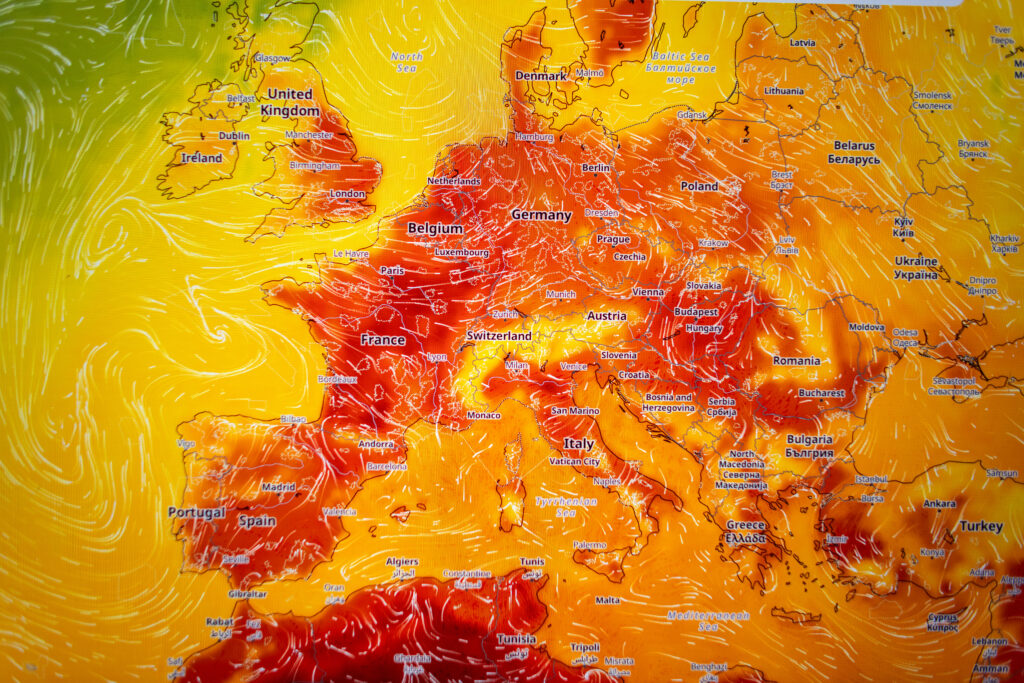
Since 17 June, France has been experiencing an exceptional heatwave, with temperatures reaching as high as 44.3°C in the Landes department. This heatwave has affected the whole of Europe, where numerous temperature records have been broken, in some cases reaching unprecedented levels. At a time when Europe is particularly exposed to climate change, European economies are especially vulnerable to the consequences of these episodes of extreme heat. This latest heatwave illustrates the scale of the climate challenge and raises questions about the ability of states to adapt to extreme weather events that are set to become increasingly frequent. What impact do these heatwaves have on economic activity across Europe, and which sectors are the most vulnerable? Are the policies implemented by European states genuinely effective in limiting their consequences? Finally, how can the European Union adapt its policies to better protect its economy against increasingly frequent heatwaves? Insights from Dominique Plihon, Emeritus Professor of Economics at Sorbonne Paris Nord University and a member of the Économistes atterrés.
To what extent are climate change, and heatwaves in particular, affecting European economies? Which economies and sectors are the most severely impacted?
In July 2025, Europe experienced a major heatwave similar to the one seen in 2026. Economists at the European Central Bank (ECB) published a study analysing its effects on the European economy, concluding that it had lasting consequences for economic activity in the regions affected.
According to the study, summer heatwaves reduce economic activity by around 1% in the first year, and by 1.5% two years later. Similarly, economic activity remains 3% lower four years after a drought and 2.8% lower four years after a flood. This contradicts the idea that economies recover quickly from extreme climate events.
Agriculture is the first sector to suffer from extreme heat, as crop yields decline during heatwaves. The tertiary sector, in other words services excluding agriculture and industry, is also heavily affected. The study shows that investment in these sectors increases during heatwaves, but productivity does not. Why? Because these additional expenditures are used to improve resilience to high temperatures, for example through air conditioning, rather than to invest in technologies that would enhance long-term productivity.
Heatwaves also drive up food prices. In 2022, an extreme heatwave increased food prices in Europe by 0.7 percentage points. According to the ECB study, an equivalent heatwave could lead to an increase of 1.8 percentage points by 2060.
These effects are also likely to intensify. Regions that are already warm experience the greatest economic impacts because high temperatures become unbearable more quickly. As global warming progresses, an increasing number of European regions are likely to face similar conditions. If global temperatures rise by an average of 3°C, summer days in Europe could become up to 6°C hotter by the end of the century.
What measures have European countries put in place to counter the effects of climate change? Are some countries better prepared than others to adapt to these impacts?
It is difficult to determine which countries are best prepared to respond to the climate crisis, as national policies differ considerably. Germany, for example, decided to phase out nuclear energy in 2023 in favour of renewable energy, whereas France has made it a priority source of energy, despite the fact that its environmental sustainability remains open to debate over the long term.
In 2019, the European Union (EU) adopted the European Green Deal, an ambitious strategy intended to place the EU at the forefront of efforts to tackle climate change, with the objective of achieving carbon neutrality by 2050. The Green Deal was to be implemented through the Fit for 55 legislative package, covering a wide range of policy areas including transport, housing and international trade. Its flagship measures include the ban on new petrol and diesel engines from 2035, the reform of the carbon market through the removal of free allowances, and the gradual introduction of a Carbon Border Adjustment Mechanism from 2025.
The European Commission also planned a €1 trillion investment programme for the period 2021-2030 to finance green investment, particularly in the development of clean energy and support for research and innovation in low-carbon technologies.
Are current European policies sufficient to protect the economy against increasingly frequent extreme climate events? What changes should the European Union introduce in order to build a more sustainable economy that gives greater consideration to climate-related factors?
It is far from certain that current European policies are sufficient to protect the EU against the effects of climate change. Quite the opposite! Following the 2024 European elections, there has been a profound shift in direction, amounting to a rollback of the climate policy previously driven by the European Commission. The elections altered the balance of power within the European Parliament, where the Greens and the left lost their majority. The Parliament is now dominated by the right and the far right, both highly critical of climate policies, which they regard as overly “punitive”.
Under pressure from the new majority in the European Parliament, together with powerful industrial and agricultural lobbies opposed to the new rules set out in the Green Deal, the Green Deal itself has come under sustained attack. The Fit for 55 legislative package at the heart of the Green Deal is being progressively dismantled, as illustrated by the recent proliferation of so-called “omnibus” directives, whose purpose is to deregulate the EU in order to “free” economic actors that are supposedly constrained by European bureaucratic rules considered counterproductive, lacking in transparency and damaging to the competitiveness of European businesses.
Building a more sustainable economy within the EU would require abandoning the current policies that are leading to the dismantling of the Green Deal, at a time when the ecological crisis is accelerating, as demonstrated by the growing number of extreme climate events in recent years.
Restoring the Green Deal is all the more necessary given that, according to the Intergovernmental Panel on Climate Change (IPCC), Europe will be the region of the world most severely affected by these episodes of global warming…