
Analyses
8 July 2026
What chess and go tell us about the world… and why Machiavelli’s chessboard tells us something entirely different
-

Dr. Justin Larouzée
Holder of the CPJ Chair in “Systems, Uses, Risks & Territoires” at UTTOP, and associate researcher at the Centre for Research on Risks and Crises at Mines Paris – PSL
-
Dr. Emmanuel-Pierre Guittet
Founder and director of EXPOL Consulting, associate researcher at CECLS and associate expert at CERI at Sciences Po Paris
Three games, three ways of inhabiting reality. On the one hand, the rules that contrast the chessboard with the goban and outline two almost symmetrical philosophies of action, two relationships with time, the opponent and force. On the other hand, the rules of Machiavelli’s chessboard – or Djambi –, a forgotten game of strategy and power. This analysis offers a fresh reading of the work of strategic cultures specialist Pierre Fayard, while exploring the contemporary relevance of Djambi as a means of deciphering the transformations of an unpredictable world.
Almost everyone knows chess, those in the know are familiar with go, and almost no one has heard of Djambi; this is an assumption that seems to us representative of the popularity of these three strategy games. It is even more likely, however, that the relationship between these games and strategic cultures remains largely unknown, regardless of how familiar the reader may be with them[1]. Yet sitting down in front of a chessboard does not merely involve moving wooden pieces across black and white squares, but also, unknowingly, embracing an entire way of thinking. Rules that appear self-evident are in fact crystallisations of a worldview, in this case, one that has developed in the West over the centuries. Moving on to go, placing the first stones on the intersections of a goban, means entering another mental universe. Another game begins, another philosophy takes shape in physical, metaphorical and symbolic space. Every society develops its own way of conceiving the art of achieving its objectives, seldom articulated and always inherited. A French person instinctively approaches strategy in the French manner, just as a Japanese person does in the Japanese manner, and it often takes a detour through a foreign culture to become aware of one’s own. Games are precisely what make this detour possible. They are condensed representations, models, even miniature worlds in which we can discern the principles governing our ways of acting.
Who moves first, and where?
Differences can be observed from the very first move of a game (cf. Figure 1). In chess, White moves first, meaning, metaphorically: light. In go, Black moves first, meaning darkness. This is because, in China, the day begins at midnight, it is born in the night, from which light grows until noon, the beginning of night, when shadow begins to grow (the principle of Yin & Yang). In Chinese culture, therefore, strategy begins with what cannot be seen. Whereas all the pieces, all the power, are visible on the chessboard at the outset, the goban is initially empty and the opening configurations are imperceptible. On one side, a way of thinking based on manifestation and assertion; on the other, one based on potential that matures in the shadows.
Machiavelli’s chessboard, or Djambi, with its four competing camps, escapes the light/darkness, white/black duality and therefore supports neither of these metaphorical structures or strategic cultures. The other dualism that Djambi escapes is the relationship between emptiness and fullness, as in chess the pieces are present and exposed at the beginning of the game, but every eliminated piece remains on the board. Unlike chess, which follows a subtractive dynamic, or go, which is based on an additive principle, Djambi operates within a closed system. In Djambi: nothing is lost, nothing is created, everything is transformed; the conceptual analogy is with the chemist Lavoisier’s law of conservation of mass, or with the first law of thermodynamics, known as the law of conservation. This vision produces a strategic approach imbued with pragmatism, in keeping with Machiavelli’s realist and naturalist thinking.
Figure 1: from left to right, the starting positions on the chessboard, the goban and the Djambi board.
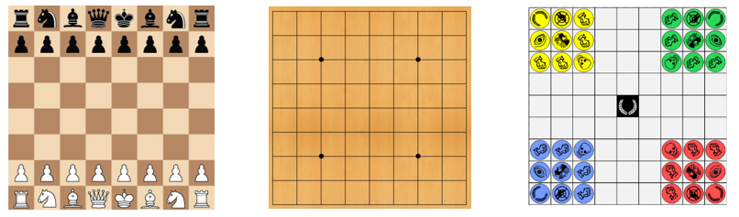
In all three cases, the second move confirms what the first had suggested. In chess, players immediately seek to control the centre, concentrating their forces there in order to exclude their opponent. In go, play begins along the edges, in an apparent dispersal of forces. For a player trained in the Western tradition, this empty centre is a challenge. The opponent establishes a position somewhere, and the instinctive response is immediately to confront them locally. The logic of go is diametrically opposed, responding globally and from a distance, deliberately leaving the centre open for future opportunities. Chess and go once again appear radically antagonistic, whereas the opening phase of a Djambi game is devoted to manoeuvres involving the reorganisation and repositioning of pieces in order to protect resources and create potential for action, but above all to discussions between players aimed at forming alliances and jointly developing strategies. Djambi’s orthogonality is radical: what matters lies outside the game (the board). Its strategic culture is based on shifts between logical levels (meta-perspectives) and communication.
Destroy or build
The opposition between chess and go becomes more pronounced when their game mechanics are examined. Chess is played through simplifying destruction. Winning often means reducing the opponent’s potential. By literally capturing pieces and removing them from the chessboard, the player clears the area around the king in order to reach it. The game is a progression towards checkmate, achieved through subtraction. When applied to international relations, this approach produces a strategy that consists of weakening an adversary (through economic sanctions, embargoes, or disinformation campaigns), with the aim of isolating it and reducing its influence on the world stage.
Go is played through construction. Players place stones, weave relationships and surround territories. These territories consist of empty intersections, and this emptiness is fertile. This strategic approach can be observed in China’s policy in Africa. Rather than seeking to dominate through force or direct confrontation, China invests heavily in infrastructure, establishes economic partnerships and develops strong diplomatic relations with numerous African countries. By building roads, railways and ports, China creates networks of influence and cooperation that enable it to secure strategic resources while strengthening its presence on the continent. This strategy of weaving relationships and surrounding economic and political territories reflects the philosophy of go, in which patience and gradual construction lead to subtle but effective domination. Pierre Fayard (2000) describes go as reflecting the strategic culture of a rural society in which wealth lies in caring for and preserving the land. However, although China’s strategy in Africa adopts the subtle appearance of go and avoids confrontation, it nevertheless pursues a logic of resource capture, seeking to maximise influence and control through economic rather than military means.
Djambi, for its part, offers a hybrid dynamic. Under certain conditions in Djambi, a player can take control of the pieces belonging to a defeated opponent, meaning that eliminating too much of the opponent’s material is not necessarily advisable. Moreover, pieces that have been “killed” are not removed from the board. On the contrary, the “corpses” become obstacles, metaphorically representing traces of memory and, by analogy, the ruins of battlefields, which players must continually take into account. This mechanism reflects a contemporary strategic reality: far from clarifying the field of action, conflicts saturate it with material and symbolic remnants. Mass bombing, the destruction of infrastructure, the forced displacement of populations: all these phenomena permanently reorganise strategic spaces and political options. In this context, violence is not limited to the elimination of opponents. It produces remnants that obstruct decision-making spaces and complicate future strategies. These remnants include not only material destruction (ruined buildings, destroyed infrastructure), but also intangible consequences, such as psychological trauma, collective humiliation and social stigma. In Gaza, mass destruction and restrictions on movement are not merely acts of war: they establish a state of constant precarity, transforming everyday life into an instrument of control and domination.
This mechanism of the “corpse that remains on the board” finds a theoretical echo in the concept of necropolitics developed by the philosopher Achille Mbembe. In his seminal 2003 essay, he defines contemporary sovereignty not merely as the power to sustain life, but as “the power and the capacity to dictate who may live and who must die”. Necropolitics therefore refers to the way in which certain regimes of power organise death, or exposure to it, as an instrument of government. The objective is not total destruction, but the creation of an intermediate state: populations maintained in what Achille Mbembe calls “death-worlds”, neither entirely alive nor entirely dead, subjected to a permanent state of precarity that makes them governable. The Djambi board illustrates precisely this logic: “killed” pieces do not disappear, they remain, obstruct and constrain. Similarly, in Gaza, the destruction of infrastructure is not aimed solely at neutralising military capabilities; it creates a space in which ordinary life becomes impossible, where every journey and every everyday action is subject to permission or prohibition. Achille Mbembe in fact used occupied Palestine as a paradigmatic case in his analysis, seeing it as the materialisation of sovereignty exercised through territorial fragmentation, the control of mobility and the differential management of death. What Djambi makes visible on the board, necropolitics makes visible in geopolitical space: violence does not erase, it accumulates in layers.
Russia’s war against Ukraine offers another illustration of necropolitical logic. Repeated strikes against Ukrainian energy infrastructure are not intended solely to weaken the country’s capacity for military resistance. They create a deterioration in living conditions, exposing millions of civilians to winters without heating, forced displacement and a state of precarity that becomes entrenched over time. The populations are not eliminated, but their existence is made so precarious that they lose any ability to act freely. On the Djambi board, as in these conflicts, corpses accumulate and permanently reconfigure the players’ strategic options. Another physical metaphor could be invoked, that of the second law of thermodynamics, known as the law of entropy, which establishes the irreversibility of physical phenomena and the increase in entropy. Observing these three games thus reveals not only different strategies, but also different worldviews: annihilating in order to triumph, building in order to prosper, or living alongside chaos in order to prevail.
Figure 2: from left to right, endgame positions in chess (fewer pieces), go (more stones) and Djambi (the same number of agents).
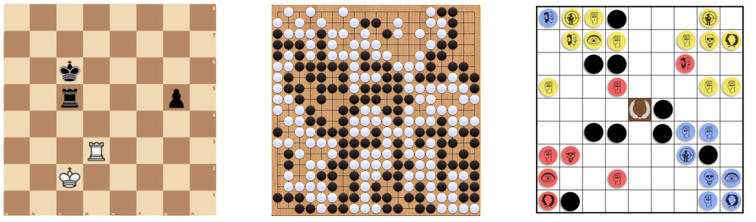
The relationship with construction, destruction or transformation relates to the concept of value. In chess, every piece has its own value. The queen is worth more than a bishop, and a bishop more than a pawn. Hierarchy is embedded in the pieces themselves, and this is neither subjective nor poetic: their values are quantified[2]. he value of the pieces is only marginally contingent[3], and is regarded as stable throughout the game. In go, all stones are equal. Their strength does not derive from their intrinsic properties, but from the way in which they are arranged and connected. Strength is relational, never essential. One is not strong simply because one is strong, but because the situation makes one strong. Once again, Djambi escapes this distinction: the pieces are not equal (either in appearance or in power), but their value varies according to the context, and pieces that are useless and vulnerable at the beginning of the game gain power and usefulness as the game progresses, while the reverse is true of others[4]. Djambi therefore highlights a dynamic and contingent relationship with value, which is fluid and dependent on events[5].
Against the other, with the other
In chess, one plays against the opponent. Their pieces must be eliminated, their king brought down. In go, one plays with the opponent. This does not mean abandoning the intention to win, quite the opposite. The opponent is not prevented from establishing territories, and may even be encouraged to do so, provided that this costs them a great many stones and concentrates their forces locally, thereby freeing up the wider field. The other is not an obstacle to be destroyed, but a potential to be used. Following Sun Tzu, one recognises that the fact that the other is an enemy does not mean they cannot be useful to me. It is nevertheless necessary to understand how they operate, what motivates them and what makes them move. Hence the primacy given in the Chinese tradition to knowledge over resources, and to information and intelligence.
Djambi moves beyond this opposition between confrontation and coexistence. It is based on a logic of alliance and betrayal, in which the other can simultaneously be an ally, a rival, a stepping stone or an obstacle. This strategic complexity reflects the contemporary dynamics of international relations, in which actors must navigate between cooperation and competition. The signals sent by states, whether alliances or threats, are often ambiguous and require constant interpretation, as do the manoeuvres in Djambi.
The crisis in the Red Sea since the end of 2023 offers a striking illustration of this logic of unstable alliances and potential betrayal. Attacks by Yemen’s Houthis against commercial vessels in the Bab-el-Mandeb Strait have forced dozens of shipping companies to divert around Africa, extending journeys by several weeks and considerably increasing global logistics costs. In this configuration, the Houthis are not playing against a single opponent, but simultaneously with and against several actors. Iran, which supports them, the United States, which bombs them, the Gulf states, which monitor them, the world’s trading powers, which bear the consequences of the disruption. None of these actors is a pure enemy or a reliable ally; each is, depending on the moment and the issue at stake, a temporary partner or an obstacle to be circumvented. This is precisely the logic of Djambi: on a board divided between four camps, the alliance of the moment may become the betrayal of the future, and calculated neutrality may be preferable to unequivocal engagement. The Red Sea also illustrates how a weak actor can saturate the strategic space of a stronger one, not by destroying it, but by making its field of action more costly and uncertain, something that Djambi’s “corpse” mechanic conveys with remarkable precision.
In a different context, relations between the United States and China over Taiwan and the Indo-Pacific embody the opposition between the logic of chess and that of go. Washington tends to think in terms of formal alliances, red lines and direct deterrence – an approach based on assertion and direct confrontation, inherited from Western strategic culture. Beijing, for its part, advances through gradual encirclement: the construction of artificial islands, the development of the Belt and Road Initiative, and investment in ports and infrastructure in third countries. China does not seek to control the centre first, but the edges, exactly as in go. The tension between these two strategic cultures, one seeking rapid decisions and the other cultivating potential that matures in the shadows, constitutes one of the underlying drivers of Sino-American competition.
The warrior, the sage… and the diplomat
The sinologist François Jullien (2016) proposes two archetypal figures to illustrate the strategic orientations embodied respectively by chess and go. For the chess player, the figure of the warrior: armed and engaged in battle, he stands apart from the situation he intends to transform. He has a plan, applies it and reduces the obstacles. He masters the world, calculates and optimises. What matters is energy and willpower. Pierre Fayard identifies in this the Hollywood narrative of the hero who triumphs through sheer force of will in a world in which good and evil are clearly distributed; and, more profoundly, the monotheistic heritage that separates the creator from his creation, the strategist from his terrain, and the ends from the means. For go, the proposed figure is that of the sage. He does not distinguish himself from the environment in which he acts, but forms part of it. He is invisible because he is within it. He has no plan to impose, but an intention. He seeks to understand, to blend in, and to identify the active forces and movements that he might use. His will disappears into the process. As in aikido, he gives his opponent no point of leverage, leaving them unsure what they should oppose. He advances, through small movements, from the invisible to the inexorable. We propose associating the Djambi player with the archetypal figure of the diplomat. In a fluctuating world, he alternates between the figure of the fox and that of the lion[6]. He is ambivalent and cultivates virtù and mētis, in other words, situational intelligence. He knows how to roar and display strength, but also how to reassure and offer. His word is constantly doubted, yet it is impossible to dispense with it. He knows that politics has its own morality and that, as Machiavelli writes, “a war is just when it is necessary”.
The figure of the Machiavellian diplomat takes on an additional dimension when viewed through the prism of necropolitics. The diplomat does not merely negotiate peace or war: he also deliberately manages the distribution of death and life. Achille Mbembe reminds us that modern sovereignty is exercised not only through brute force, but through the capacity to decide who will be protected and who will be exposed, who will benefit from legal guarantees and who will be left in a permanent state of exception. The Djambi diplomat embodies this ambivalence: depending on the circumstances, he can offer a life-saving alliance or withdraw his protection, leaving a former ally at the mercy of the other players (Larouzée & Guittet, 2026). This logic can be found in the harshest contemporary diplomatic practices. When powerful states make their humanitarian or military assistance conditional on political concessions, or use access to medicines, food or infrastructure as negotiating leverage, they exercise precisely the necropolitical power described by Achille Mbembe: not killing directly, but deciding who will have the means to survive. In Djambi as in international reality, the figure of the Machiavellian diplomat is therefore inseparable from this strategic management of life and death.
A lesson for our time?
Why take this detour through two ancient games and compare them with an obscure and largely forgotten one? Because the world in which we live appears increasingly resistant to Manichaean or reductive approaches. It is interdependent, and a localised crisis has global repercussions. It is changing, with technologies and practices transforming at a speed unprecedented in the history of our species. In Olivier Hamant’s terms (2023), the world has become fluctuating (dynamic and uncertain). All the more uncertain because, as Bertrand Badré and Saurabh Mishra point out, “infrastructure, increasingly guided by algorithmic systems, tends to make certain futures inevitable while making others impossible to envisage”. They continue their argument as follows: “this phenomenon illustrates a major danger within contemporary dynamics: the gradual loss of societies’ capacity to choose between competing paths. This new world order is being solidified in concrete and coded into silicon”. Achille Mbembe’s necropolitics offers one final insight. In a world where conflicts no longer end in clear victories, but in states of saturation, the fundamental strategic question is no longer “how can we win?” but “how can we govern the remnants of violence?”. Societies capable of managing collective trauma, material ruins, conflicting memories and displaced populations are those that retain a capacity for action over the long term. Those that seek to deny or erase them through a new wave of violence become trapped in an entropic spiral for which Djambi, with its board that is never cleared, offers the most accurate metaphor.
For Sun Tzu, in The Art of War, weapons are instruments of ill omen that should be used only as a last resort, once all other means have failed. Following his thinking, there are three major strategic avenues: cunning, diplomacy and arms. The essence of these three registers can be found in go, Djambi and chess. These orientations are complementary, the issue is not to choose a side, but to broaden one’s repertoire. For strategic culture, to borrow Pierre Fayard’s elegant phrase, is like agriculture: it is cultivated, inspired and improved.
[1] The historical origins and rules of chess, go and Djambi can easily be consulted online, for example on Wikipedia: chess; go; Djambi.
[2] The queen is worth 9 points, the rook 5, knights and bishops 3, and a pawn only 1. The king, whose loss marks the end of the game, has no value: it is priceless.
[3] At an advanced level, it can be observed that bishops are more valuable in open positions, while knights perform better in closed positions.
[4] The necromobile becomes more useful as the game progresses, while the diplomat tends to become less so.
[5] As is a Prince in relation to the qualità dei tempi, according to Machiavelli.
[6] Niccolò Machiavelli, “How Princes Should Honour Their Word”, Chapter 18 of The Prince (1532): pp. 74-77.
Bibliography
Pierre Fayard, La maîtrise de l’interaction, L’information et la communication dans la stratégie (Paris: Zéro Heure Éditions, 2000).
Olivier Hamant, Antidote au culte de la performance : la robustesse du vivant (Paris: Gallimard, 2023): pp. 1-63.
François Jullien, La propension des choses. Pour une histoire de l’efficacité en Chine (Paris: Éditions du Seuil, coll. “Points Essais”, 2016).
Justin Larouzée and Emmanuel-Pierre Guittet, “Gestion de crise, prise de décision et engagement : réflexions croisées sur l’utilisation du Djambi comme dispositif ludopédagogique”, Revue (In) Disciplines 5, (2026).
Niccolò Machiavelli, Le Prince, translated by Jean Vincent Périès. In Œuvres politiques de Machiavel. Text established by Ch. Louandre (Paris: Charpentier, 1855. First edition, 1532).
Achille Mbembe, “Necropolitics”, Public Culture 15, no. 1 (2003): pp. 11–40.