
Interviews
21 April 2026
“The central role of the scientist is that of a sentinel”
-
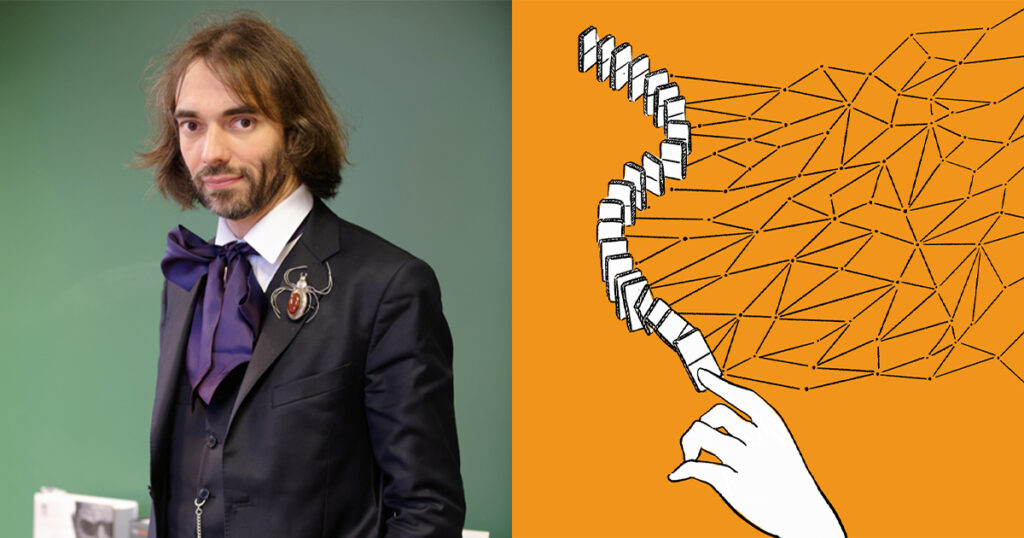
Interview with Cédric Villani
Mathematician and former member of parliament
-

Interview conducted by Léa Samara, Julia Tasse and Marc Verzeroli, on 8 January 2026.
This text is a complement to the interview with Cédric Villani, mathematician and former member of parliament, as part of the dossier in La Revue internationale et stratégique no. 141, “War of systems: an alphabet of resilience” (Spring 2026). Entitled “Modelling instability? Complexity in the service of strategic decision-making”, this major interview, available in the journal, successively addresses the thinking behind complex systems, modelling and scenarios, not in order to predict, but to inform decision-making under conditions of uncertainty. In this additional text, available exclusively online, Cédric Villani reflects on the role of scientists in public debate in a context of growing attacks on science.
What role can scientists play today in public debate, in the face of rising challenges to science, without substituting themselves for politicians, but while making the specificity of their approach heard?
Scientists and politicians pursue distinct objectives. Scientists seek truth, at the cost of doubt and constant revision; politicians seek justice, that is to say what it is legitimate to decide. The former, the scientist, must not adapt their research to the expectations of those in power, but may take the context into account in order to assess the field of possibilities, as with Working Group III of the Intergovernmental Panel on Climate Change (IPCC), the group working on action. The latter, the politician, can – and should – rely on the state of knowledge. The independence of science and politics is a founding principle of modern societies, intended to guarantee academic freedom and avoid the distortion of science.
One might object that the current period is marked by distrust towards scientists. Yet in recent crises, this distrust has targeted not so much science itself as the scientific system, perceived as institutional and at times instrumentalised, with researchers assimilated to extensions of political power. To restore trust, it is therefore crucial that scientists be able to address citizens directly, outside strictly institutional discourse, and embrace forms of embodiment and proximity, within reasonable limits. Conversely, in the United States, one can observe a more brutal marginalisation, where political power denies scientific legitimacy and censors fields of research. Faced with these two risks – social distrust and political pressure – the scientist’s mission is twofold: to preserve independent research and to remind politicians that, although they remain the sole decision-makers, their choices benefit from being informed by science.
The forms of interaction between science and politics are well described by Roger A. Pielke who, in The Honest Broker[1], distinguishes four configurations. The first is that of the scientist as provider of knowledge, who publishes results and leaves it to politicians to draw conclusions from them. The second corresponds to responding to a commission, when academies or experts are called upon to inform a specific decision. The third is that of collective warning, when scientists mobilise to signal an emergency, as the IPCC has done regarding climate, or in France, researchers warning about Parcoursup in light of changing university demographics. Finally, the fourth consists in proposing coherent scenarios without prescribing a single choice, as in the work carried out by RTE presenting different energy pathways.
In the current context, marked by a sharp acceleration of crises, the growing technicisation of issues, and a tendency to make decisions on the basis of news stories or emotions, the scientist’s central role is also that of a sentinel. It involves reminding people of orders of magnitude, verifying the coherence of reasoning, and denouncing unfounded narratives, whether they concern security, technology or climate. The example of carbon offsetting is revealing: presenting projects whose actual impact on emissions remains marginal as decisive, while generating significant financial gains, constitutes a clear inconsistency that scientists must point out. The fact that these solutions claim to be grounded in science and rely on a high degree of technical sophistication makes scientists’ interventions all the more legitimate, even indispensable. A company that achieves one hundredth, or even one thousandth, of what it announced, in an existential societal debate, should receive no indulgence merely because it makes heavy use of technology; on the contrary, it should be assessed more rigorously. And this critical function of the scientist is not intended to decide in place of politicians, but to preserve a rational framework for debate, provided it is carried by identifiable voices.
In a public debate often structured in a binary way, is not the scientist’s mission also, at times, to reintroduce complexity into issues that have been simplified to the extreme?
Formulations such as “for or against climate action” or “for or against war” reduce complex systems to binary oppositions in the public sphere. Yet the scientific approach is based on nuance and uncertainty, which are difficult to reconcile with media formats privileging clear-cut positions. The ideal consists in articulating rigorous and nuanced analysis with messages that are sufficiently simple to be audible and mobilising. Intellectual and political history shows that this dialectic is not new; Marxist thought, for example, combined an extremely dense theoretical corpus, developed within an academic framework, with its condensation into clear and operational slogans capable of circulating widely and structuring collective action. This ability to translate analytical complexity into simple formulations, without entirely denying its depth, remains a central condition of political effectiveness in the contemporary public sphere.
This tension has been exploited by the “merchants of doubt”, analysed by Erik Conway and Naomi Oreskes in Merchants of Doubt[2], who turn scientific nuance against public action, and often use it to trap scientists themselves. The history of the IPCC bears witness to this: as Nathaniel Rich shows in Losing Earth[3], the first reports were long hindered by debates over the choice of words – “certain”, “probable”, “possible” – whose meaning differs between science and the public sphere, delaying the formulation of a politically effective message.
Here is a striking historical anecdote. During the Second World War, the great Italian physicist Enrico Fermi, regarded as the best nuclear experimentalist outside Germany and Frédéric Joliot-Curie, who remained in France, refused to conduct experiments on uranium fission. Leo Szilard, Isidor Isaac Rabi and the other brilliant theorists of the Manhattan Project urged him to try, but he did not believe in the uranium chain reaction. Pressed on the matter, he said there was only a 10% chance it would occur. His colleagues protested: a 10% chance, for a phenomenon as serious as the possibility of an absolute weapon, was obviously enormous! In decision theory, scientific probability must be weighed against potential consequences. E. Fermi carried out the experiments with L. Szilard – the first controlled chain reaction. We know the rest.
The history of the bomb abounds with lessons that remain highly relevant regarding anticipatory management, at the intersection of science, politics and collective responsibility. Including, of course, its unintended consequences, and L. Szilard became a fervent pacifist, organiser of the Pugwash Conferences on Science and World Affairs for disarmament, and of the Doomsday Clock – the clock of the apocalypse, measuring the time that nuclear physicists estimate remains before atomic war; incidentally, today it is closer to midnight than at any time since its creation.
Ultimately, when faced with a serious phenomenon capable of affecting the whole of society, it is important to listen to and encourage research that makes it possible to better understand it, and to adopt proportionate measures. That seems like common sense, does it not? That is precisely what the precautionary principle says, so often criticised by many people who have never actually read it, in the French constitutional framework. And even then, this principle is only enshrined with regard to environmental damage, whereas it deserves to apply to all serious issues. Not as a principle of inaction, but as a rational framework for decision-making under uncertainty when the potential impact requires action.
Interview conducted by Léa Samara, Julia Tasse and Marc Verzeroli, on 8 January 2026.
[1] Editor’s note: Roger A. Pielke Jr., The Honest Broker. Making Sense of Science in Policy and Politics (New York: Cambridge University Press, 2007).
[2] Editor’s note: Erik Conway et Naomi Oreskes, Merchants of Doubt (Paris: Presses universitaires de France, 2021).
[3] Editor’s note: Nathaniel Rich, Losing Earth: A Recent History (Paris: Points, 2020).