
Analyses / Europe, European Union, NATO
19 November 2026
From Yalta to Shenzhen: A Brief History of European Countries’ Sovereignty
-

Senior Research Fellow at IRIS, Head of the Europe, EU, NATO Programme on EU/NATO issues
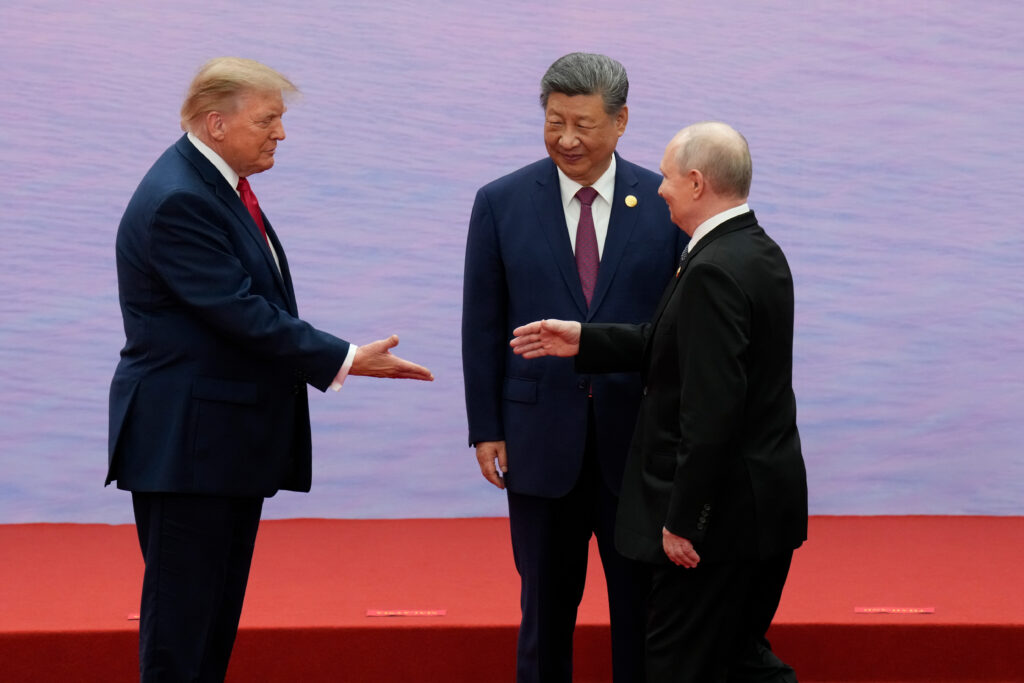
The tripartite summit bringing together Vladimir Putin, Donald Trump and Xi Jinping, on 18 and 19 November 2026 in Shenzhen, China, is not intended to reshape the security architecture of the Old Continent, contrary to what some observers may have suggested somewhat hastily by drawing a parallel with the 1945 Yalta Conference. They do not (yet) have the means to do so, at least for the time being. Nevertheless, the parallels between the events that took place in these two cities, eight decades apart, remain interesting. They can help us to grasp the Old Continent’s long historical trajectory – a slow but inexorable evolution, the course of which, eight decades later, appears not to have changed direction.
On his return from Yalta in February 1945, Winston Churchill was disheartened, just as Europeans are today. Admittedly, at the time Churchill had reason to be proud: he was the only European leader to feature in the famous photograph immortalising him alongside Joseph Stalin and Franklin D. Roosevelt at that summit intended to redraw the map of Europe. But he had realised just how much his country – despite being the most powerful and influential on the Old Continent – had been sidelined by the two new non-European superpowers, which were, in particular, preparing to seal the fate of Central Europe.
A year later, however, Churchill was to take the world by surprise. In a speech that has gone down in history, delivered at the University of Zurich in 1946, he raised the idea of a ‘United States of Europe’. Churchill was certainly no European federalist. His remarks remained vague and were directed primarily at continental Europe. But despite the vague, even inconsistent, nature of his proposal, the old lion had nevertheless learnt one essential lesson from the Yalta Conference: if the European democracies did not wish to be consigned to the dustbin of history by resigning themselves to being subject to the decisions of others, they had to unite politically, economically and militarily, one way or another.
Eighty years later, these same European democracies have failed to take the step towards political union, despite their economic integration. Yet they had attempted to do so in 1950, to no avail. The North Atlantic Treaty Organisation (NATO), established a year earlier, was still in its infancy, whilst West Germany was not yet a member. Faced with the Soviet threat, France had proposed the creation of a European Defence Community (EDC), intended to establish a genuine European army, thereby enabling Germany’s rearmament within a common framework. Admittedly, this army was initially to be placed under the operational command of NATO – and thus, primarily, the United States. But at the time, the long-term nature of the US military presence on the continent was far from assured. The Americans themselves hoped they would not have to remain on the Old Continent indefinitely. The Cold War decided otherwise: American troops established a permanent presence in Western Europe, Germany joined NATO, and the EDC project was eventually abandoned. France itself had withdrawn from the project for various reasons, notably to preserve its national sovereignty.
Much later, the end of the Cold War revealed to Europeans the extent of their dependence and strategic powerlessness. The Balkan wars of the 1990s provided a particularly brutal illustration of this: unable to intervene on their own in the former Yugoslavia to put an end to the massacres, Europeans had no choice but to wait for the United States to intervene. However, Washington had little desire to become involved in a sub-region which, since the collapse of the Soviet Union, had lost much of its strategic importance in its eyes. After much hesitation, the Americans did eventually intervene. But they made no secret of their irritation at the inability of their European allies to take charge of security in their own neighbourhood.
It was this experience, in particular, that prompted Europeans, in the late 1990s, to establish a common defence policy within the European Union (EU). The ambition was clear: to acquire the capacity to intervene where the United States no longer necessarily intended to do so, particularly on the European continent. To date, they have not yet achieved this objective. The EU’s defence policy has, in fact, remained marginal, if not insignificant, as it has continued to come up against the sensitivities of Member States, which remain keen to preserve their national sovereignty. Only a defence industrial policy at EU level has recently come into being, though it lacks an operational dimension.
Even today, in Brussels, whenever a major strategic issue arises, European diplomats and leaders seem primarily concerned about the potential damage that any new joint initiative might inflict on the illusion of their national sovereignty. They prefer to act at national level, and have therefore seen fit to appoint not one, but seven envoys to represent them in peace negotiations with Putin and Trump over Ukraine. In short, it is a way of reminding both their enemies and their false friends that, whilst Europeans may not yet be divided, they will not miss an opportunity to become so.
Meanwhile, the fate of their continent is no longer being discussed in Yalta, but 10,000 kilometres away, in China. And this time, not a single European appears in the photograph. But what, then, is the point of the national sovereignty they are so determined to defend in Brussels?
This article has been translated from French into English using artificial intelligence.