Cartographies / Political and Geostrategic Observatory of the United States
29 January 2026
Donald Trump: War and Peace
-
Deputy Director of IRIS
-

Deputy for Communication
-

Head of Data, Mapping and Infographics
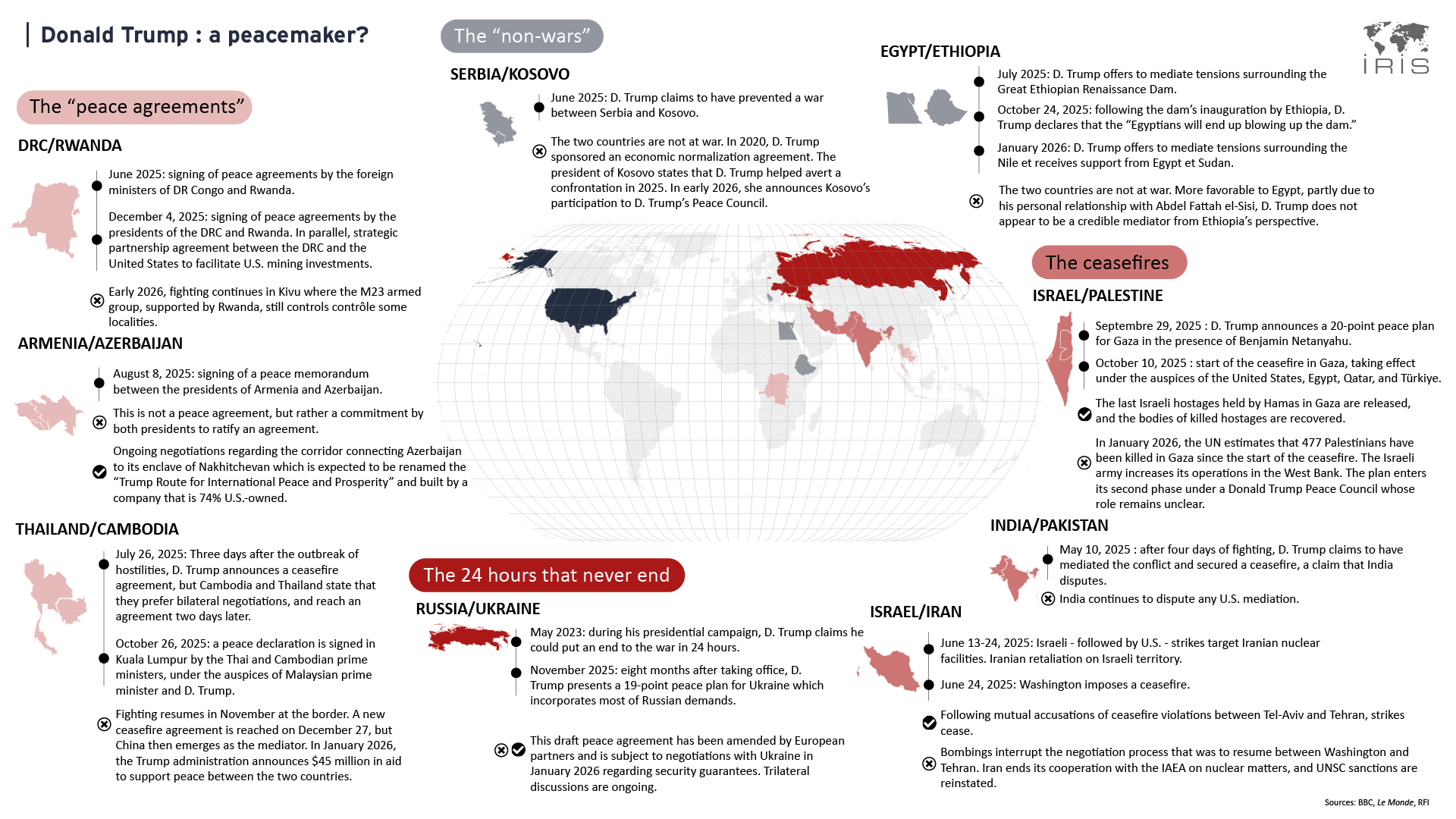
One year in office. Since 20 January 2025, Donald Trump has been a constant presence in most major international affairs, driven in particular by one obsession: winning the Nobel Peace Prize. A legitimate goal, according to his own account, given that he had managed to resolve eight wars – something no one before him had ever achieved. But what is the true story behind his ‘successes’ in conflict resolution? Whilst in some cases (the Rwanda–DRC and Armenia–Azerbaijan conflicts), the US president has indeed facilitated certain steps towards peace — often achieved through the intervention of other actors, but for which he takes full credit —, in other cases he has achieved nothing more than a cessation of hostilities, with no real prospects for a lasting peace (the Israeli-Palestinian conflict, Iran–Israel). He has also claimed to have resolved conflicts that were not actually wars (Ethiopia–Egypt, Kosovo–Serbia). Furthermore, he had claimed to be able to resolve the Russia–Ukraine conflict within twenty-four hours. Whilst negotiations are indeed under way, the US president has so far demonstrated, above all, his ability to give priority to Russian demands. Donald Trump, now at the helm of his nebulous Board of Peace, has ultimately received nothing but the Nobel Prize medal presented to him by the Venezuelan opposition figure María Corina Machado on 15 January.
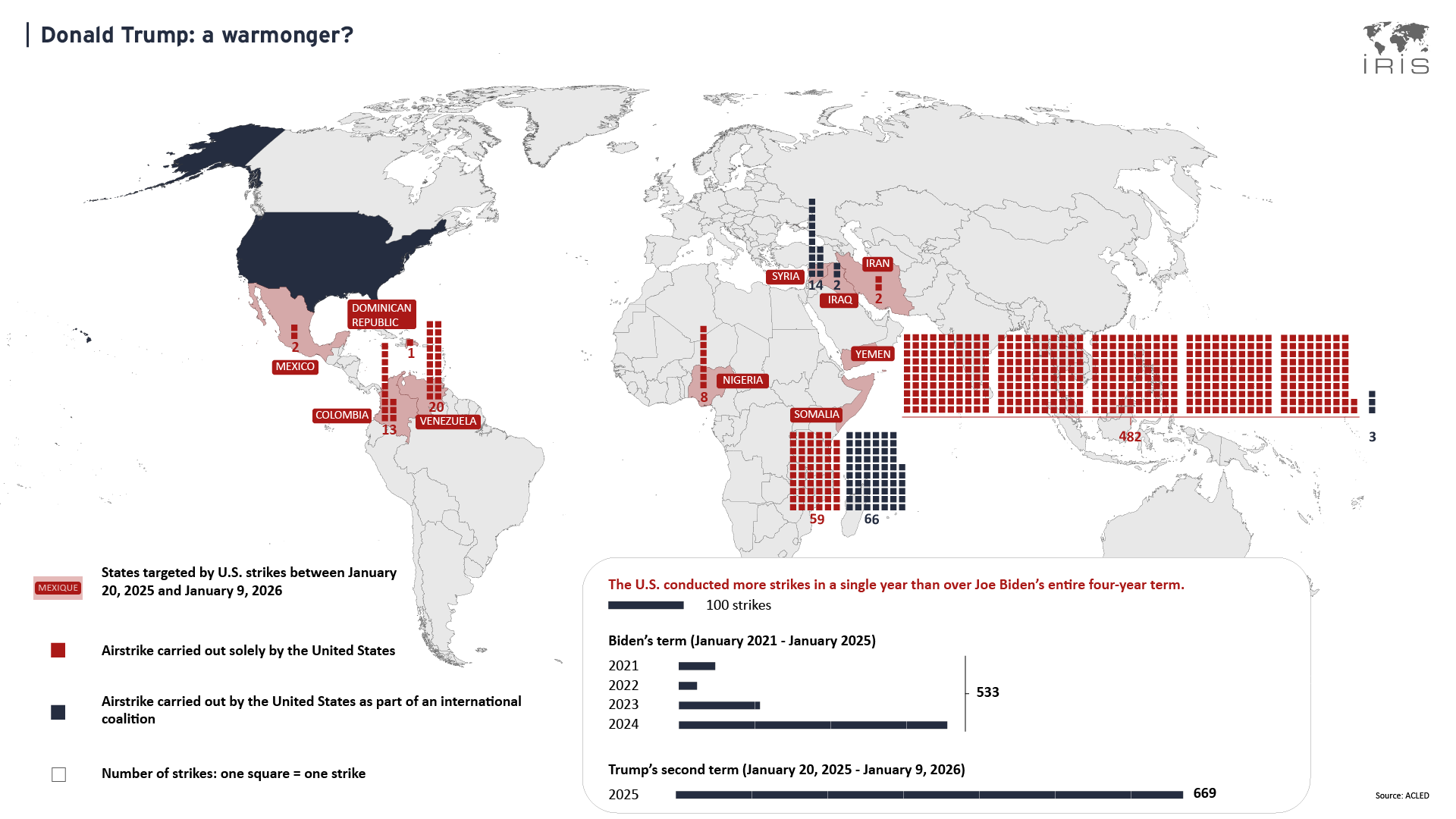
Whilst he may not be a peacemaker, is Donald Trump therefore a warmonger? The man who, since his first term, has rejected US interventionism in conflicts that are too costly has, in this first year of his second term, ordered more air strikes than his predecessor did throughout his entire term. Yemen, Somalia, Syria and, more recently, Venezuela: the president clearly has no qualms about relying on the military’s air power to assert his authority, if not as the world’s policeman, then at least as its sheriff.