
Analyses / Defence, Strategy, Armament
9 June 2026
SCAF: A Damaging Failure for Defence Industrial Cooperation and for Europe
-
Conseiller scientifique, responsable du Programme Défense, stratégie, armement de l’IRIS et d’ARES Group
The abandonment of the Future Combat Air System (SCAF), a joint programme involving France, Germany and Spain, announced by Germany on 9 June 2026, comes as little surprise given the difficulties that France and Germany, and above all the two main industrial actors, Dassault and Airbus, have faced for several years in reaching agreement. It could even be described as a “chronicle of a death foretold”.
In light of this failure, it is necessary to revisit several issues and avoid simplistic conclusions such as “cooperation in armaments does not work” or “we cannot work with the Germans, they are not reliable allies”.
Three issues in particular stand out and should be examined separately.
The failure of cooperation on a defence programme: the two original sins
The reasons behind this failure lie first and foremost in the fact that, on 13 July 2017, France and Germany took the political decision to launch the programme on the basis of a 50/50 division of responsibilities under French leadership, without considering whether such an arrangement was realistically workable. Cooperation on a defence programme is not straightforward. It requires a clear understanding of the respective capabilities of the industrial actors involved in order to allocate responsibilities rationally. The 50/50 model should therefore probably have been adjusted with regard to the combat aircraft component, which was only one of the seven pillars of SCAF, in order to rebalance responsibilities in favour of Dassault, which possessed the greatest expertise in this area. However, this possibility conflicted with the political agreement reached at the outset. The first mistake was therefore to make a political announcement regarding this cooperation before considering the conditions necessary to ensure that such cooperation could function.
But beyond the question of burden-sharing, cooperation on such a scale above all requires that the industrial lead contractors, in this case Dassault and Airbus, have aligned long-term strategic interests. This would have been possible had the two companies envisaged from the outset creating a joint entity to manage the programme, or even establishing a common military aerospace company. No such project existed and Dassault would have opposed it, whereas Airbus would probably have favoured absorbing Dassault. Although the disagreement is indeed industrial in nature, the French and German governments should from the outset have identified the threat hanging over SCAF and sought to address it. The German statement announcing the end of SCAF referred to a “shared assessment that the companies are unable to reach agreement on the development of a common combat aircraft. They acknowledge this reality”. This also illustrates the inability of both governments, whether through lack of willingness or capacity, to address a problem that had existed since the programme’s inception. In this respect, they bear as much responsibility as the industrial actors.
The failure linked to the very design of SCAF
From the outset, the ambition was to develop an integrated future air combat system rather than a simple combat aircraft. This approach was sound, as there is now a need to integrate all components of air combat, including a manned aircraft, unmanned systems, a combat cloud and artificial intelligence, in order to ensure the defence of the European continent. The problem was that this approach made cooperation even more complex within a framework designed around a rigid structure. It was also necessary to take into account the specific features of the defence policies of the participating states, notably the fact that France is a nuclear power and that the aircraft would need to be capable of operating from an aircraft carrier. Solutions were probably possible through changes to the structure of the cooperation itself, but none appear to have been identified. Added to this is the fact that the war in Ukraine has undoubtedly altered requirements.
The failure of SCAF is a major political failure for Europe
In 1985, François Mitterrand addressed Helmut Kohl in the following terms after the failure of the European combat aircraft project: “I wish to reiterate that, in my view, the development of a common military aerospace industry is a fundamental project for security and defence, as indeed for Europe’s technological and industrial future. I can only regret the recent failure of the single European combat aircraft project.”
Forty years later, our leaders have failed to make progress in this direction and must recognise the seriousness of the decision that has been taken, which will remain a major failure in the construction of a European defence framework, at a time when we need it most. There is little point in saying that we must become more autonomous from the United States simply because they are asking us to do so: both France and Germany must recognise that acting separately makes such an objective unattainable.
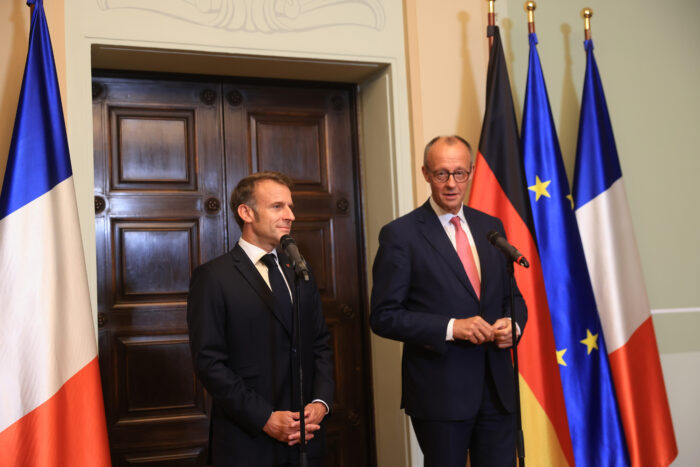
One could argue that a certain lack of flexibility on the French side, often interpreted in Germany as arrogance, combined with the German belief that money can solve everything[1], and above all remove the need to depend on France, contributed to this failure. A sign of the scale of the rupture is that the termination of SCAF was not even announced through a joint statement, with German Chancellor Merz taking the initiative to announce the split alone. In an article on Franco-German defence industrial cooperation published six years ago with Christian Mölling, we identified all of its pitfalls and the means to address them. Since then, nothing has been done and we have even moved backwards. History will judge the consequences of such a failure.
[1] Germany’s defence budget will be twice the size of France’s in 2029