
Interviews / Climate, Environment, Security
10 November 2026
COP31: What Are the Climate Goals in a Fragmented World?
-

Research Fellow, Head of the Climate, Environment, Security Programme, IRIS
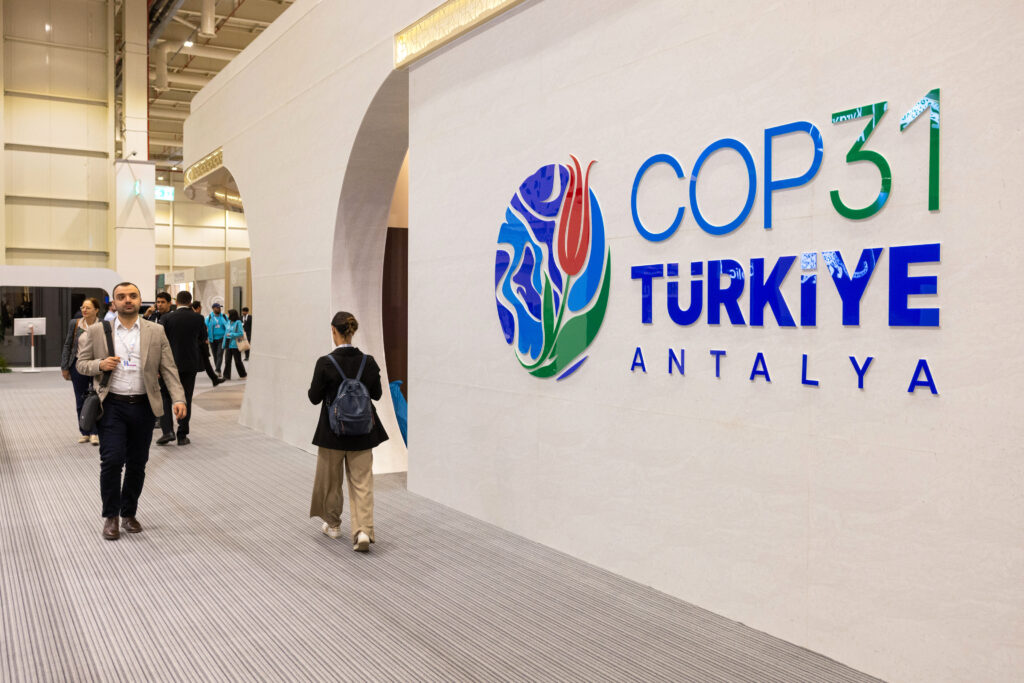
The 31st Conference of the Parties (COP31) on climate change opened on November 9, 2026, in Antalya, Turkey, and is scheduled to run through November 20. It features an unprecedented arrangement: Turkey is chairing COP31, while Australia is leading the negotiations. What does this dual chairmanship signify? What is the geopolitical and climate context in which it is taking place? What are the various issues on the agenda? We discuss this with Mathilde Jourde, a researcher at IRIS who heads the Climate, Environment, and Security Program.
What is the context of this COP?
This COP is taking place against a backdrop that is particularly dire in several respects.
First, in terms of climate, the World Meteorological Organization (WMO) noted that the year 2026 was part of a “long series of global records.” Temperature anomalies made the summer of 2026 one of the hottest on record, causing numerous deaths worldwide, including nearly 8,000 in France. Exacerbated by these heat waves, wildfires have also ravaged several regions, notably France (76,000 hectares of forest have burned since the beginning of the year, according to the Office national des forêts), Indonesia, and Canada. Record-low rainfall also affected India, which experienced a historically weak monsoon. Nepal suffered devastating flooding caused by a glacier collapse that claimed more than a thousand lives.These various extreme weather events are the result of climate change, which is being exacerbated by an unusually strong El Niño event this year (an oceanic phenomenon that occurs every 2 to 7 years and is characterized by unusual warming of surface waters in the central and eastern Pacific Ocean).
This COP is also taking place against a geopolitical backdrop marked by the growing fragmentation of multilateralism, which is leading to heightened interstate tensions and conflictual dynamics on the international stage. While in Europe, Russia’s large-scale invasion of Ukraine, launched in February 2022, continues, the Middle East is marked by escalating tensions, with the United States and Israel launching a war against Iran in February 2026, leading to the blockade of the Strait of Hormuz. The repercussions of these conflicts are global, stemming from disruptions to certain supplies—particularly energy and fertilizers—and their cascading effects across multiple scales, including social, economic, political, food security, and energy sectors.
Given this context, this COP is all the more essential, as it is the only forum in which nearly 200 countries come together to discuss and attempt to advance global governance on climate change.
What does this dual presidency signify?
This COP is notable for its unprecedented co-presidency, shared by Turkey and Australia. The two countries have different responsibilities: while Turkey, as the host, is in charge of logistics and the Action Agenda, Australia is responsible for leading the negotiations. In fact, since neither Turkey nor Australia was willing to relinquish the presidency of this COP, it took several years of discussions and debates to reach a compromise. Consequently, the signatory countries to the United Nations Framework Convention on Climate Change (UNFCCC) agreed, by consensus, to a co-presidency shared by these two countries.
Given the unique nature of this format, the two countries hosting this COP will need to be particularly vigilant regarding certain operational challenges, notably by ensuring that the division of roles and responsibilities between the two countries is clearly defined, in order to prevent any friction during the negotiations for the final agreement.
The fact that Australia and Turkey are hosting this COP also highlights certain contradictions, which were already evident at COP28 and COP29, where the host countries—the United Arab Emirates and Azerbaijan, respectively—were also major producers of fossil fuels. While Australia is one of the world’s leading producers and the second-largest exporter of coal, Turkey still relies on coal for 30% of its electricity generation.
What are the priority issues at this COP?
Following in the footsteps of COP20, COP31 is also being billed as a “COP of implementation.” In a etter published in August 2026, COP31 President Murat Kurum presented the Action Agenda—a platform running parallel to the negotiations that brings together state and non-state actors—as a tool for the concrete implementation of negotiated commitments. He thus promoted the “Climate Implementation Bridge,” a mechanism described as aiming to “bridge the gap between national climate ambitions and their implementation.”
It has identified several priority areas for action, three of which are accompanied by voluntary global target. First, the challenges of electrification, in line with the “Global Electrification Pledge,” which aims to increase the share of electricity to 35% of global final energy demand by 2035, up from 20% today. Second, the issue of waste reduction will also be a key priority, with a goal of reducing waste growth by 50 percent; currently, Turkey is the top destination for European plastic waste exports, the majority of which is burned or incinerated upon arrival. By supporting this initiative, Turkey could thus establish itself as a leading player on this issue. Finally, the development of resilient cities—through a reduction of at least 25% in energy consumption intensity in the building sector—is also identified as a key priority. Other issues are also on the agenda, such as those related to green industrialization, education and youth, food security, the oceans, health, and biodiversity.
Another underlying issue at this COP concerns science. Some countries, such as Saudi Arabia and India, are hindering progress in discussions on funding or the timeline of the Intergovernmental Panel on Climate Change (IPCC), thereby slowing down the progress of its work—work on which the second Global Stocktake is based. COP31 will therefore be a key moment to reaffirm the commitment of the COP signatory countries to ensuring the integrity of science.
Finally, the extreme weather events of the summer of 2026 will also bring attention to issues related to adaptation through the “loss and damage” fund, particularly its implementation. At COP30 in Belém, countries agreed on a goal to triple adaptation funding. In line with the report titled Limiting Overshoot: Navigating Exceedance of 1.5°C and Pathways Toward Return, which establishes that the 1.5°C threshold defined by the Paris Agreement will be temporarily exceeded, adaptation needs are expected to grow significantly.
Beyond these priority issues, the success of this COP will also be judged by whether or not fossil fuels are mentioned in the final agreement.
At COP28 in Dubai, the final agreement explicitly mentioned the need for a “transition away from fossil fuels.” However, this reference was not included in the final agreements of COP29 and COP30. Despite the absence of any mention of fossil fuels in the final text of COP30, the Brazilian presidency announced in 2025 the TAFF (“Transitioning Away from Fossil Fuels”) roadmap, an initiative aimed at developing an action plan to support the phase-out of fossil fuels. This momentum continued with the Santa Marta Conference, the first international conference dedicated to the phased-out of fossil fuels. In this context, it will be particularly interesting to see whether COP31 succeeds in generating new international momentum around this issue.
This article has been translated from French into English using artificial intelligence.