
Analyses / Africa/s
27 May 2026
Senegal: Chronicle of a Rift Between President Faye and his Prime Minister Sonko
-

Senior Research Fellow, Head of the Africa/s Programme, IRIS
On 22 Friday May, Ousmane Sonko was dismissed from his post as Prime Minister, potentially sparking a political crisis. For several months, Sonko had considered himself to be engaged in a “harmonious coexistence” – a description that seems paradoxical when one considers what coexistence entails, especially given that he and Bassirou Diomaye Faye come from the same political circle and were still displaying a deep closeness as recently as 2024.
A Friendship That Seemed Unbreakable
The idyll between the two politicians – “brothers”, comrades-in-arms and friends in their daily lives – had, however, got off to a good start. For a long time, they embodied a duo whose paths seemed destined to merge. They met as students, then found themselves studying together at the ENA. Subsequently, they embarked on the same career as tax and property inspectors. In 2014, reflecting their ideological and political affinity, they co-founded PASTEF, the Party of African Patriots of Senegal for Work, Ethics and Fraternity. In 2022, Bassirou Diomaye Faye became its secretary-general. Meanwhile, Sonko set his sights on the presidential election.
We remember the beaming and knowing smiles of 24 March 2024. They had done it! Their victory was resounding. It tasted of revenge: they had succeeded in their bid to reach the highest offices of state. However, their rise to power had been arduous and improbable, even thwarted, so fiercely did Macky Sall cling to power. Both men had been imprisoned in Cap Manuel jail, and their fate seemed sealed. But within a few days, the tide turned. The streets were in uproar and journalists from around the world were training their cameras on Dakar, Sall was abandoned and forced to back down.
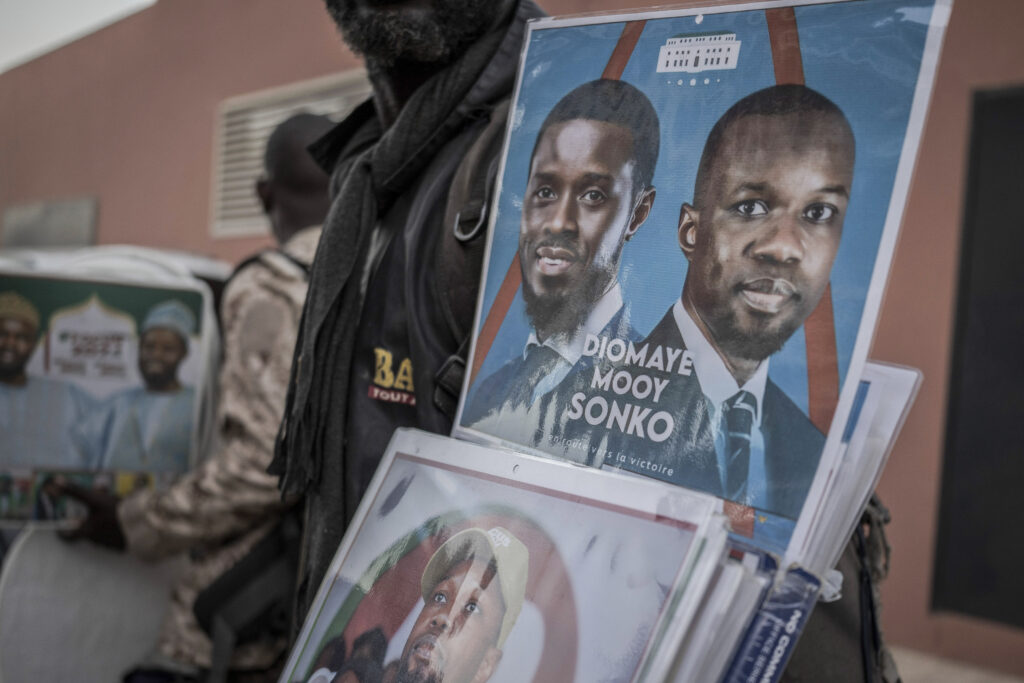
The two men were released from prison and launched a lightning campaign under the slogan: “Diomaye mooy Sonko, Sonko mooy Diomaye” [Diomaye is Sonko, Sonko is Diomaye]. As Ousmane Sonko’s candidacy had been invalidated, he chose his most loyal aide to run for the highest office in the state.
Their victory was resounding and beyond dispute. Nothing seems capable of separating the two men. Except that, for many, it is Sonko who truly won the presidential election is Sonko, not Faye, who was still largely unknown to the general public at the time.
It must be acknowledged that Ousmane Sonko made his mark on the political scene as early as 2019 when he caused a surprise by finishing third in the presidential election. Despite his legal troubles and the Sweet Beauty scandal, he remains popular among young people. A role model, an idol. Over the years, he has forged a unique political and emotional bond with some Senegalese people, fuelled by a narrative of rupture, resistance and change.
In this context, Diomaye Faye seemed to be off to a poor start. Without Sonko’s popular support, he would undoubtedly never have become President of the Republic. But he has taken on the role.
Is the Break-Up of Political Duos a Senegalese Tradition?
As Elgas points out in his programme Afrique. Mémoires d’un continent on RFI, Senegalese political duos, though initially marked by strong loyalties which are sometimes perceived as unwavering, have rarely withstood the test of power.
The first example is the partnership between Léopold Sédar Senghor and Mamadou Dia. Friends and comrades-in-arms since the late 1940s, they collaborated together to build an independent Senegal. Following the dissolution of the Mali Federation in August 1960, Senghor became President of the Republic and Dia President of the Council. Although the two men were long portrayed as complementary, they gradually came to oppose one another on matters of power organisation, economic policies and relations with France. The institutional crisis of December 1962 led to Dia’s arrest on charges of attempting a coup d’état, followed by more than a decade in prison.
The partnership between Abdou Diouf and Moustapha Niasse, orchestrated by Senghor, began to fray within a matter of months.
However it was, undoubtedly under Abdoulaye Wade that conflicts of loyalty and imprisonments resurfaced with a vengeance. Together with Idrissa Seck, they championed the slogan of change (sopi). Although he was long presented as Wade’s heir apparent, Seck nevertheless saw their relationship deteriorate until he was sidelined politically and imprisoned in 2005 in the Thiès construction projects scandal. He was acquitted a few months later; the streets of Dakar were then flooded with thousands of people chanting “Idi”, as if the father had betrayed him.
La séparation entre Faye et Sonko, à première vue, ne déroge pas aux schémas de leurs prédécesseurs. Mais leur configuration de départ est singulière : le détenteur de la légitimité électorale n’était pas nécessairement celui qui concentrait le capital politique.
The Dividing Lines
Undoubtedly, some of the disagreements between the two men remain beyond our understanding. As Abdou Diouf recounts in his memoirs, the entourage plays a significant yet often underestimated role.
Beyond the initial bias, Faye and Sonko, frequently urged by the media to recall their friendship, have succumbed to enmity.
Resentments and grudges have steadily accumulated over the past two years.
First, the approach. Several observers have noted tensions regarding the management of campaign promises, including the pace of reforms, the treatment of figures from the previous regime, and judicial reform. In short, the scale of change expected by the grassroots supporters has remained a constant source of concern. Sonko has publicly expressed his impatience on several issues.
Debates over the debt, the report to the IMF – from which Sonko reportedly wished to distance himself – the issue of political funds and, more broadly, that of economic strategy, have gradually brought into sharp relief differing visions of how power should be exercised. Underlying these disagreements is a deeper divergence: should one govern by breaking with the past immediately, or should one work within institutional and international constraints?
The rivalry came first to light during the organisation of the ‘Tera Meeting’ by Ousmane Sonko on 8 November 2025 at the Léopold Sédar Senghor Stadium. The term ‘tera’, borrowed from the vocabulary of units of measurement, was intended to highlight the exceptional and unprecedented nature of the mobilisation. Buses from all corners of the country and mass marches converged on the capital under the watchful eyes of the press and observers.
The fervour and capacity for mobilisation demonstrated that day serve as a reminder that the movement’s political capital remains largely centred on Ousmane Sonko.
Officially presented as an opportunity to review the first eighteen months in power, to provide political clarification and to relaunch the PASTEF project, the rally was nothing less than a display of political strength.
The message was clearly received at the highest levels, and a response came swiftly. Faye then chose to strengthen the ‘Diomaye Président’ coalition by entrusting Aminata (Mimi) Touré with a central role. This decision was interpreted – and arguably not without reason – as a political signal of the president’s growing autonomy.
A former Prime Minister under Macky Sall who later became an opponent, Mimi Touré is a controversial figure within part of the PASTEF – some activists criticise her for her past involvement in the previous regime and for only recently supporting the movement for change.
Regardless, Faye wants to demonstrate that he is not under his Prime Minister’s command.
For several months, he has seemed unable to become a fully-fledged president, sharing power with a Prime Minister who himself aspires to the presidency. It is an impossible equation.
For several months, Sonko and his supporters have boasted of their superiority, reminding those concerned of what they owe them: in Pascal Boniface’s book *Les maîtres du monde*, it was Sonko who was chosen. Not Faye.
What Now ?
Sonko has been dismissed from his post as Prime Minister. On 22 May, he wrote on Facebook that he felt almost relieved to be sleeping at home in Keur Gorgui.
A relief that was short-lived.
The Speaker of the National Assembly, El Malick Ndiaye, has resigned from his post and Sonko, as leader of the majority party with 130 out of 165 MPs, has already succeeded him on 26 May.
He is once again an opposition figure, a role in which he once excelled and which made him popular.
However, this situation creates an unprecedented scenario: a president deprived of his main political support, facing a parliament controlled by his former ally. This scenario raises fears of unprecedented tensions between the executive and the legislature.
Will Diomaye Faye succeed in convincing people of his legitimacy without Sonko? Nothing is less certain. Will Sonko seek to have him removed from office? The question remains open.
However, this fratricidal duel is overshadowing the country’s real difficulties: healthcare, the economy and, above all, youth unemployment.
Two years after the change of government, several announced reforms remain unfulfilled or delayed, fuelling growing frustration among the population. Beyond the duel between the two men, it is above all the social expectations, young people and voters, as well as the wider population facing challenges such as unemployment, reduced purchasing power and the crisis in public services, that risk paying the heavy price of the political crisis.
Did the country really need that? It’s a fair question.