
Analyses / Middle East / North Africa
12 November 2025
An Ex-Jihadist Received at the White House
-

Deputy Director, IRIS
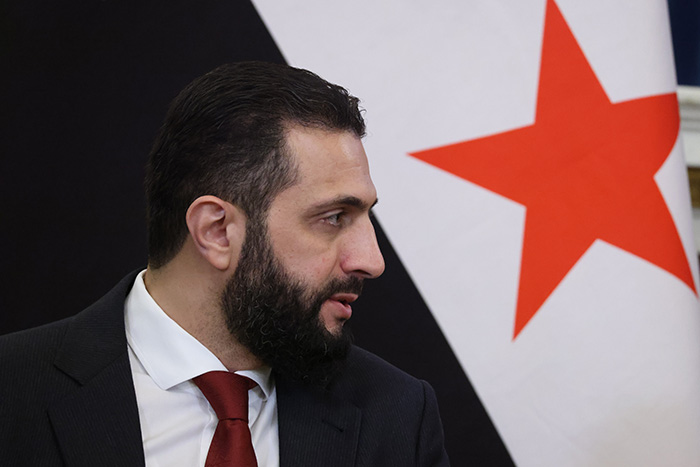
The reception at the White House of the Syrian interim president Ahmed Al-Charaa – a former jihadist fighter who, in the 2000s, experienced illegal US detention facilities in Iraq, including the notorious Abu Ghraib prison – is certainly surprising. Yet beyond the apparent paradox, this situation has its own political logic. The question then centres on assessing the political trajectory of the new leaders in Damascus. Their jihadist past is known, but their political evolution is no less so. Embodying a form of Islamist nationalism, they will not renounce their affiliation with the Islamist movement to which they claim to belong. At the same time, they are profoundly Syrian, and their stated primary concern is preserving the unity of the state.
They are therefore confronted with the titanic task of rebuilding a bloodless country, ravaged by nearly fourteen years of civil war, where almost all structures must be reorganised. All the political energy of the interim authorities is directed towards this goal, with a threefold challenge: establishing a more inclusive regime, rebuilding solid relations with as many states as possible, and achieving the lifting of sanctions affecting the country. So far, the new Syrian political authorities have made few mistakes, despite the social, political, and communal violence that continues to plunge society into mourning. While economic issues are central, they are not the only ones to be resolved. This almost exclusive focus on internal stabilisation objectives has earned them some criticism for their silence regarding the genocide being carried out in Gaza by Israel.
Questions of political stabilisation thus arise on a daily basis. Syria is an ethnic and religious mosaic within which centrifugal forces are numerous, often instrumentalised by neighbouring powers. Everyone understands, for example, that Israel, claiming to establish itself as the protector of the Druze community, uses it as a means of pressure on Damascus. Turkey, for its part, maintains constant demands regarding the Kurdish question, an even more pressing challenge for Syria’s stability.
However, these situations are not equivalent, and it is undeniably Tel Aviv that represents the greatest risk for Syria today. As early as the day after Bashar Al-Assad’s flight, during the night of 7 to 8 December 2024, Israel multiplied its strikes against Syria: 300 bombings of Syrian military targets were recorded within a few days. The Israeli army also hastened to occupy the Syrian side of Mount Hermon, violating the 1974 ceasefire agreement. Since then, more than 800 strikes have targeted Syrian strategic infrastructure and capabilities, and Israeli military units have established a lasting presence on the territory of a sovereign state. This is yet further evidence that preventive war has become the norm in the regional policy of the Israeli state, in defiance of international law. Once again, it can moreover be observed that international condemnations have remained rare, timid and without any deterrent effect.
It is for these reasons that the stakes surrounding Ahmed Al-Charaa’s visit to Washington refer to the geopolitical reconfigurations currently under way in the Middle East and to the potential role Syrian leaders may play in them. Donald Trump, despite the often erratic aspects of his political initiatives, does have a political line. It consists in attempting by all possible means to contain Chinese power, and therefore multiplying projects and economic agreements to this end, while allowing his family and associates to benefit in the process. To do so, he needs to attempt to restore a form of stability favourable to business in the Middle East.
While remaining an unwavering supporter of the State of Israel, some of the initiatives taken by Benjamin Netanyahu undeniably hinder Trump’s projects. Thus, the desire for annexation of Palestinian territories promoted by the Israeli far-right government, or the Israeli air strikes on the Qatari capital in September, run counter to his objectives, and he has been forced to twist Benjamin Netanyahu’s arm on these issues. Donald Trump has probably understood that two options are currently conceivable in the Middle East. Either allow Israel’s logic of preventive war and all-military approach to unfold, at the risk of perpetuating chronic instability, or attempt to reduce political tensions by working with regional powers that have an interest in doing so, chiefly Saudi Arabia and Turkey.
It is in this context that one must analyse Ahmed Al-Charaa’s reception at the White House. Donald Trump is providing guarantees to the two main political patrons of the latter, Riyadh and Ankara. This is why he confirms the lifting of sanctions against Syria – which must nonetheless be validated by a vote in Congress – which he had initially announced during his official visit to Saudi Arabia in May 2025, already at the time in the presence of Mohammed bin Salman and Recep Tayyip Erdoğan. It is also for this reason that the United Nations Security Council lifted, on 6 November, the sanctions targeting Al-Charaa due to his past membership of Al-Qaeda and then of the Islamic State. The United States did the same so that the Syrian interim president could return to the US. From the point of view of the US president, Syria thus appears to have an important role in stabilising the region, and it is therefore important for him to strengthen its new leaders. In this process, we have further confirmation that the leaders of the political Islam movement, of which Ahmed Al-Charaa is an almost chemically pure example, are far from revolutionary and adapt perfectly to the imperialist aims in the region.
If the fall of Bashar Al-Assad’s dictatorship is of crucial importance for the Syrian people, history is not written in advance and the challenges for the new leaders in Damascus are many. Nevertheless, Syria’s gradual reintegration into regional and international relations is an indicator of the axes along which geopolitical power relations in the Middle East are being recomposed.