
Interviews
29 January 2026
Paris International Agricultural Show: Political Showcase or Competitiveness Test?
-

Associate Research Fellow, IRIS
The 62nd edition of the Paris International Agricultural Show will be held from 21 February to 1 March. This Show remains the most important in France in terms of visitor numbers—over 600,000 last year. What are the stakes of this edition, which takes place in a context of international tensions? Is this agricultural show still suited to the contemporary challenges of the sector? How can France’s difficulties on European markets be explained? An overview with Sébastien Abis, Associate Research Fellow at IRIS and Director of the Club DEMETER.
Is this 62nd edition of the Paris International Agricultural Show a risky one?
Even though agriculture now represents only around 1% of national GDP, it concentrates each year at the Show an extraordinary level of political attention, which often surprises observers abroad, where this trend is less pronounced and less persistent. In France, from the President of the Republic to the entire government, to all political party leaders and local elected representatives, everyone turns up and strolls between the professionals of the sector and their stands, and among an always very diverse crowd. Even in politically quiet years, this is the case. In 2026, with municipal elections in March and presidential/legislative elections in a year’s time, a visit to the Show is certainly included in the political calendar. And therefore in that of the media, who use the opportunity to access them more easily. The risk, then, is that the Show will serve more as a political stage than as a space for strategic thinking about the future of agriculture.
Next, this show will take place in a context of strong tensions. To go to the essentials, two broad sets of questions will overlap. The first relates to the most immediate and national issues: for months we have seen numerous agricultural demands and a flurry of announced measures. There is impatience among some agricultural circles faced with the government’s difficulties in keeping its commitments or implementing decisions, a situation significantly amplified by French budgetary uncertainty. It is highly likely that this will be closely scrutinised by the end of February: no new announcements, but above all concrete actions and implementation of decisions that now date back to the winter of 2024, when Gabriel Attal was still at Matignon. Agricultural incomes are very low, or even non-existent, in many sectors due to rising production costs (energy, fertilisers, labour, etc.). Moreover, in a month’s time, the first communications are likely at the Show regarding the ongoing “sovereignty conferences” launched by the minister Annie Genevard last autumn. Actors from the most important sectors were asked, within a very tight timeframe, to project themselves 10–15 years ahead to assess France’s productive capacities, taking into account global climatic and geopolitical changes, as well as consumption patterns.
The second set of questions at the Show will concern external factors: negotiations on the next Common Agricultural Policy (CAP), which is due to enter into force in 2028 and whose overall preserved budget envelope will be deployed under very different modalities given the new architecture of the multiannual financial framework promoted by the European Commission; the Ukrainian dossier and its extreme agricultural complexity if the country joins the EU—at a still uncertain horizon, but one that is bound to become a far more inflammable subject than Mercosur; tariff strategies implemented by the United States under a Trump administration that knows where to hurt European economies… The list of international challenges is long, and we should insist on several geo-economic trends that are weakening the health of French agricultural sectors: Algeria no longer buys cereals from France; China imports fewer French wines; Russia is increasingly becoming self-sufficient in seeds; and our products are struggling on neighbouring European markets.
For the first time in 50 years, the risk of a deficit in France’s agricultural and agri-food trade balance is real. What does this mean?
This would be a first since the mid-1970s. Since that time, France has recorded a structural trade surplus in the agricultural and agri-food sector—one of the very few sectors with such a surplus, alongside aeronautics, cosmetics and armaments. From 2000 to 2020, this surplus ranged between €8 and €10 billion per year. Yet in recent years, three phenomena: a surplus that has grown increasingly small, highly concentrated on a few product families (wines and spirits, cereals, dairy products, etc.) and oriented towards distant markets, that is, non-EU countries. But global markets are more competitive, exports from surplus sectors have been weakened by geopolitical transformations around the world as well as climatic changes at home, and France has increased imports in certain historically deficit segments (seafood products, fruit and vegetables, or coffee and cocoa—two tropical products whose prices have soared since 2020). The result: France’s agricultural and agri-food balance for 2025 will be very slightly in surplus, balanced, or in deficit; customs statistics will soon deliver their verdict. But it is certainly a rupture, which concerns sectoral actors and political leaders, especially at a moment when agriculture is being positioned as a key sector of French sovereignty and influence in the world. If France were to shift durably towards a deficit in its agricultural and agri-food balance, this would not be a mere statistical accident. It would mark the transition of a country historically oriented towards exports, yet no longer able to convert its agricultural potential into strategic power.
How can the difficulties of French agriculture on European markets be explained?
Concerning the loss of markets within the EU, France could show a cumulative trade deficit of three billion euros with the other 26 Member States. We import heavily from Poland and Italy, for example. This is not bad—it sustains the European market. But these countries offer consumers products for every day of the week, whereas France tends to produce too many items intended for weekends or festive occasions. France still too often offers an agriculture of the exceptional, when the market expects an agriculture of the everyday.
I am exaggerating slightly, but the offer of French products is beginning to diverge from societal expectations, for whom price must go hand in hand with quality. Origin comes next in purchasing decisions. The majority of consumers want good, safe and not too expensive products. Buying French and local—certainly—but not necessarily for every product or all the time. This calls our agro-industrial model into question. Our agri-food factories need to be modernised, need to attract workers, and need to offer products that correspond to market demand—not merely those sold in the local village grocer’s shop or the delicatessen of a chic Paris neighbourhood.
Is this agricultural show still suited to the contemporary challenges of the sector?
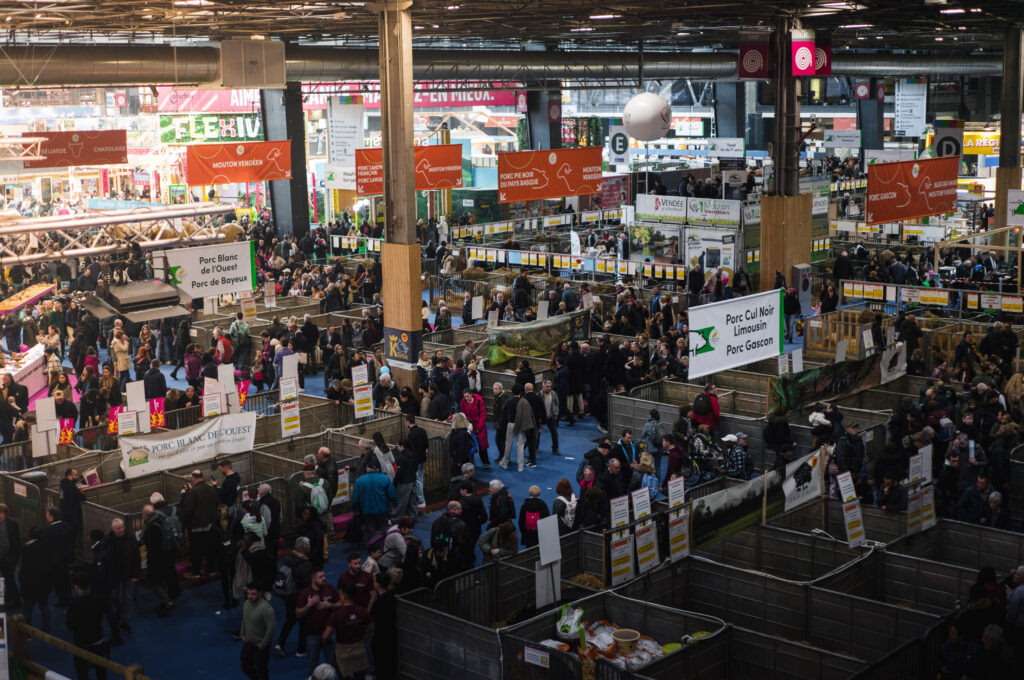
First of all, I should note that this year the slogan is “coming is supporting.” Indeed, for the first time in its history, the Show will take place without cattle, due to the health crisis caused by lumpy skin disease. And cows at the Show—that’s sacred… It is both entertainment for city dwellers lacking contact with animals, and the agricultural competitions, a tradition of the Show for professionals. But it is true that this Show is full of paradoxes. For the general public, the animal hall tends to concentrate the visit, along with the regions’ hall. Yet there are many other spaces to discover to better understand the agricultural world in all its diversity: sciences, innovation, digital technologies, logistics… There are also the institutional stands, those of schools and research bodies, those of the sectors allowing visitors to delve into certain crops or into agroforestry or fishing; and the areas for conferences and debates featuring many international guests. Spending a day at the agricultural show means learning a great deal that goes far beyond the sector itself. In this sense, the Show is undoubtedly unique.
However, is it representative of today’s agricultural sectors? Insufficiently, no doubt—perhaps because certain myths are maintained, probably to satisfy visitors from elsewhere. Notably in the hall where the animals are displayed, which would benefit from being rethought to better show, for example, how progress is being made regarding animal welfare or the use of AI on farms for precision livestock farming. But more broadly, the Agricultural Show has become a revealing sign of French weaknesses, when it should be above all an accelerator of competitiveness. Especially since agriculture is immortal: to feed ourselves and move beyond oil, we need it more than ever! It would be odd to lose sight of this in France. This Show is therefore destined to continue every year, unlike other events of this type which are focused on ephemeral sectors or sectors destined to disappear.
It seems to me, therefore, that this Show would benefit from highlighting the entrepreneurial spirit of agriculture. Every farm is a business. The sector can never remain static: the world evolves, consumption changes, opportunities renew themselves. We are in an era in France and Europe where the relationship to work, performance, risk-taking, the courage to undertake and innovate lies at the heart of numerous political, societal and economic discussions. The agricultural sector can embody all this. I am not saying that all farmers are dynamic, or that some are not suffering, or that everything is fine; I simply want to draw attention to the fact that situations are highly contrasted and that some constantly move forward—by diversifying their productions, adapting to customer requirements, engaging in more environmentally friendly practices, and inventing new agricultural business models.
French agriculture cannot rely solely on European aid or financial support from the French authorities in times of crisis. Such public support is sometimes necessary, but it does not stimulate the sector’s competitiveness. We must certainly avoid a major divide between survival agriculture and elite agriculture, but this dualisation unfortunately exists. Moreover, in the context of debates on the future CAP, let us dare to ask the question: should it buy social and rural peace, or should it fund sustainable production and innovative economic systems?
To what extent does the Paris International Agricultural Show go beyond the national framework and take on an international dimension?
This international dimension is indeed not always highlighted, yet we have pavilions from many countries, many visitors also come from abroad, and a country is honoured each year. After Morocco last year, Côte d’Ivoire is featured in 2026, confirming the importance given to the African continent. Yet in 2026, official development assistance and French cooperation mechanisms are declining sharply in budgetary terms.
Many agricultural and agri-food companies also hesitate to invest more heavily in Africa, given security risks that can sometimes be discouraging. French agriculture and agri-food remain present in certain African countries, but the visibility of this action could be improved if public authorities and private operators worked more closely together. Strategic choices of key countries may also need to be made, rather than trying to be present everywhere, or almost everywhere. It is also necessary to listen to African needs and stop proposing solutions that sometimes do not correspond to their expectations.
To be thorough, I would also say that it is time to build a European team on the continent, where for now each Member State acts unilaterally. Europe has a common agricultural policy, but still no external agricultural strategy. In today’s world, this absence is becoming a strategic handicap.