
Analyses / Europe, European Union, NATO
18 December 2025
EU Breakup Risk and Productive Resilience
-

Associate Research Fellow, IRIS
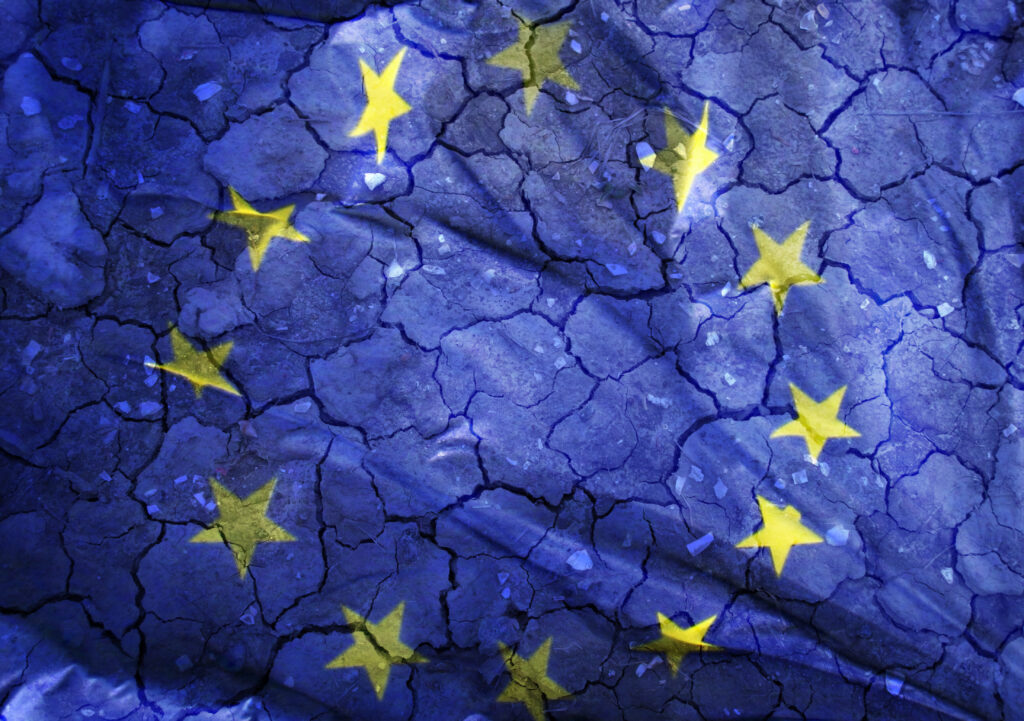
The U.S. administration criticises the European Union for failings that often have real basis. However, the EU’s economic subordination to the United States and the embrace of its cultural crisis play a key role in Europe’s falling behind. In light of this paradox, these attacks are all the more destabilising since the Trump administration’s economic demands – acquiesced to by Ursula von der Leyen – simultaneously hinder any possibility of Europe re-entering the technology race. Beyond transatlantic invective, this historical impasse makes the prospect of the EU’s breakup tangible. We must anticipate its potential effects through productive and intellectual resilience.
The trade terms dictated by Washington first illustrate the technological impasse amid the transatlantic chaos. In exchange for unilateral tariffs of only 15%, the von der Leyen Commission has implemented a policy of accommodation towards the U.S. tech sector on most issues, with the exception of those related to social media content. The fact that these concessions are subsequently presented as a competitiveness policy unfortunately does not mitigate their long-term effects.
The abandonment of technological autonomy follows a series of ill-conceived strategic choices. More than the lack of discussion, these bets have revealed a gap in scientific and industrial competencies. Examples include: the excessive gamble on hydrogen, the generalised transition to electric vehicles without competitive impact studies, later forcing a retreat, the semiconductor failure (with the costly reliance on technology transfers from Intel, now losing momentum). One could add the export of Germany’s energy transition shock, amplified by the abandonment over the past decade of gas import diversification projects, in favor of Nord Stream I & II. Concrete skills have been supplanted by bureaucracy, high-level events, and regulatory prose.
We have imitated the excesses of U.S. governance, but omitted the scale of its research system, funding for technological programs, and the emergence of Big Tech within this framework. The aspect that inspires Europeans is more centered on the type of managerial hypertrophy that led to the decline of a company like Boeing.
The crisis in European industry illustrates the exhaustion of a logic of extreme logistical optimisation, at the expense of innovation and new industries. This has allowed us to benefit from very low costs in Asia and Central Europe while capitalising on the prestige of legacy brands. The energy crisis and China’s technological leap – long presented as a promised land for European exports – have derailed this model.
The fact that the United States seeks to anchor its reindustrialisation effort in the subordination of its vassals adds to these difficulties. Shortages of military equipment on the Ukrainian front have not only revealed the extent of industrial attrition in the EU and the US, behind the enthusiasm generated by the AI bubble at the same time. They have also accelerated the fracture within the Western bloc, leading Europeans to start redeveloping their military capabilities. However, this period of political turmoil seems ill-suited to long-term strategic planning and to averting nuclear risk, which motivated previous generations. Moreover, remilitarisation is largely benefiting US defence companies as evidenced by high-profile orders of F-35s.
In reality, the level of deindustrialisation calls into question our very interpretation of GDP, given the activities that are now at the heart of developed economies, sustained by bubbles until they burst. At a time when many countries are developing, training engineers in large numbers, and deploying them for industrial expansion, we must soberly assess the value of our deindustrialised economies in the era of PowerPoint and circular funding.
The euro crisis did not lead to genuine reconsideration. On the contrary, it was followed by a policy of monetary bubbles and, around 2017, the belief in an imminent leap forward for federal structures. A reindustrialisation dynamic was even announced, although a more cautious analysis could only indicate the opposite trend. It is in this context that France’s situation has continually deteriorated on the financial and industrial front. The maxim that each crisis is an opportunity to complete a stage in the EU’s edification has accompanied the fading prospect of a stable, creative, and prosperous society.
A fresh start for the European Union is hindered by the very nature of its falling behind, rooted in deep cultural trends, of which the bureaucratic drift and the educational crisis are central elements. Instead of remedies, we see numerous parties and movements of all kinds positioning themselves in a cultural war, the terms and theatrics of which are directly imported from the U.S. The Commission’s current concessions would, in a best-case scenario, delay a productive recovery by several years.
Beyond Donald Trump’s invective, the long-term persistence of the EU can no longer be the sole working hypothesis in the face of looming financial shocks, productive and educational decline, and the outcome of the Russo-Ukrainian war. States and economic stakeholders must prepare for the possibility of a disruption in the European system within a decade.
The focus, at this stage, should not be on making prophecies about the triggering factor, among various options: from the election of the Alternative für Deutschland (AfD) to the exit of certain Central European countries, potentially losing their status as net beneficiaries of the EU budget due to Ukraine’s integration – which might explain why Moscow does not oppose it.
Rather, the task at hand is to undertake preparatory work to avoid a disorderly breakup. Such an event would have dire consequences for countries that, at that moment, would lack both a productive base and necessary resources. In a scenario combining breakup and lack of preparation, the trend illustrated by the EU-Mercosur agreement could, by that time, even lead to food supply difficulties. A resilience strategy must address these tangible risks.
Anticipating the possible return of responsibilities to the national level, within a framework closer to an integrated customs union and a monetary coordination mechanism, could provide some impetus towards a productive strategy and an educational revival. As the level of mutual ignorance among Europeans has reached an alarming level, such an effort could even bring us together around more concrete objectives of good relations and stability.
Find more analyses and interventions by Rémi Bourgeot on EPISTELEM.