
Interviews / Political and Geostrategic Observatory of the United States
19 February 2026
“Board of Peace” or “Trump’s World”?
-
Director of Research, IRIS
Announced in Davos by Donald Trump, the “Board of Peace” forms part of the extension of his plan for Gaza, while considerably expanding its ambition. Presented as a structure intended to work for peace and stability, this new body raises questions as to its legitimacy, its functioning, and the way in which it competes with the United Nations. Analysis by Hadjar Aouardji, Director of Research at IRIS and specialist in US foreign policy in the Middle East.
As the Board of Peace prepares to meet in Washington for its inaugural session, could you remind us of the context of its creation? Is this body designed to compete with the United Nations?
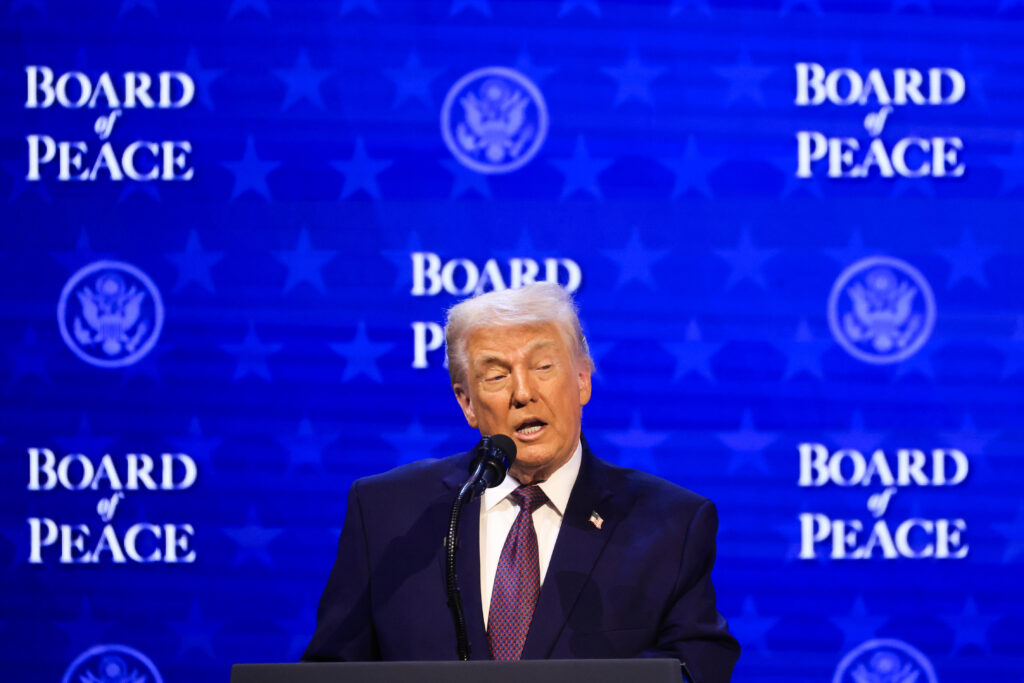
The first time this body was mentioned was last September, in the context of Trump’s 20-point plan to pacify the ongoing conflict between Israel and the Palestinian territory of Gaza. This plan is particularly remembered for its demands for the return of all Israeli hostages, alive or dead, and for the disarmament of Hamas, while postponing to a highly hypothetical future the creation of a sovereign Palestinian state. The plan led to the signing of a “ceasefire”, staged with great fanfare in Sharm el-Sheikh, for which Egypt, Qatar and Turkey acted as guarantors. The staging of this signature strongly resembles the décor put in place in Davos around President Trump on 22 January.
Following the signing of the “ceasefire”, the first phase of the Trump plan was implemented, and the Israeli army withdrew behind a yellow line, currently occupying 53% of the Palestinian territory. The plan was also supposed to guarantee the massive delivery of humanitarian aid. In practice, this commitment has not been upheld by the Israeli authorities, who have drastically limited it. Efforts made to secure the return of Israeli hostages (on 26 January, the body of the last hostage was found and repatriated) have been the only aspect of the plan truly implemented. Let us also recall that between October 2025 and February 2026, more than 600 Palestinians are thought to have been killed. Under these conditions, can we really speak of a ceasefire?
Between October 2025 and mid-January 2026, the US administration communicated very little on this issue, and the resolution adopted by the UN Security Council on 17 November attracted little attention. Yet this resolution 2803, adopted by 13 members of the Council (with Russia and China abstaining), endorses the Trump plan, which it calls the “Comprehensive Plan of President Donald J. Trump to End the Conflict in Gaza”, and which is annexed to the document. This resolution welcomes the creation of the Board of Peace, defined as a “transitional administration with international legal personality, mandated to guide the reconstruction of Gaza”. However, the body presented by President Trump in Davos has a far broader scope of action, and its Charter does not mention the Palestinians anywhere. There is an element of deception here, in seeking to derive a form of UN legitimacy for this body, which is in fact designed to circumvent and compete with the United Nations. On this point, President Trump declared in Davos that the UN had potential which it had failed to use to put an end to the war in Gaza. Moreover, the preamble to the Charter establishing the Board of Peace attacks the UN from the very first lines: “declaring that lasting peace requires pragmatic judgement, common-sense solutions, and the courage to depart from approaches and institutions that have too often failed”. Echoing this, Secretary of State Marco Rubio declared at the Munich Security Conference: “The United Nations still has incredible potential to be a tool for good for the world. But we cannot ignore that today, on the most urgent matters, it has no answers and has played no role. It has not been able to resolve the war in Gaza. It is American leadership that freed the hostages from the hands of barbarians and brought a fragile ceasefire.” This conveniently overlooks the fact that, on this particular issue, numerous US vetoes have obstructed the Security Council’s action…
How does this Board of Peace function, and which entities make it up?
Its architecture is complex, and President Trump, as chairman, reserves the right to create “subsidiary entities” of the Board as well as to dissolve them.

To begin with, the body is chaired by Trump, and it is important to understand that he does not chair it as President of the United States, but in a personal capacity. This means that his role at the head of the body will continue beyond his presidential term. His mandate can end in two scenarios: if Trump himself resigns, or if the Executive Board of the Board of Peace (editor’s note: see below) unanimously votes to remove him in the event of incapacity. However, in both cases it is President Trump who will appoint his successor[1].
There is then a Board of Peace, which brings together representatives of member states (currently: Albania, Saudi Arabia, Argentina, Armenia, Azerbaijan, Bahrain, Belarus, Bulgaria, Cambodia, Egypt, the United Arab Emirates, Hungary, Indonesia, Israel, Jordan, Kazakhstan, Kosovo, Kuwait, Uzbekistan, Morocco, Mongolia, Pakistan, Paraguay, Qatar, El Salvador, Turkey, Vietnam). These states may be invited to sit on the Board for a period of three years (which Trump may decide to renew or not). However, this duration does not apply to countries that pay a sum of 1 billion dollars within one year of the Board’s entry into force, in return for a permanent seat.
Alongside this assembly of states, the Charter refers to an Executive Board bringing together leaders of “global stature”, whose role is to make the “vision” of the Board of Peace operational. To date, seven people have been appointed for a two-year term, which may be extended or terminated at Trump’s discretion: Marco Rubio, Jared Kushner, Steve Witkoff, Tony Blair, Marc Rowan (CEO of Apollo Global Management), Ajay Banga (President of the World Bank) and Robert Gabriel (National Security Advisor). The Executive Board holds regular meetings, is required to exercise the powers necessary and appropriate to implement the mission of the Board of Peace, and reports on its activities and decisions to the Board of Peace on a quarterly basis, “and at any other time the President may determine”. Each member of the Executive Board oversees a specific portfolio relating to Gaza, including strengthening governance capacities, regional relations, reconstruction, investment, etc.
President Trump has also appointed Aryeh Lightstone and Josh Gruenbaum, two US officials specialising in economic diplomacy and the mobilisation of international investment, particularly in the Middle East, as advisers to the Board of Peace, entrusting them with the task of operationalising its mandate and diplomatic priorities.
The profiles appointed to the Executive Board are striking in that the private, financial and political interests of its members (close to President Trump or involved in major companies and international institutions) appear closely intertwined with the objectives of reconstruction and investment in Gaza, raising questions about transparency, governance and the risk of conflicts of interest.
So there are no Palestinians on the Executive Board. Does the Trump plan not also refer to a committee of Palestinian technocrats and an international stabilisation force?
Whether in the Board of Peace or its Executive Board (the two entities that appear in the Charter), there is indeed no Palestinian representation. However, Resolution 2803 and the Comprehensive Plan do refer to a National Committee for the Administration of the Gaza Strip. Its creation, which is limited to managing day-to-day affairs, forms part of a strategy aimed at depoliticising the Palestinian cause. Composed of twelve technocrats led by Ali Shaath, a civil engineer born in Khan Younis, it currently has no real means of action. Bulgarian diplomat Nickolay Mladenov, appointed High Representative for Gaza, is tasked with leading stabilisation efforts and ensuring the link between the committee of Palestinian technocrats and the Board of Peace.
Trump has also announced the creation of another body, headed by Mladenov, whose members partly overlap with the aforementioned Executive Board: this time it is the Executive Board for Gaza[2], which, unsurprisingly, also includes no Palestinians. On this Executive Board, alongside Marc Rowan, the American billionaire who heads Apollo Global Management, sits another billionaire: the Israeli-Cypriot property developer Yakir Gabay, a close associate of Jared Kushner. At the Davos Forum, the US president’s son-in-law presented a “master plan for Gaza” which strongly resembles the Riviera project announced by President Trump in 2025. On that occasion, speaking about Yakir Gabay’s involvement, he declared: “He agreed to do it pro bono, really out of conviction, because this is what he wants to do.” Nevertheless, it is easy to see that, here again, the intertwining of personal ties and investor profiles raises serious questions of conflicts of interest.
Finally, the Trump plan and the UN resolution that adopts it did indeed mention an international stabilisation force. Its mission is to work with Israel and Egypt to stabilise the security situation in Gaza, by ensuring the demilitarisation of the Strip, protecting civilians, training Palestinian police forces and carrying out any other tasks deemed necessary for the implementation of the Comprehensive Plan (Article 7 of UN Security Council Resolution 2803). The White House has appointed General Jasper Jeffers to command this force, and for the time being Indonesia has announced that it will send a contingent of soldiers and could deploy up to 8,000 troops by June. The meeting of the Board of Peace, held at the Donald J. Trump Institute of Peace (Washington) on 19 February, is expected to provide an opportunity to announce the participation of other countries in the international stabilisation force.
Lastly, although, apart from Hungary and Bulgaria, no EU member state has so far accepted the invitation to join the Board of Peace, it should be noted that several representatives apparently intend to attend this inaugural meeting as observers: the European Commissioner for the Mediterranean, Dubravka Šuica, as well as Italy, Romania, Greece and Cyprus.
[1] In addition to these two scenarios, one article of the Charter sets out the conditions for the dissolution of the Board of Peace: “The Board of Peace shall be dissolved at such time as the President deems necessary or appropriate, or at the end of each odd-numbered calendar year, unless renewed by the President no later than November 21 of such odd-numbered calendar year. The Executive Board shall establish rules and procedures relating to the settlement of all assets, liabilities and obligations upon dissolution” (Article 10.2).
[2] See infographic. The Executive Board for Gaza is composed of Nickolay Mladenov (Bulgarian diplomat), Jared Kushner (businessman and son-in-law of Donald Trump), Tony Blair (former Prime Minister of the United Kingdom and former Special Envoy of the Quartet for the Middle East), Hassan Rashad (head of Egyptian intelligence), Marc Rowan (co-founder and CEO of Apollo Global Management), Hakan Fidan (Turkish Minister of Foreign Affairs), Reem Al Hashimy (UAE Minister of State for International Cooperation), Steve Witkoff (current US Special Envoy to the Middle East), Sigrid Kaag (Dutch politician and diplomat), Ali Al Thawadi (Qatari diplomat), Yakir Gabay (Israeli-Cypriot real estate magnate).