
Interviews / Sport and Geopolitics
10 February 2026
Russia Back in Global Sport?
-
Senior Research Fellow at IRIS, Head of the Sport and Geopolitics Programme
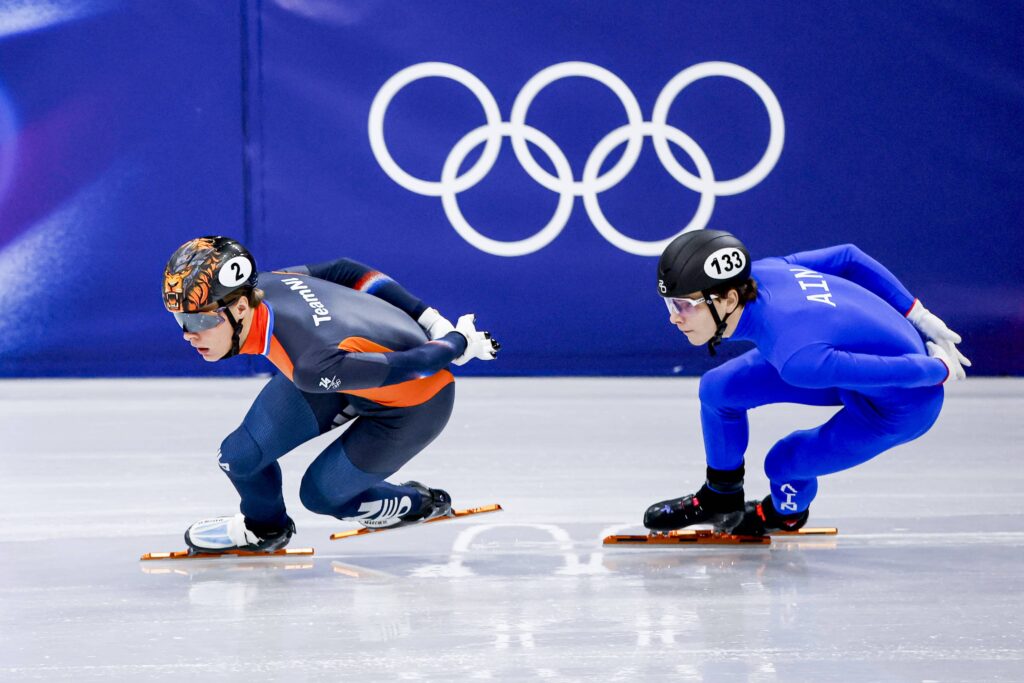
On 6 February, the Milan-Cortina 2026 Winter Olympic Games opened in Italy, to be followed by the Paralympic Games in March — a competition that remains one of the most powerful showcases of national prestige and power. Since the doping scandals revealed in the wake of the 2014 Winter Games, followed by the invasion of Ukraine in 2022, Russia has been progressively sidelined from the Olympic movement. Although this year the International Olympic Committee (IOC) has announced the participation of 13 Russian athletes competing under a neutral flag, several international federations have already declared their full reintegration of Russian athletes into competitions. Beyond sport, the stakes are highly political. Lukas Aubin, Research Director at IRIS, Head of the Sport and Geopolitics Programme and specialist in the geopolitics of sport and of Russia, answers our questions.
Since 2022, what strategy has the Kremlin implemented to “continue to exist” in the global sporting arena?
Following its exclusion after the invasion of Ukraine, Moscow adopted a two-pronged strategy, seemingly contradictory but in reality highly opportunistic.
On the one hand, the Kremlin attempted a break with the sporting architecture dominated by the West. It engaged in a discourse delegitimising international sporting institutions, portrayed as politicised and instrumentalised by the West, while seeking to build a “counter-global sport”: alternative competitions, events branded under BRICS or the “Global South”, and the staging of a multipolar sporting order. The objective was less sporting than political: to demonstrate that Russia could exist outside the traditional Olympic system. In practice, these counter-events struggled to attract major stars or generate genuine influence: a largely symbolic, even Potemkin, strategy.
At the same time, Moscow pursued a strategy of gradual return to mainstream international sport. Discreet lobbying efforts targeted the IOC, international federations and numerous national committees, particularly in Africa, Asia and certain European countries. Russian federations multiplied informal channels, sending emissaries sport by sport, discipline by discipline. This multivector sports diplomacy aims to fracture Western unity and progressively reopen spaces for participation.
The link between these two approaches lies in the evolution of the register of power: the shift from classic sporting soft power to sporting sharp power. It is no longer merely about attracting or persuading, but about penetrating rival media and institutional spaces, disseminating narratives, generating fatigue, and gradually normalising Russia’s presence within the global sporting landscape. After four years of war in Ukraine, the strategy is beginning to bear fruit.
What incentives are now pushing international federations to gradually reintegrate Russia, despite the continuation of sanctions in other domains?
Several converging dynamics explain this trend towards partial reintegration.
First, there is the normative argument of “apolitical sport” and the protection of athletes. Many sporting leaders take refuge in the idea that athletes are not responsible for their state’s decisions. This argument, already mobilised in debates over “neutral” athletes, serves as both moral and legal justification for gradual normalisation.
Second, there is an institutional alignment effect. Once the major Olympic bodies open the door, even symbolically, international federations move into the breach. Sport operates through organisational mimicry: if the centre relaxes its stance, the periphery follows. So far, the International Judo Federation and the International Paralympic Committee have taken the lead.
Third, legal constraints are weighing increasingly heavily. Prolonged exclusions expose federations to litigation, complex arbitration proceedings, and accusations of discrimination. Over time, the legal and reputational cost of a total ban becomes higher than that of a controlled easing.
Fourth, Vladimir Putin, Donald Trump, Recep Tayyip Erdoğan, Benjamin Netanyahu, Xi Jinping… Illiberal (democratic or authoritarian) and reactionary powers are multiplying on a global scale. Increasingly, the law of the strongest and of money appears to prevail over international law.
Finally, there is a dimension rarely acknowledged publicly: the political economy of sport. Russia remains a reservoir of athletes, performances, media markets and revenues. For financially fragile federations, the temptation to “unlock” sport is real. Added to this is a strategic concern: if isolation persists, Moscow could consolidate alternative circuits, permanently fragmenting global sports governance.
What prospects lie ahead for Russia in global sport in the context of “Trump II”?
The current dynamic points towards an acceleration in Russia’s sporting normalisation, without implying an immediate and full return.
The Milan Winter Games constitute a symbolic stage: minimal presence, under constrained status, yet politically useful for Moscow, as it demonstrates that total exclusion is no longer the norm. In the medium term, the 2026–2028 sequence is strategic: major international events, the renewed centrality of the United States in global sports governance, and a reconfiguration of political balances of power.
In this context, the discourse emerging from the White House under “Trump II” acts as a political accelerator. A more transactional, less normative posture weakens Western cohesion and makes the argument of “bringing sport back before politics” more audible. This offers Moscow a window of opportunity to push the idea of a gradual return, first under conditions, and potentially later under its own colours.
However, three structural constraints remain. First, persistent European resistance, both at the political level and within certain federations. Second, the wartime context: as long as the conflict continues, sporting normalisation remains politically explosive. Finally, the legacy of state-sponsored doping continues to provide both technical and moral grounds for limiting an unconditional return.
In sum, Russia appears to be moving towards a “step-by-step” but fragmented return to global sport: discipline by discipline, generation by generation, event by event. Rather than a “grand comeback”, what we are witnessing is the gradual normalisation of its presence — which, from a geopolitical perspective, already constitutes a strategic victory for the Kremlin.
Focus