
Interviews / Sport and Geopolitics
23 February 2026
Winter Games 2026: A Reflection of the Politicisation of International Sport?
-

Associate Research Fellow, IRIS
The Milan–Cortina Winter Olympic Games closed on 22 February 2026, once again revealing the extent to which sport remains a deeply political arena. Over 25 editions, the Winter Olympic and Paralympic Games have been shaped by international power relations, the question of Olympic neutrality, gender issues and the fault lines between powers. This edition was no exception: protests in Italy, debates over athletes’ freedom of expression, the gradual reintegration of Russian and Belarusian delegations, and persistent questions regarding North–South inequalities. An overview with Carole Gomez, assistant graduate in sports sociology at the Institute of Sport Sciences of the University of Lausanne and associate researcher at IRIS.
What geopolitical assessment can be drawn from this edition?
As with previous editions, both national and international politics found their way into the programme, whether on the margins of the competitions or at the very heart of the Olympic arena, thereby constituting an important test for Kirsty Coventry, the new President of the International Olympic Committee (IOC).
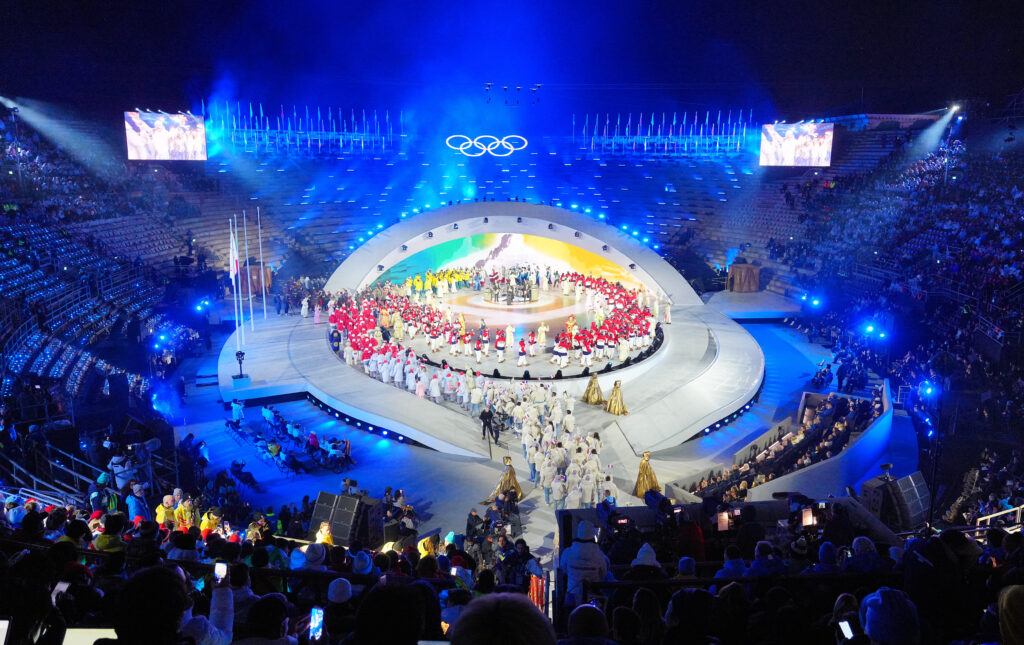
Let us begin by considering the host country, Italy, which was hosting its third Winter Games. After experiencing strong mobilisations – demonstrators labelled “enemies of Italy” by Prime Minister Giorgia Meloni prior to the Games, notably denouncing the use of public funds, environmental impacts and the presence of the United States anti-immigration police ICE – these movements gradually subsided, engulfed by the sporting spectacle. A crucial element in the expression of a state’s soft power, the opening ceremony sought to mark a break with that of the Paris 2024 Games, staging a heritage-based and traditional representation of Italy.
Beyond the national scene, several events punctuated the fortnight, particularly surrounding the question of Olympic neutrality. Three of them deserve attention.
First, the disqualification of Ukrainian skeleton athlete Vladislav Heraskevytch, flag bearer of his delegation, was widely commented upon. His fault: attempting to wear during competition a helmet commemorating teammates killed in the conflict with Russia. This episode recalls recent precedents, notably the disqualification of Afghan athlete Manizha Talash at the Paris Games for displaying the slogan “Free Afghan Women”. Here, there was no slogan, only the faces of former teammates. Nevertheless, as in its decision regarding the dancer competing with the Refugee Olympic Team, the IOC considered that this form of freedom of expression constituted a political demonstration at a competition venue, thereby contravening the Olympic Charter. After attempting to find common ground, the Lausanne-based body ultimately disqualified the skeleton athlete. This decision was confirmed by the ad hoc chamber of the Court of Arbitration for Sport, which held that while athletes’ freedom of expression remained guaranteed in certain spaces, it was limited on the field of play in order to preserve the neutrality of competitions and the focus on sporting performance. This case once again illustrates the precarious tightrope walked by the IOC: seeking to reconcile the imperative of neutrality, which is constitutive of its institutional identity, with respect for human rights – beginning with athletes’ freedom of expression – proves to be a particularly arduous task. And a risky one. Indeed, this balancing act is regularly challenged by accusations of double standards that the IOC faces regarding the supposed neutrality of other athletes, notably Israeli ones who, for example, have participated in military operations.
Secondly, although this did not concern sporting competitions strictly speaking, the question of neutrality also arose – not for an athlete but for one of the IOC’s members elected in 2020: Gianni Infantino, President of FIFA. During the first session of the “Board of Peace” created by the United States President Donald Trump, Infantino’s presence alongside heads of state and government raised questions. According to the IOC Charter (Article 16), its members are required to act “always independently of commercial and political interests as well as of any racial or religious consideration”. While FIFA’s support for the reconstruction of football in Gaza was ultimately deemed by the Olympic body to be consistent with the role of an international federation, the openly displayed proximity between Infantino and Donald Trump raises questions in light of this requirement of independence from political interests. Asked about the possibility of joining the Board of Peace himself, the IOC merely reiterated once again its position of neutrality, thereby implicitly highlighting the political nature of the initiative.
Finally, linked to the question of Russia’s (and Belarus’s) place on the international sporting stage, the prospect of the Milan–Cortina 2026 Winter Paralympic Games prolongs these issues. The decision by the International Paralympic Committee (independent from the IOC, it should be recalled) to allow Russian and Belarusian athletes to compete under their national flags marks a further step in their gradual reintegration into international sport following their exclusion after the invasion of Ukraine in 2022. Announced during the Games, this decision did not fail to provoke reactions, with diplomatic boycott announcements regarding the opening ceremony resurfacing from Ukrainian and Czech officials and athletes. The European Commissioner for Sport, Glenn Micallef, also reacted, indicating that he had decided not to attend the event. In this regard, the Paralympic Games appear likely to be as politically and diplomatically charged as the Olympic Games themselves.
Consequently, the geopolitical assessment of Milan–Cortina 2026 reveals less a rupture than a continuation of trends observed for decades: an increasingly mediatized politicisation of the Games, a claim of neutrality and apoliticism that is increasingly difficult for international sporting bodies to maintain, and a fragmented international environment that turns sport into a sounding board. In light of these issues, the next Summer Games in Los Angeles, organised in the United States under the presidency of Donald Trump, as well as the Winter Games in France in 2030, will clearly require very close attention.
To what extent do the Winter Olympic and Paralympic Games reinforce a certain “North–South divide” on the international sporting stage?
Regarding the Winter Games, this “North–South” divide – even if the term is somewhat too generic to be entirely relevant – manifests itself in at least two respects.
First, in terms of hosting major international sporting events, it should be recalled that of the 25 editions of the Olympic Games (14 in the Paralympic Games), 15 have taken place on the European continent, six in North America and four in Asia. Oceania, South America and Africa therefore remain without any Winter Olympic or Paralympic Games. This geography nonetheless invites reflection from two perspectives. On the one hand, the emergence of new poles, particularly in Asia – PyeongChang in 2018 and Beijing in 2022 are evidence of this – as well as the appetite of certain states now seeking to invest in winter sports. In this respect, Saudi Arabia, which until recently was to host the 2029 Asian Winter Games (ultimately organised by Almaty), deserved particular attention, even though this is not comparable with hosting a mega sporting event such as the Olympic and Paralympic Games. On the other hand, this geography also raises questions regarding its future. In 2024, two researchers estimated that out of 93 mountain sites currently capable of hosting competitive winter sports, only around thirty might remain by the 2080s[1], depending on the evolution of global emissions by that time. The IOC itself considers that by 2040 only ten countries may still be able to host the Games.
Secondly, in terms of participation, the Winter Games are undeniably less universal than the Summer Games. While those in Paris brought together 204 National Olympic Committees, the Refugee Team and the Individual Neutral Athletes Team, those in Milan gathered “only” 93 delegations, with a majority of National Olympic Committees coming from the European continent (47). It should be noted that three delegations participated for the first time: Benin, Guinea-Bissau and the United Arab Emirates. The medal table confirms this limited diversity, with only 29 delegations (including 20 from the European continent) winning a medal.
It is also worth noting the interesting case of China, which ranked fourth at its “home” Games in 2022 and fell to twelfth place here. Does this reflect a Chinese loss of interest once the Games are over? This seems unlikely and deserves closer examination, since the number of medals won is identical (15) with an almost identical total number of events. Above all, the absence of a substantial Russian delegation (20 athletes in 2026 under the banner of “Individual Neutral Athletes”, compared with 212 in 2022 under the acronym ROC – Russian Olympic Committee) somewhat reshuffled the distribution of medals among other nations: 32 medals in 2022, none in 2026.
The International Olympic Committee announced that the Milan–Cortina edition was the “most balanced in terms of gender parity” and promoted a commitment to gender equality. What is the real state of gender equality and the handling of gender-based violence today in international sport, particularly during the Olympic and Paralympic Games?
Let us begin with gender equality. Indeed, the IOC communicated extensively that these Winter Games were the most balanced in history, with 47% female athletes and the introduction of new women’s events that further anchor Milan in this dynamic. This follows directly in the wake of the Paris Games, which achieved perfect gender parity (after 128 years of existence). These figures call for several remarks.
On the one hand, this undeniably represents significant progress in the history of the Winter Games. In a report[2] published in 2021, Pascal Boniface and I pointed precisely to the very slow evolution in participation levels, particularly in winter sports. For example, at the Albertville Games in 1992, only 27% of participants were women. In other words, over the course of three decades, this gap has been partially reduced. Consequently, monitoring the evolution of these figures at the next Games, and more broadly the development of women’s participation within national federations in the coming years, will be particularly important.
Yet what is equally interesting is not so much what this figure reveals as what it conceals. If gender parity appears almost achieved among athletes, what about female coaches and leaders? Beyond that, what resources are actually provided to male and female athletes within their sporting environment? While prize money is the same for all here, what about sponsorship remuneration? Or media coverage?
It is also important to remember that certain disciplines remain closed to women. In this case, Nordic combined[3], which has been on the Olympic programme since the first Games in 1924, remains the only Olympic winter sport exclusively reserved for men. This is despite the fact that the first women’s World Cup took place in 2020 and athletes could already qualify.
Regarding interpersonal violence[4], since the 2000s the world of sport has been deeply shaken by the revelation of major scandals. The media coverage of large-scale cases – such as the 265 American gymnasts who were victims of Larry Nassar – combined with the dynamics associated with the #MeToo movement, has contributed to a turning point in how sporting organisations address these issues. More precisely, the IOC has been committed to combating violence in sport since 2007, with a notable acceleration from 2016–2017 onwards. The publication of a Consensus Statement in 2016 and again in 2024, the establishment of various mechanisms aimed at athletes from Rio 2016 onwards, and the creation in 2022 of a “Safe Sport Unit” illustrate this gradual institutionalisation, reinforced by the Agenda 2020+5.
Rather than speaking of violence, the IOC more readily refers to “safeguarding” and “safe sport”, allowing a shift from an initial focus on the protection of minors and sexual violence (abuse and harassment) to a more holistic approach to the sporting environment, including mental health issues. Since the Paris Games, this has taken concrete form through the creation of the Athlete 365 “Mind Zone” within the Olympic Village. At the same time, the IOC has invested in artificial intelligence to combat cyberbullying in a context marked by millions of social media posts. However, cases of online harassment – such as that directed in 2024 at Imane Khelif, the Algerian Olympic boxing champion – have tested the effectiveness of these mechanisms.
More broadly, while the various initiatives undertaken by international sporting bodies (the establishment of policies, training programmes, awareness campaigns and designated officers responsible for handling cases) must clearly be welcomed, the heterogeneity of these dynamics raises numerous questions regarding the reality and credibility of this fight against violence[5].
[1] Steiger, R., & Scott, D. (2025). Climate change and the climate reliability of hosts in the second century of the Winter Olympic Games. Current Issues in Tourism, 28(22), 3661–3674. https://doi.org/10.1080/13683500.2024.2403133
[2] Sport mondialisé : les défis de la gouvernance. (2021). In IRIS. https://www.iris-france.org/wp-content/uploads/2021/03/Rapport-_-Sport-mondialise_les-defis-de-la-gouvernance_Light.pdf
[3] The IOC has indicated that it intends to consider removing this discipline in future editions.
[4] Term used to designate different forms of physical, psychological and sexual violence, as well as neglect.
[5] Gomez, C., & Schoch, L. (2026). Safeguarding in sport: Toward a performative compliance of international sports federations? International Review for the Sociology of Sport.