
Interviews / Asia-Pacific
8 December 2025
Emmanuel Macron in China: What Room for Manoeuvre Does France Have Vis-à-Vis the Chinese Giant?
-

Senior Research Fellow, co-Head of Asia-Pacific Programme, IRIS
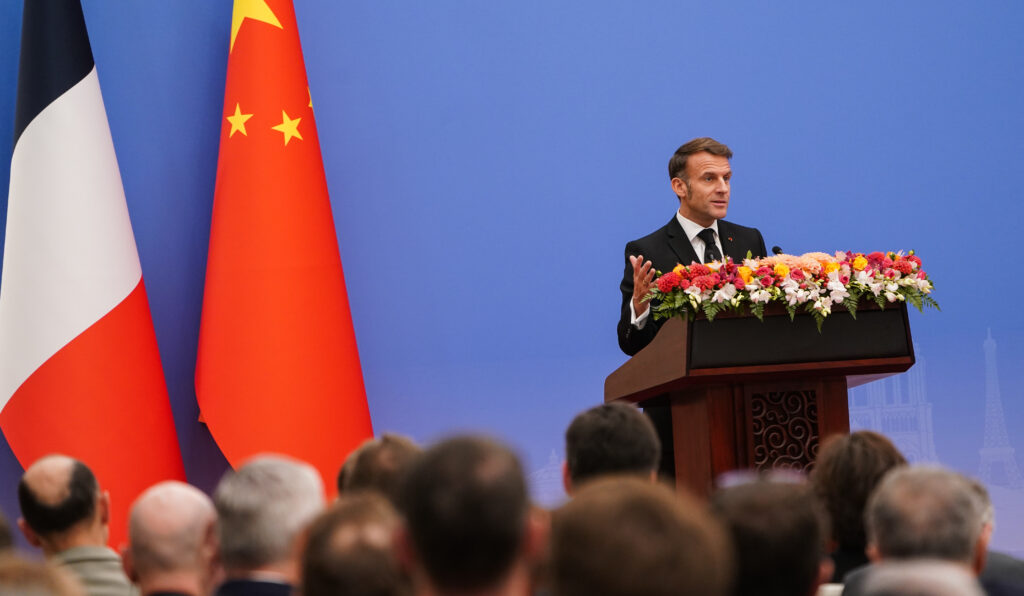
From 3 to 5 December, Emmanuel Macron travelled to Beijing for his fourth presidential visit to China since his first term began in 2017. Presented as an opportunity to “rebalance” the bilateral relationship, this diplomatic stopover above all highlighted the decline of French influence in the face of Beijing’s strategic priorities. Between protocol slights, limited economic progress and difficulties in positioning on the Taiwan issue, what can be learned from this visit about Paris’s ability to carry weight in its relationship with China? A point of view byEmmanuel Lincot, Director of Research at IRIS and co-head of the Asia-Pacific Programme.
In light of this presidential visit to China, how should Franco-Chinese relations be characterised? What place does France occupy for China?
The Chinese may say that there is a special relationship with France, that it was the first state to recognise the People’s Republic of China (which is historically false), but in practice, since last year, France has suffered a snub of no small significance when Xi Jinping travelled to France for two days of a state visit (including one conducted in disastrous climatic conditions in the Pyrenees) compared with three days in the Balkans (Serbia and Hungary). Xi Jinping thus clearly gave priority to an Eastern Europe that is more receptive to him, just as it is to Russia. Structurally, France’s decline (3,000 billion euros of debt and a trade deficit of more than 40 billion euros with China alone) reinforces the regime and a large part of Chinese public opinion in the depreciatory view that France is a “romantic” country — meaning “has been” — politically ineffective, risky for Chinese nationals, and economically mediocre. On the international stage, France’s voice carries little weight. Emmanuel Macron’s obstinacy in trying to make Xi Jinping bend on his support for Moscow, and the Chinese head of state’s equally obstinate indifference to French entreaties, is one of the clearest illustrations of this. The French playbook seems outdated.
What assessment can be made of efforts to rebalance trade between France and China, a central focus of the presidential visit?
Emmanuel Macron achieved only very small advances: whether in the agri-food sector, the renegotiation of cognac exports, or culture, with the wish to return to two million Chinese tourists in France as in 2019. This is doubtful, given the drastic decline in consumption in China and the fact that we are no longer in an open world. Prices and flight times between China and Europe have increased considerably, not to mention the fact that, with the exception of Air China, no aircraft can fly over Russia. But was the creation of opportunities for French cultural industries on the Chinese market even discussed? Was francophonie as a tool of influence and economic potential considered? I doubt it. In any case, France alone can do nothing. It must rely on intra- or extra-European coalitions, particularly in a crucial area: technology transfer. If China refuses, we will need to be ready to take radical measures: surtaxing Chinese products and exerting pressure in the South China Sea, with the support of Tokyo and Seoul.
With regard to Taiwan, can France maintain a position of “strategic autonomy” without provoking Beijing, while remaining credible with its democratic partners in the Asia-Pacific? As tensions around the island increase, what possible scenarios might there be for a French response to an invasion of the archipelago?
France is trapped by its own contradictions. From the perspective of international law, having recognised only the principle of one China — Beijing — it cannot support Taiwan as openly as it might wish. Yet Beijing’s aggressiveness also threatens Paris and its interests, namely its overseas territories. The risk is that Beijing could challenge the freedom of movement of people and goods in maritime areas that China seeks to sanctuarise. This runs counter to international maritime law and is dangerous for the strategic interests of the countries concerned, ours in particular. The evolution of the Taiwan issue matters to us, just as it matters to us to continue to make our voice heard on human rights. French diplomacy pays little attention to this, even though it is both a French and a European specific feature to consistently recall the rules of law. At a time when even the United States is moving away from this, it is important for us to speak out on the issue, at the risk of renouncing ourselves, of course. The world values France as the homeland of human rights. If we defend them loudly by supporting Ukraine, we cannot remain silent, on pain of incoherence, on Taiwan, nor on the persecutions taking place throughout China. Finally, as is well understood, a major crisis around Taiwan would have dramatic consequences for the global economy: with 80% of microprocessors manufactured in Taiwan or under Taiwanese licence, the impact on France would also be disastrous. While a military and deterrent solution is hardly conceivable for France, it is difficult to see how it could nevertheless avoid its obligations, whether with regard to the Indo-Pacific or towards the United States should Washington decide to become involved in an emerging conflict between the two Chinas.